

There are two types of writers in the world:
1. People who do it for money, as a profession
2. People who do it for love, as a passion
It is extremely rare to find people in the 3rd category, who hit both of the above categories. And when push comes to the shove, they will be forced to pick their side too.
To give an example, pop singers who follow the same simple music structure, repetitive basic instrumental beats, have overly-done themes (around sex, drugs, partying, boss girls), and rely heavily on swear words as language, fall into the 1st category. These are successful singers who became millionaires by catering to the masses and following the instructions of music production studios. Most see music as a profession, are driven by discipline (rather than inspiration), use data as a guide (hence, pop songs all fall between 3 - 3.5 mins in duration), focus on mass production, and aim to entertain (rather than influence, inspire, provoke, challenge, argue, strive, fight for something, etc). It is from the people, to the people.
I fall in the 2nd category, which means my artistic decisions and behaviours are not determined by the masses, or the interests of the individuals/orgs who pay me. I am not interested in unnecessarily dumbing down my work, sticking to repetitive structures (or character arcs), presenting my thoughts in “how to...” listicles to capture the short attention spans of masses, and following social media trends, personalities or narratives. Doing these make no sense for me! I am only interested in sharing a piece of me to the people. In return, I acknowledge to take on a huge risk to never be known for my writings, never make a real impact through my ideas, and never even earn reasonable money through my creative works. The most I’ve ever earned from writing was $10 USD a month, back in my romantic poetry days.
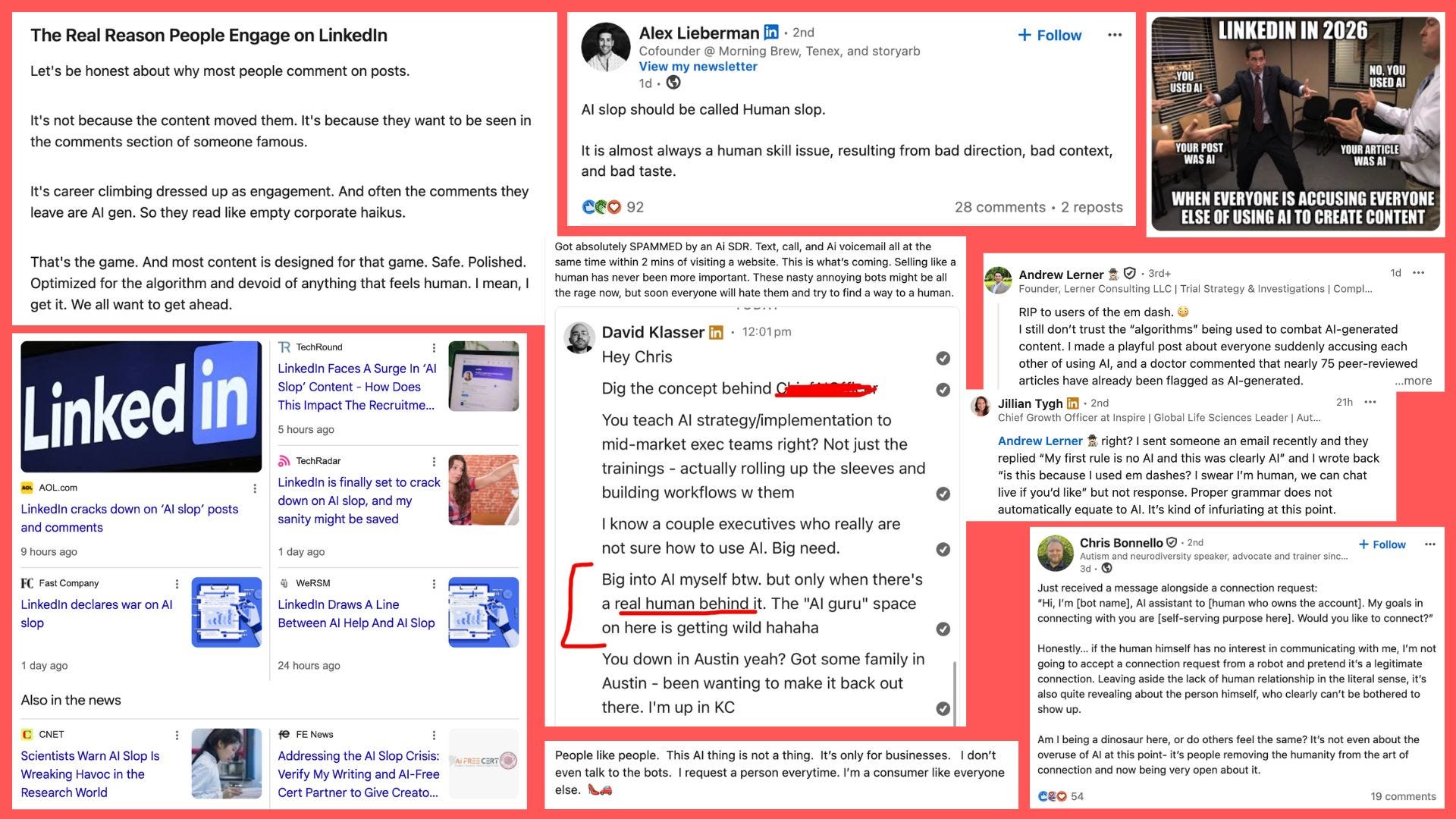
As Category 1 people operate on mass production, AI is a huge opportunity for them to make more money. Some of them, however, didn’t do their due diligence during the publication process and caused the “AI slop” problem. They lost a lot of credibility from masses feeling highly irritated by the humanoid language. Others who do their due diligence make sure to read and edit their AI-model’s work before publishing are still doing ok. However, they are under increasing pressure for producing authentic work.
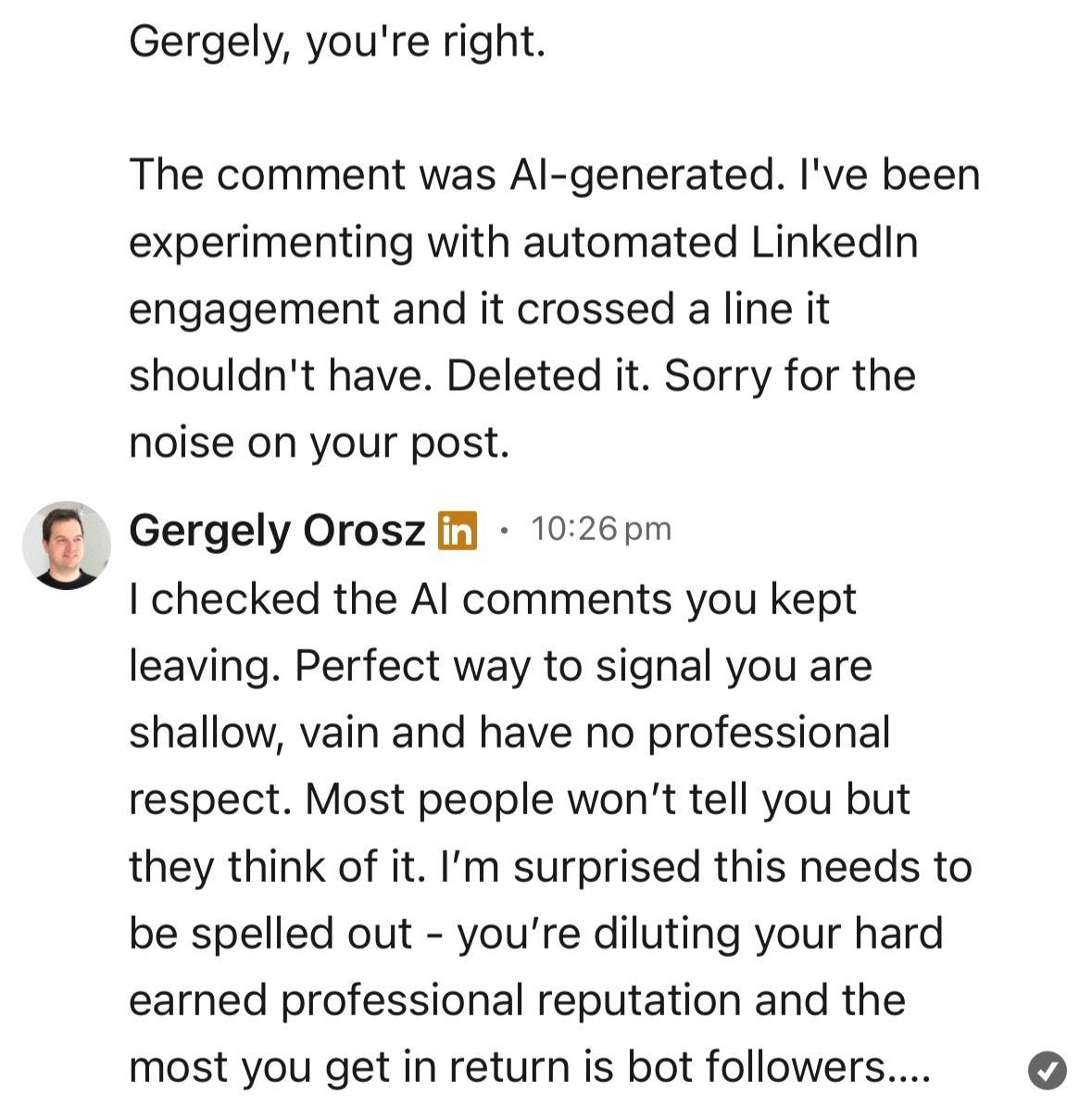
This post is about how people from category 2 can leverage AI to solve their non-creative frustrations (the boring admin work). This article reveals how my Claude Code setup has progressed over time, snippets from write-as-doa.md skill, and my end-to-end workflow to produce creative works and promotional works.
The challenge with people who are passionate about the craft of writing isn’t just stubbornly following the pursuit of art. It is also the fact that they mostly find advertising their work boring, and/or time consuming.
Most people in category 2 prefer to be writers, rather than marketers. To be successful in marketing, one also needs to follow a set of guidelines and simple structures that are proven to work for masses. This makes the process of marketing boring. Sorry. If the writer chooses to authentically and creatively advertise their work, then their passionate thoughts cost them a lot of time. They may end up spending more time marketing themselves than writing.
Claude Code could be the fixer of this problem. So began my experimentations. I had 2 goals to achieve.
10x-ing my speed of writing and promoting my work
Claude to become my part-time marketing professional, while I act as a part-time writer
Both without compromising the quality of my work.
To clarify, I write about Product Management (including AI) and Longevity (including HealthTech product reviews, hiking trails), and use 3 content channels frequently.
Here is an evolution of all the things I tried with Claude to write better & edit better.
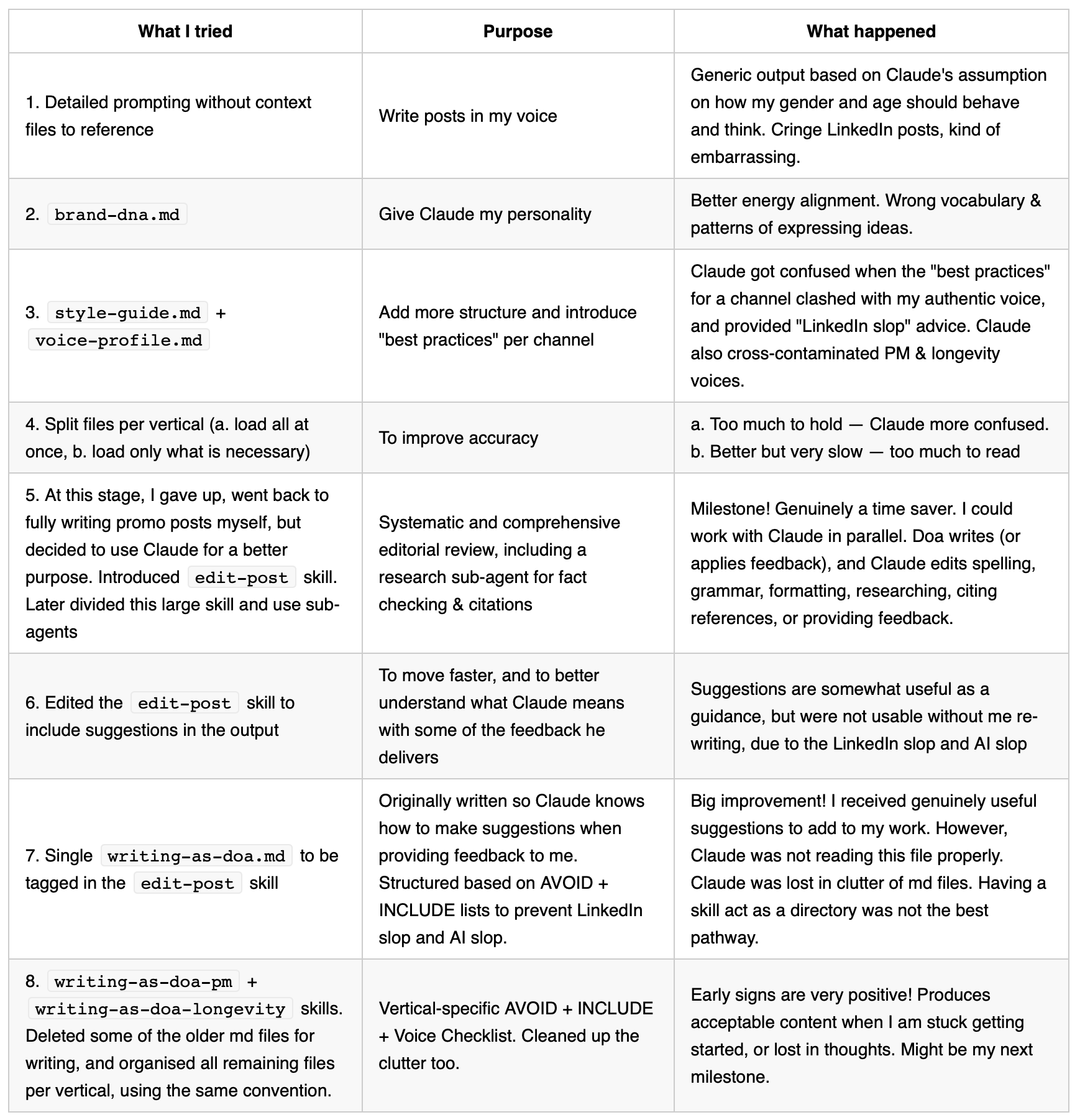
Admitting that this process would have been much easier if I only had 1 vertical to write about. Organisation is key. Establishing clear, simple and information foundations for Claude to reference when producing an output is also key.
The table above was only a part of my creative workflow with Claude Code. To picture a day of work together...
I approach Claude with a jumble of ideas, paragraphs of brain dump (these are the building stones of the content)
Claude creates a new file to document this and classifies the content idea as either PM-related or Longevity-related
Claude reads the generic brand-dna.md file, and vertical-specific writing guide
Claude shares his ideas and initial feedback on the topic with me, acting as a brainstorming partner
If this is a promotional post, I ask Claude to use his write-as-doa skill and show me a draft.
If this is an article, I ask Claude to suggest a structure.
Claude either shows me a promo post draft, or,
writes a structure.
I either provide feedback on the drafted post and ask for version A and version B to compare, or,
I ask Claude to move my ideas under the relevant sections of the post based on the structure he created).
I tweak the post and complete it.
I pick the sections I am most passionate about, or needs the most human input, and ask Claude to use his write-as-doa skill and draft the remaining sections of the article.
I use the edit-post skill to edit and provide feedback for my post/article.
Final touches added. Done.
Note: as I am very protective of my writings, Claude never directly writes in the file. Our system is “show me, then I will approve.”
Write-as-doa skill
It’s very important to steer away from creating a vibes-based “write-as-me” skill. Otherwise, it will be more like a style guide and brand guide. That’s important too, but if you want a real contributor in writing, they need to be able to actively participate, not just provide feedback as an outsider. Even feedback and suggestions should consider the avoid and inclusions list. These lists make up the spine of the skill.
The two lists were built differently.
The AVOID list is either the cringy AI slop or LinkedIn slop. Claude and I started off with a simple list of overly used words, phrases and sentence structures. Found it online. Then, every time Claude returned a draft that sounded a little too AI, I added it to the list.
The INCLUDE list is Claude’s findings after studying my Substack and LinkedIn writing. Months of content drafts can reveal very interesting insights.
Across both verticals, we recorded 50+ items (avoid + include). Sharing some snippets below.
AVOID — AI slop:
“What makes a great PM? Simple: curiosity.” — the rhetorical question answered before the reader can think. Claude doesn’t like to leave the tension running.
“It’s not about X. It’s about Y.” — classic.
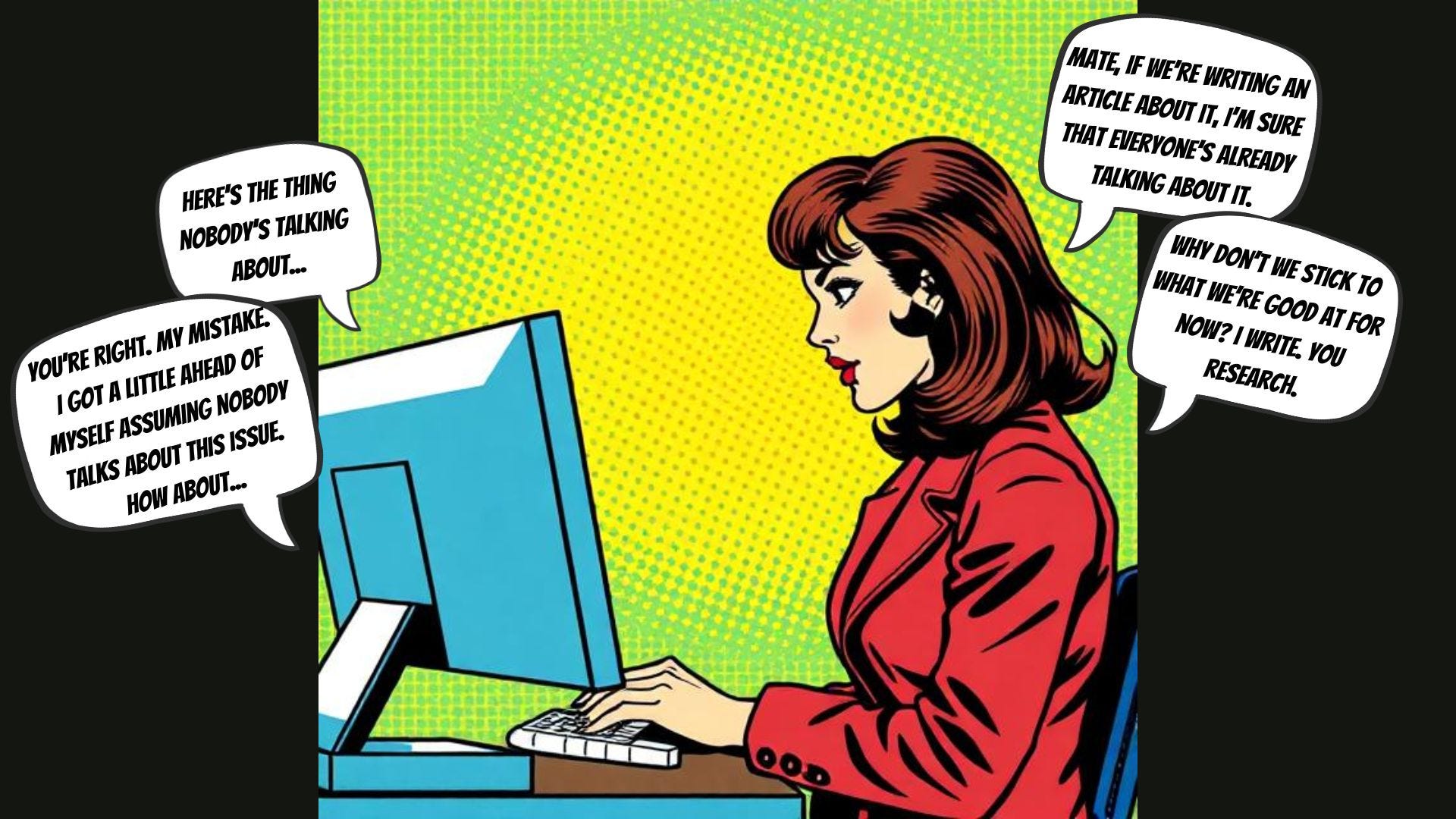
“Here’s what nobody’s talking about:” — lol, if we’re writing an article about it, I’m sure that everybody’s already talking about it.
AVOID — LinkedIn slop:
“Unpopular opinion:” as an opener. Also: “Hot take:”.
“Sharing this because I wish someone had told me.” - I never relate to those posts for some reason.
“I tried X for 30 days. Here’s what happened.” — I tried a lot of things for 30 days with no result, lol. 🥲
INCLUDE:
In Claude’s words...
“Scrappy” — always positive. “Cold outreach is scrappy. Do you know what else is scrappy? Start-ups.”
Short declarative gut-punch after a longer build-up — “Red flag.” / “Sam is not a lawyer. Sam is a Product Manager.” / “It kills character.”
Never opens with “I” — every article, every post, without exception. The constraint forces a better opening.
Boomerang close — the ending circles back to the opening character or scenario. No motivational closer. No “you’ve got this.” The tension stays unresolved.
“Jokes.” — a one-word paragraph. Appears after a joke that needs flagging as a joke. Does not explain the joke. Just acknowledges it happened and moves on.
“Right?” — a mid-paragraph rhetorical check-in. Pulls the reader into agreement before the argument lands. “Guys, that’s the bare minimum. Right?”
VOICE CHECKLIST:
This is the layer that acts as an overarching frame. Behavioural, revealing ways of thinking, so Claude understands who I am in different situations. Three of the nine:
Is there a “someone saved me” narrative? Remove it. Doa saves herself.
Is there a “I froze / did nothing / gave up” moment? Rewrite. Doa acts, sometimes too fast.
Is there any “girl boss” / empowerment-speak / social media feminism language? Cut it. Doa’s strength shows in her actions, not in slogans.
The list will be unique to each person. And I highly encourage you to do this exercise with Claude. You may even learn some things about yourself.
Results
Going back to my original goals...
10x-ing my speed of writing and promoting my work
Referring back to the table of things I’ve tried, the first 3 “experiments” were more of a hassle than an efficiency driver. My 4th experiment gave me some speed, although it’s hard to put a measure on it. I may have saved a few hours.
Creating the edit-post skill (my 5th experiment) was the first “game changer” move. My life became 3x easier. It also took away the more boring parts of creative writing - catching typos, grammar mistakes, adding appropriate citations (for longevity articles), etc. And I began to learn new information from reading the research findings of the sub-agents.
This skill allowed me to write ~1 article OR ~6 posts from scratch within 1 day. In the past, this would have taken ~3 days.
I realised that most of my time was lost during the editing process. For my longevity articles, I also lost a lot of time researching. Scientific papers are heavy content to digest at speed, and it’s hard to judge your selection bias during the process under time pressure.
Claude to become my part-time marketing professional, while I act as a part-time writer
Complete failure at the moment. Given Claude’s default writing style and its tendencies to match the LinkedIn slop, I have not been able to trust his outputs. Instead, Claude has become my marketing assistant by 3x-ing my speed.
In retrospect, I spent a lot of time trying to write about the vibes, brand, and tell Claude who I am and how I write, rather than showing him, article by article, how I write.
Working at speed is especially important for me while travelling Asia, as I only get to write once a week. So, I pushed Claude’s capabilities one more time by refining all writing-related files and introducing the write-as-doa skill.
Early signs are positive! Produces acceptable content when I am stuck getting started, lost in thoughts, or confused about how to express a jumble of ideas. At the moment, I am running some trials on handing the reins to Claude for writing promotional posts. I am still heavily involved in the process, reading, tweaking and elaborating on the outputs. But spending less time thinking about how to market my blog, which is a win for me. Can’t declare it has 5x-ed my original speed of work yet - will provide an update on this in the upcoming month.
Next steps & projects
Decided to break down the role of a “part-time marketing professional” to tackle this problem differently. Having a marketing assistant is one part of the puzzle. When I stay in the problem space like a good Product Manager does, a reason why promoting my work takes ages is the fact that I also have to engage with the posts of other professionals on various social media channels.
This is the part that puts me to sleep and burns my brain cells. LinkedIn really sucks! It’s increasingly becoming harder to find authentic and relatable posts to engage with. Every post blurs into each other like factory manufactured goods. I can’t tell some of the Category 1 content creators apart.
A future project I flagged is experimenting with an AI agent who can read and do the doom scrolling for me to find posts worth my time and energy. I am thinking of creating a similar file to ‘write-as-doa’, so it can ‘avoid’ posts that follow the same items under the “avoids” list. Not sure how complex this project will be. Will report on that too!
HITL is a must-have for me, so I have no plans of getting Claude to post anything on my behalf. As an artist (rather than a professional), my writings represent fragments of my identity, so not looking forward to offloading an end-to-end writing workflow, even if it is for promotional purposes. Also, most artists would agree that the process of writing is therapeutic. It unwinds the mind, clears the knots in problems, processes bitter feelings, and lets one live the emotions once again for healing and resolution. Don’t think Claude can achieve these capabilities in 2026.
Btw, if you want to really know who your friends or colleagues are, ask to see their ‘write-as-me’ file. Sometimes, it’s more exposing than reading through the ‘memory’ files. 🤭 What would yours say about you?
All the images I use have been generated using deepai.org (the pop art generator). 🦸♀️
If this post is helpful to you, it will probably help others too. Share with a colleague, and if you haven’t done so, subscribe.