

This is a simple (yet very important) question that requires deep thinking to get a clear and confident answer. Throughout your career, you will be reminded of this question more times than you may like.
Let me explain why having a powerful answer to this question is important.
Answering this question will give you confidence while transitioning into a product role. Or maybe, your answer will reveal that product management is actually not the right role for you.
Transitioning into a product role takes 6-12 months. Product Dave (provides a great Product Management Fundamentals Course, if you are interested) has an article about this topic to set the right expectations: “if you possess transferable skills, relevant knowledge, or a strong drive, landing a position in about 8 to 9 months is not uncommon.” This timeframe is accurate, according to my experiences helping aspiring PMs to land their first role.
It’s a long journey! The stronger your reason is to keep on pushing against the currents, the more likely you will be to achieve your goal (and still maintain your passion).
There seems to be a glorified storyline tagged onto the product manager role. The fact that it’s challenging to get into product (like a closed, exclusive, invite-only bubble) doesn’t help to break this “cool” image either. Or maybe it’s watching too many sexy Silicon Valley entrepreneur movies that’s hinting the wrong ideas. Anyhow, I recommend an exercise for you to follow (it involves talking with other PMs) to understand if product management is right for you (explained in my prior post).
In short, if you view product management as an easy way out of software development or entrepreneurship, where you get to work independently to draw your own product vision, make decisions according to your passions (involving the most fancy ‘technical’ platforms) to launch the next ground-breaking ‘unicorn’ (which involves intelligent words like, Gen-AI, blockchain, VR, Web3), and earn a sh*t ton of commissions, then start practising your lucid dreaming skills. You may have a higher chance of achieving all of that while you’re sleeping. And it may not even take 8-12 months.
You will be asked this question in product interviews.
As you progress through the journey of transitioning into a product role, you will notice that there is something called a “product culture” — which is an ambiguous (no standard definition), yet highly valuable ideology — almost all product leaders are obsessed with protecting it from the foreign invaders. You may be that foreign invader. They won’t know until they quiz you thoroughly.
Once you interact with other PMs, you will notice that there is a common set of values, behaviours, and ways of thinking — a shared understanding — that they possess. Given how lean product teams are, and how impactful a product manager can be in a company (especially if the company is not a large corporation), it makes sense for leaders to be paranoid about preserving the ‘ways of thinking’ that have a historical track record of bringing high success and team collaboration. Do some people take this too far to the point that they are simply inflexible and closed-minded? Maybe some people do. But let’s leave the exceptions to the side.
An example is trying to find out if you approach ideas/solutions from a scientist’s or a lawyer’s perspective. Do you try to test and search for reasons against your proposed solution? Or do you try to cherry-pick the pieces of evidence which will defend and support your idea?
For those who don’t come from a product background, some of these ‘ways of thinking’ may not come naturally. It may even take some time to adjust and digest why these are important to the role (and how they lead to team success).
What does that have to do with the “why do you want to be a product manager” question? Trust me — your answer will reveal a lot about your personality, values, and ways of thinking.
To clarify, even within a high-level shared understanding among product people, there are variances. Some companies want to put more emphasis on customer empathy, while others may heavily focus on data, or stakeholder management and internal influencing skills (quite common in larger organisations). So, the way you answer this question will also help your hiring manager understand if you are the right fit for their team’s culture. Fair.
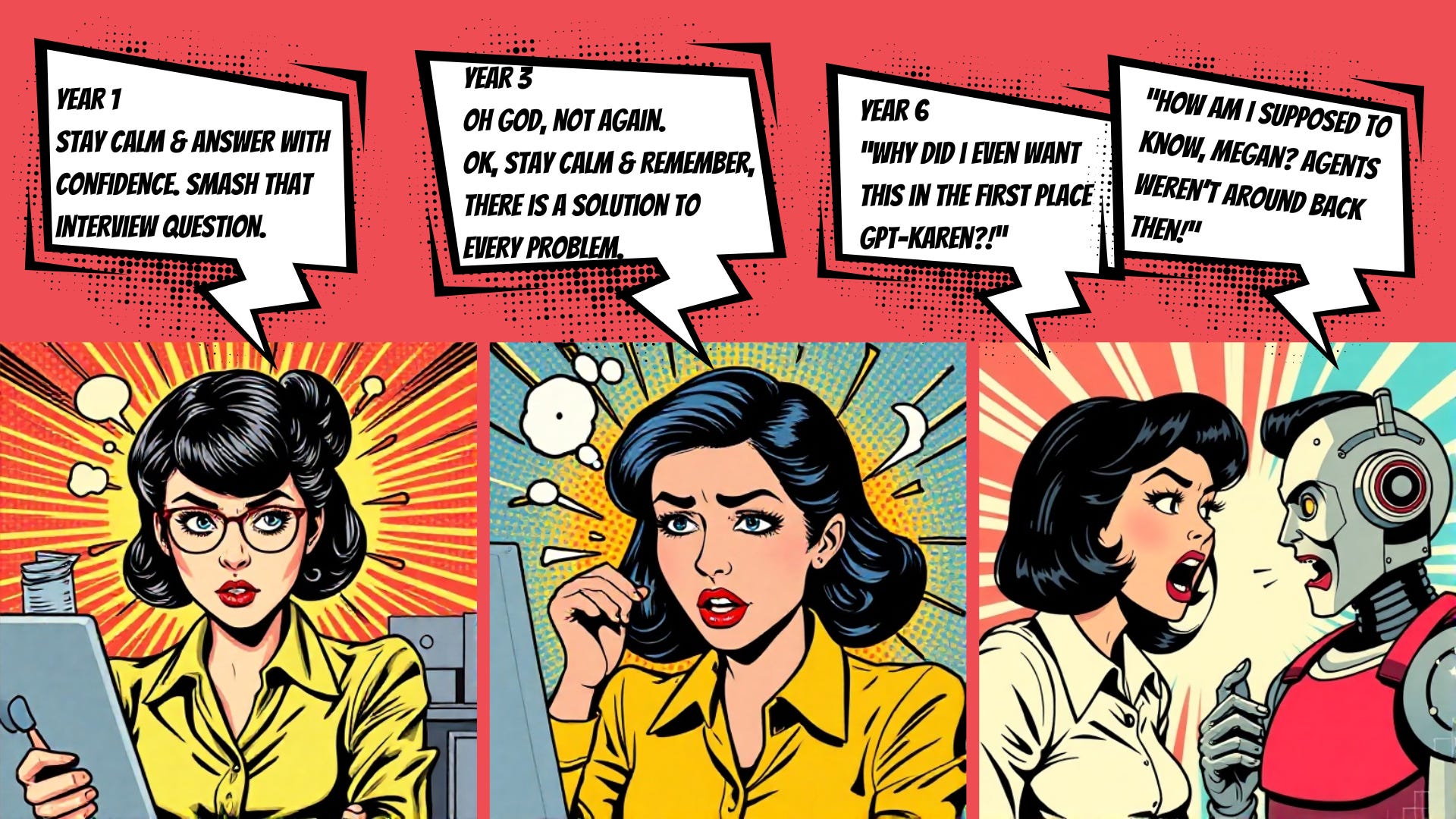
At multiple points throughout your career, you will ask yourself this question.
This role is not easy. Hope I made that clear. Most product ideas will fail (stats keep on changing, but assume it’s somewhere between 75-95%). There is a lot of pressure to launch ‘the next big thing’ and have a visible impact. The AI race between companies only amplified this pressure in recent years. Your stakeholders often won’t prioritise the customer (they’ve got their KPIs and the business revenue), yet you’ll be expected to repeat like a parrot what the customer needs and wants. As you are working towards fixing a problem, 10 other issues will arise, and everyone will have a different opinion as to which problem to prioritise and how to solve that problem. Too much noise in a very fast environment.
It’s so much fun! But as years go on, you may find yourself feeling quite tired. Burnout among product managers has been named “the silent epidemic” by product leaders and influencers. According to Mind the Product, +80% of PMs experience burnout during their careers. Evie Brockwell’s research reveals that this figure is actually 92%, and 72% of PMs have experienced burnout more than once.
When things are tough, stepping back, pausing yourself, turning down all the noise, taking a few breaths in, maybe going on a walk, and asking yourself, “why do I want to be a product manager,” can really help. It’s a question that can connect you back to your passion and remind you that the tough situation is only temporary.
The answer you provide will help you choose the right company, product culture, team, industry, and product you work on in the future.
Why you want to become a product manager is ultimately what makes you excited about your career (what gets you to wake up with passion).
Maybe you realise that your interest lies in HealthTech because you really want to see the impact a product has on customers (and you are passionate about the health space). Maybe you realise that you’ll prefer to work for start-ups because of the fast pace and ambiguity (with lots of opportunities to unpack)!
Your answer will help you chase after fulfilling experiences and plan the future of your career. As you get more senior in your role, it could even help you to understand if you want to climb up the leadership ladder.
The answer you provide will help you connect with a wider personal purpose.
Half the time I mention “purpose,” I get a bored reaction. Maybe bored isn’t the right word. It’s like when someone rolls their eyes at you, thinking, “does this really need to link to some existential purpose?” I’m not trying to pull you into spiritualism or philosophy, nor trying to connect you with the wider universe. If you wish to go down that route, that’s your call to make.
Just think through this carefully. Let me break it up for you.
Disclaimer: this may sound a little depressing for some.
You will be paid to spend 7.5 hours for 5 days of the week (during peak time, when you have the most physical, emotional and mental energy) doing this job, if you work remotely (realistically it’s 8-9 hours).
Add some commuting to work time, and depending on how far you live from the office, you may be spending 9-10 hours for 5 days of the week.
That is 45-50 hours every week. If that much time does not give you meaning, purpose, satisfaction, fulfilment, then what does?
Most of us don’t even get that much sleep every night (the average human sleeps 6.5 hours each night), which is the 2nd most time-consuming activity in your life.
I am not suggesting having work as the main purpose or attraction of your life. I’m just doing the maths here. You don’t have a lot of time remaining per day, especially when you take out house cleaning, cooking, shopping, sleeping, etc.
In short, while I am not a psychologist, having a meaningful reason to show up to work every day would really help with your mental health in the long run.
You may have guessed that there are no right answers to the question, why do you want to become a product manager. However, I have diligently noted down the answers I heard while interviewing other product managers during my career transition journey.
Below have been rephrased to exclude names and to shorten the long stories.
“As a Software Engineer, a few years into my career, I realised that I prefer to discuss the why, thinking of the customer, rather than the how. There is so much meaning and purpose to why. So many questions you can ask and unpack.”
“I had a digital design degree. But I wanted to wear as many hats as possible. I enjoyed working with marketing, customer support, design, but I could never see myself doing only one thing. I also knew that I was a natural problem solver. The more complex a problem was, the more I was fascinated to find solutions. I told my mentor that there has to be a magical role that gets me close to the customer, gets me to think about design, and work with marketers, while solving problems. She told me to become a product manager.”
“I loved building stuff, even though coding was just a side hobby. I got frustrated at upper management for making decisions without considering the customer feedback. I just felt that the company I was working for at the time was so misaligned with what the customer needed. I was like, who comes up with these decisions? I want to have a word with them. Then I realised there was a role called “product manager.”
“To get shit done. I like building things, progress, and fast-paced environments. My nose is also always in other people’s businesses; I want to understand the why, the big picture, strategy, and how everything interconnects. So I became the middleman who helps things move forward and be delivered. I also get to be the first one knowing the why, ‘cause I work for a start-up and always talk with the customers.”
Here was my response at the time of making this transition.
“I’m a problem solver. Genuinely love solving complex problems. I tend to have odd, creative, or unconventional ways of solving problems, but that’s what makes it fun. My heart feels warm and complete when I solve a problem and see the impact it has on others. That’s probably why I am always on the go, always trying to improve things around me. I’m after a challenge that will get me hands-on building something and that can leave an impact.”
Note: I give myself permission to change my reason as I grow in product.
In fact, I recommend that you challenge your answer each time you join a new product or company, before you take on a promotion, or maybe as part of your annual self-reflection.
Funny that I have argued throughout this post that there is no right answer to this question, because there are plenty of wrong answers you can provide. You can probably guess what those might be. 😉
If this post is helpful to you, it will probably help others too. Share with a colleague, and if you haven’t done so, subscribe.