

The longevity research I’ve been working on this year has taken my prior health-conscious behaviours to the next level. ‘Personalised’ and ‘holistic’ were the key words I focused on when exploring Viome, Whoop, FreeStyle Libre, Pulsetto, a bunch of physical therapies (i.e. HBOT) and supplements.
Approaching my 25th birthday (which still doesn’t feel real), I decided to put my experiments through a comprehensive test, which would reveal the ‘health status’ of my organs compared to those of others of my gender and age. Of course, I had to pick TruDiagnostic.
I have been really excited to write this review, even though the topic of health and longevity is very sensitive and triggering to some people. Let’s get started and keep our curious scientist hat on (and the judgemental hat off).
You may want to skip to certain sections that are relevant to you (because I tend to write essays). To give you a shortcut, in this article, you will find…
Backstory (and company info)
What I love about TruDiagnostic
What would I love to see improve/change
Common criticisms of TruDiagnostic
Including tips on getting the most accurate outcome of your TruDiagnostic test results
My results & goals
Additional links
Backstory
To bring everyone on the same page, TruDiagnostic is a US-based company that specialises in epigenetics and biological age testing. They have 2 main products.
TruAge Test
Provides biological age score (OMICmAge) on a cellular level, organ systems age scores, telomere length info, pace of ageing (DunedinPACE), smoking & alcohol impact scores, grip & gait strength, immunity & inflammation info.
TruHealth Test
Provides a comprehensive view into your body’s essential systems and nutrients via comparing your +105 biomarkers, +75 antioxidants, vitamins and fatty acids with others your age and gender.
You can also get a package option for a cheaper price. Both require blood samples, which you will need to collect by pricking your finger. See below for more details.
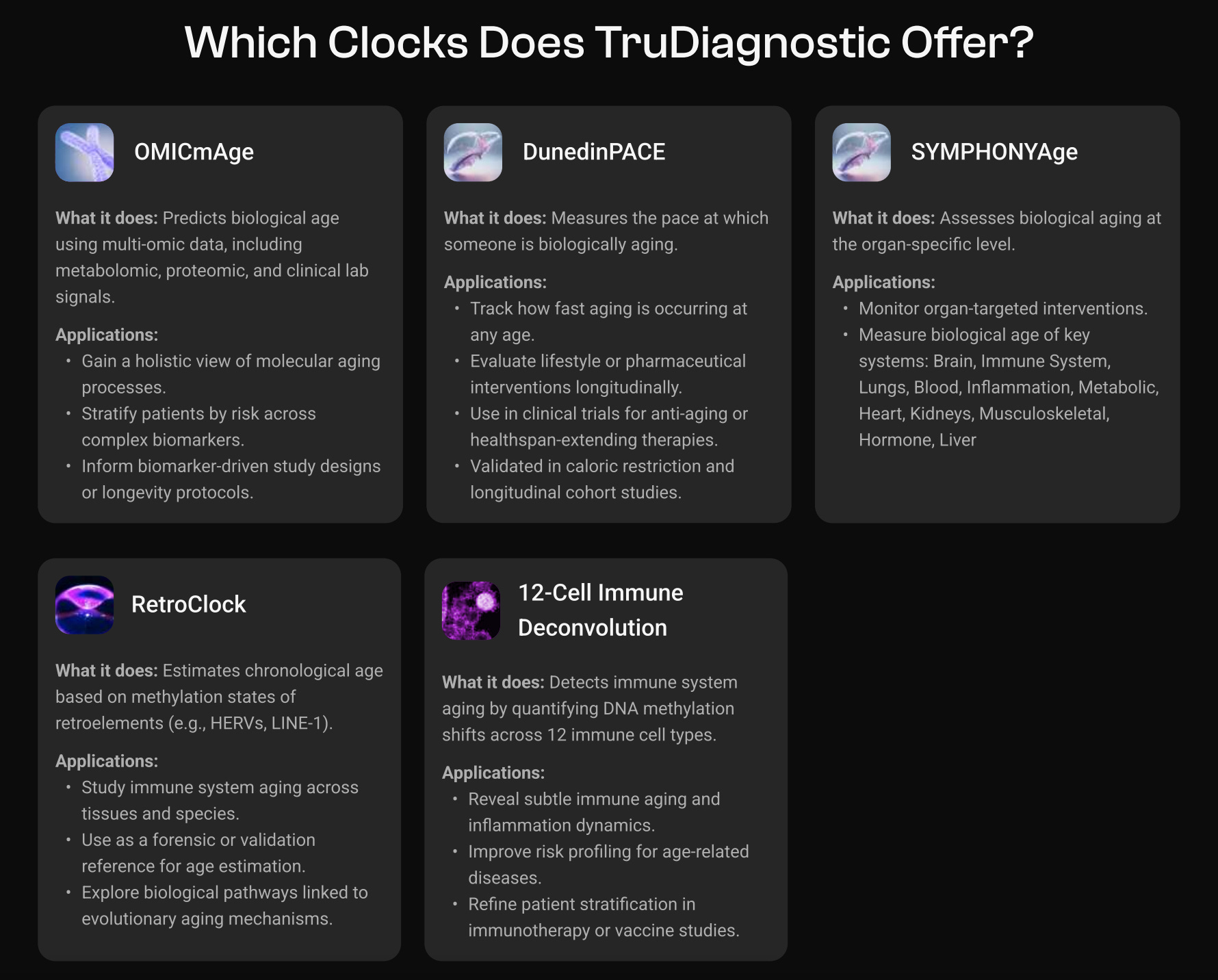
They also have many interesting peer-reviewed research publications and clinical trials if you are interested in reading more about longevity.
I knew about TruDiagnostic from my partner; he knew about the company from Bryan Johnson. This was back in early 2023. He got tested, came out 3 years older than his chronological age, and dug into solution mode. We were both fascinated by the report and insights, even though TruDiagnostic was a new company back then. In retrospect, their reports are way more useful and detailed now.
There were 2 reasons why I did not get tested back then. Firstly, I didn’t have the money to spend. Secondly, I didn’t think I would get much value out of the test when I was only 22. However, my excitement and impatience took over, so I made a note to get tested right before my 25th birthday.
How to purchase testing kits from Australia?
I purchased both tests from Chris Barnes. He is an epigenetic performance coach and the Australian partner for TruDiagnostic. The company no longer ships testing kits directly to Australian consumers. You will need to go to Chris Barnes Wellness website and send an email requesting a quote. The process is very easy. The plus side of ordering the kit via Chris is that he can help you to interpret your results and set achievable goals. He’s literally the expert in the field; I felt grateful to grab 30 minutes and bombard him with questions. He also sells a genetic testing kit, if you are interested in that.
Did I “train” (or prepped) for it?
Not really. Firstly, while I wouldn’t call myself very healthy (doing just the standard stuff, like regular exercise, eating lots of fruits, veggies and salmon, etc), I also never had major unhealthy habits (i.e. don’t smoke, don’t drink alcohol, don’t do weekly/fortnightly takeouts, don’t use sauces and excessive sugars, don’t stay up late at night, etc). So I didn’t feel the need to put in a major effort to prep for a test. I also genuinely wanted to see how my current sustainable habits impacted me. My relatively healthy lifestyle was easy, affordable and fun for me. There are two caveats to that, though.
Unfortunately, in early 2024, C-PTSD really damaged my health. I won’t get into the details, but needed plenty of help to function well and desire life.
In 2025 (and kind of late 2024), longevity became my nerdy hobby. I swung to the opposite direction with the belief that holding a high quality of life is a must-have for being alive (as in… what is the point of living if it mostly consists of suffering?). This is what I wanted to strive towards; healthy habits meant self-care, self-love and self-respect. Hence, my longevity experiments began.
Did I have any expectations from the test?
I expected to learn about my body, the impact of my historical and more recent behaviours/routines/lifestyle choices. I expected to take away some action points and have health goals to work towards.
Besides that, I had no idea what to expect. C-PTSD is a chronic illness impacting multiple organs and systems of the body (unlike the common belief that it’s just “emotional stuff”). Evidence is growing to show the link between trauma and poor brain health, disrupted nervous system, disrupted hormonal health (including lack of, or irregular periods for women, something that I relate to), higher chances of cardiovascular disease, gut health issues, and respiratory problems (if the child has been exposed to smoke).
Trauma can also cause changes in DNA methylation (which alters how genes are expressed) and can even be passed down to future generations. In short, I would not have been surprised at all if I appeared older across most of my organs.
I have also spent the past 12 months having health and longevity conversations with people from various age groups and backgrounds (mostly non-health professionals). This was a part of my HealthTech research as a PM. Something that I learned throughout these conversations is that 90% of people (strongly) think that they are very healthy, just 1-2 steps away from Bryan Johnson, because (quoted) “what’s the point of life if I’m going to be an obsessive freak like him?” Bryan would laugh his ass off hearing that confident claim.
Hearing about the lifestyle and daily habits of most people, I could point to +3 reasons why they were not very healthy within 5-10 minutes. Most common reasons are regular alcohol consumption, poor sleep habits, lack of movement, over-consumption of takeout (and ultra-processed foods), and poor consumption of fibre and omega-3s. However, 90% of people are sure that they are only struggling with their health (i.e. chronic back pain, being overweight, digestion issues) because of their genetics (as in… there is nothing they can do about it).
It’s a very humbling experience to have these conversations — shocks me so much that over the past 6 months, my confidence in my health has dropped. I thought, we must all be deluding ourselves. I have instead started sharing, “I don’t think I am very healthy, but I am definitely doing my best to set healthy habits in my life and improve in sustainable ways.”
One advice I have for people wanting to take the TruDiagnostic test is to approach it with curiosity. Overconfidence, plus a lack of self-awareness, knowledge and responsibility is a recipe for disappointment. And for long-rage threads on Reddit, cursing the company (which some are hilariously childish). Also, keep in mind that the damage from a decade of an unhealthy lifestyle cannot be magically undone by 6 months of trying to be healthy to prep for the test. This isn’t a uni exam you can cram in the last few nights. Just setting the right expectations.
What I love about TruDiagnostic
Accuracy & reliability
This is the most important aspect for an epigenetic test, and TruDiagnostic is arguably the best international provider.
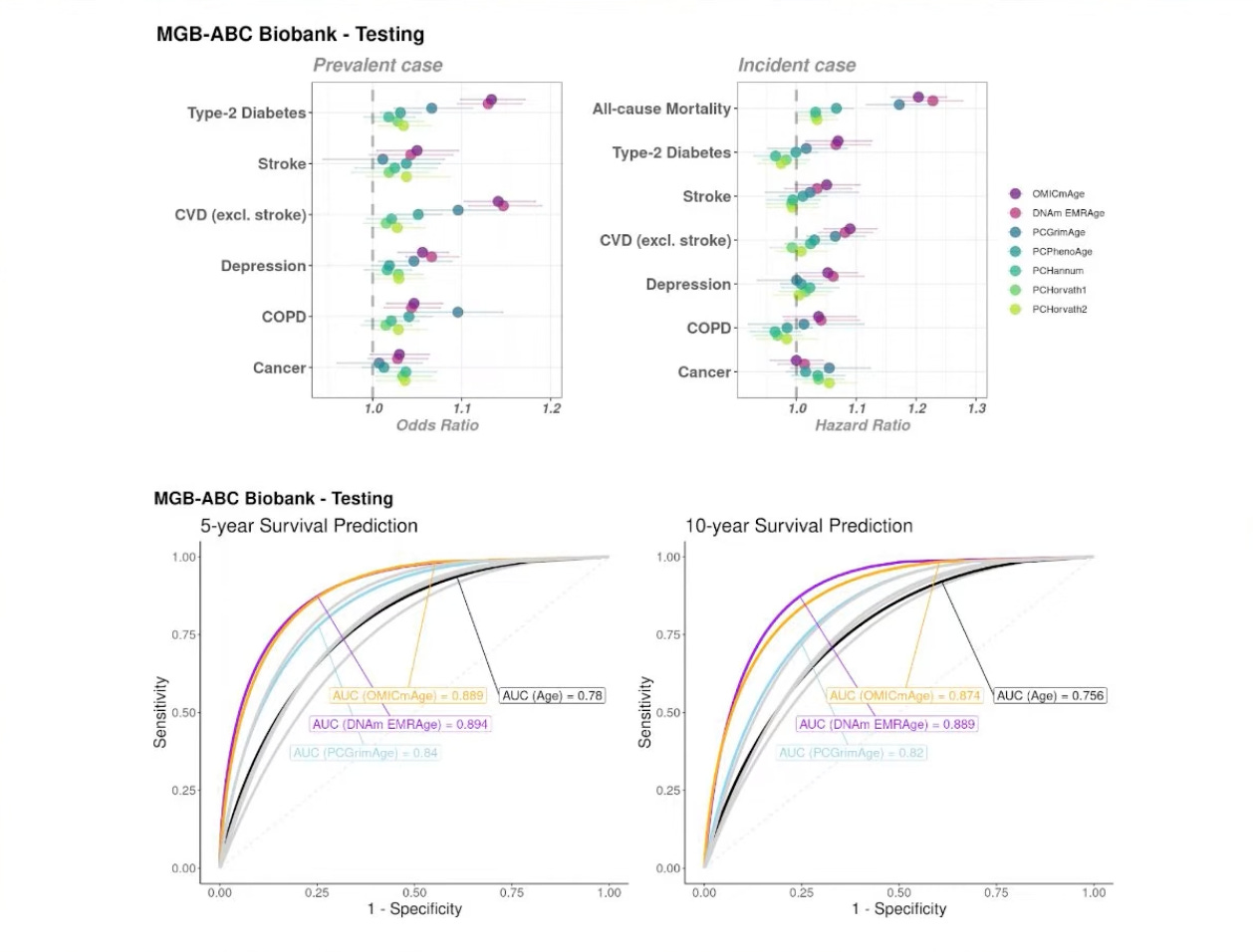
Research behind the 2nd and 3rd gen tests has been developed in partnership with Harvard, Yale and Duke. The company is leveraging the largest private DNA methylation database in the world and has been through rigorous tests for its reliability and accuracy in comparison to the standard blood test results.
Below shows the reliability of different biological ageing clocks. Testing reliability is simple; participants had to get tested using the same test multiple times, and if the results can be consistently replicated, the test is fairly reliable.


Note: some people left reviews online to point out that the reliability is off when the test is repeated in 1-2 months. In 1-2 months, someone can catch a virus (without even showing symptoms), be sleep deprived, have their period (for women with regular monthly cycles), go through additional stress, etc. Blood tests can vary within 1-2 months, or even 2 weeks, as well.
TruDiagnostic’s tests have accuracy because their algorithm is optimised to predict chronic disease and remaining years of life. We still don’t have a standardised ‘golden’ method for measuring biological age (i.e. is telomere length X% important, or X+5% important in predicting overall ageing).* The algorithm of ‘speed of ageing’ is designed based on correlations and the clinical trials scientists have done to date. Therefore, these tests have certain limitations and generally become more accurate as years pass and more research is conducted. However, measuring biological age based on mortality and disease prediction (which come from tracking DNA methylation**, epigenetic biomarkers, collected via blood test) logically makes the most sense.
*Note: TruDiagnostic tests show the telomere age separately, if you are curious.
**Note: DNA methylation is a complex thing to explain, but I’ll do my best. Methyl tags get influenced by environmental factors (i.e. stress, diet); they then influence how our genes are turned on and off (i.e. the gene for dementia or cardiovascular disease). We have thousands and thousands of genes, some are expressed and some are hidden; this is the study of epigenetics. The accumulation of certain methylation patterns is linked to the process of chronological ageing (or having an unhealthy lifestyle, which contributes to biological ageing) — this is now a predictable process for scientists due to the amount of data we have.
In such an important space that needs science backing, TruDiagnostic does not give you the ‘feel good happy talk’ vibes, handing out everyone a gold star for ‘being young.’ Unfortunately, the players in the ‘epigenetic test’ space have increased over the past few years, and some have damaged the credibility of the ‘biological age clocks.’ To be blunt about it, some products are a scam (or completely unscientific), unable to filter out noise in large data samples, showing everyone slightly younger (and fit people dramatically younger). This is where you hear stories like, “I’m 55 and my biological age is 19.” I don’t want to assume it’s intentional, as I’d like to believe that all PMs and scientists are trying to do their best. At the same time, consumers choose to engage with products that make them feel good — basic psychology. I have observed that even the healthiest people can find action areas to focus on from the TruDiagnostic test reports, as you are given results of over 105 biomarkers.
I’m not saying that they are perfect. But neither are standard blood tests; you can expect error rates between 1−6% for many common lab tests. If it helps, you can view the reports as a sign of ageing (or a sign of health) to take away health goals, rather than ‘your set in stone biological age’ (and honestly, it doesn’t matter whether you are 28.2 or 28.8 years old). Arguably, trends of ageing matter more.
For more information on the accuracy and reliability of biological age tests, refer to this page.
Fast turnaround time
From the day I shipped my parcel (express shipping in Australia), it took 2-3 weeks for the results to arrive. They are speedy — won’t make you melt in anticipation.
For people who want to experiment in this space, fast results = quick pivots & iterations on your end = agile testing cycles. 😉
Also, the process was quite easy end-to-end. Completing the questionnaire was quick (even though I overthought each answer), the instructions were clear, and collecting the blood sample was easy (left a mini bruise on my finger afterwards).
You are compared to others of your age and gender
It’s sad to state this as a “pro,” but unfortunately, the blood tests we complete after a GP’s referral don’t compare us to other healthy individuals our age and gender (except for hormone-related or other gender-related tests).
Traditional health runs on a system of “one size fits all.” For example, the recommended fibre amount for everyone is 25g a day, whether you are old, young, 100kg man, 45kg teenage girl, the result is the same. Likewise, the “healthy range” we see on our pathology reports are given to everyone AND they are calculated based on the average of others who get tested in the same lab. That means, this data is influenced by people with chronic illness and people in their 70s (reminder, the average age of mortality for women in Australia is 82.5 years old). Hence, throughout the decades, the “healthy range” displayed in these reports has shifted (often towards a poorer outcome). For example, doctors currently expect lower testosterone levels for men and lower iron levels for women, and accept them as “normal” (or the average), in comparison to the levels expected in the 1990s. I’m not saying these ranges are wrong. I’m saying that they are averages, and average doesn’t mean optimal health outcome for you.
This is a very important point that I think the majority of the population doesn’t know.
This is why some people are shocked to see some of their blood results appearing to be poor in TruDiagnostic’s tests (when compared to others their age and gender), while in a standard lab test, they appear average (in the middle of the “healthy range” for everyone).
Speed of ageing
You will get to see not just how your historical lifestyle has impacted your organs, but also how your current lifestyle is impacting your speed of ageing.
DunedinPACE test is a reflection of how your recent health interventions are impacting your pace of ageing. This is a great way to test if you are heading towards the right direction with your daily habits. It applies an optimistic lens by revealing that you can take control of your health at almost any age.
Active involvement in the scientific research community & transparency
As someone nerdy about longevity (and without a medical background), one of my challenges is accessing information. So, I have a high appreciation of companies that are transparent with their clinical trials and other scientific research. You can read about the work TruDiagnostic is involved in via their website.
Knowledge + Consumer Effort = Empowerment. 🧠💪
Side note: I also love their involvement in the longevity research community overall.
Another note: I appreciate the ethical business practice they adopt when talking about other players in the longevity space. Their CEO, Matt Dawson, approaches all discussions with data, kindness and professionalism. I cannot stand companies in HealthTech with a marketing strategy of bashing each other up (without data backing, but with lots of unnecessary visuals of ‘hot gym girls’) to prove that their way of doing health is superior. Also, health is not directly correlated to a person’s sexiness; please don’t pick your HealthTech company based on it visuals.
Privacy and data collection
Another ethical business practice of TruDiagnostic is the respectful way they handle customer data. It is HIPAA compliant and doesn’t use third parties for testing or sharing customer data. You can also opt out of participating in TruDiagnostic’s research programs.
What I would love to see improve/change
Product does not have a slick user experience
If you are purchasing a test from TruDiagnostic, it’s because of their product’s quality (the science behind their testing), not because you love their user experience. Let me explain with some examples.
I would have loved to receive an email; “your results have arrived”. Except, I found out about my results after thinking, “hasn’t it been 3 weeks? Why haven’t they let me know that my results are ready? Let me check this.” Throughout their experience, small helpful things like that are missing.
Customers often have a lot of questions after seeing their results. If you are not as nerdy as I am and you don’t have a medical background, then you will most likely be wondering, “what does this marker mean, why is it important, so what should I do about it?” I also had a bunch of questions to dig up. This process is fun for me, but not sure if other customers have that much time.
Overall, they don’t provide a very engaging product experience. You can participate in the Rejuvenation Olympics after 3 tests (link is at the bottom of the article), but the product experience ends once you receive your reports. However, I really appreciate that the majority of TruDiagnostic’s resources are going towards uplifting their product quality (scientific research and perfecting their testing algorithms).
I think their target customers are nerdy into the longevity space, because their content is technical and scientific for an average person. Or maybe this is their way of remaining credible, which works for me. By the same token, I believe their product is inaccessible for the segment of customers who care about longevity (and will take actions to improve their health), but don’t have the time and/or deeper interest to do extensive research.
Side note: I imagine a future where the roles of some doctors shift into ‘longevity coaches’ and they work with patients examining reports like the one TruDiagnostic provides. Or maybe we’ll all visit longevity clinics for regular check-ups with these tests (as this becomes more affordable), and the idea of visiting the doctor becomes a big deal (i.e. for emergency purposes, black swan injuries). So, I wouldn’t be surprised if TruDiagnostic is planning a B2B strategy, rather than focusing on B2C initiatives.
Lack of personalised recommendations
Adding to the point above, while there are some ‘action points’ recommended for users to follow based on their epigenetic result in TruHealth Report, it wasn’t enough to put together a plan or a personalised longevity protocol. I expected more. Also, their recommendations in the TruAge Report are generic and given to all, rather than being based on your results.
I understand that the company is trying to upsell with personalised coaching (for an additional cost), but this option is unclear on their website. I would not have known that I could get coaching if I didn’t reach out to the company’s support team over email. Maybe this is a new path they are exploring and experimenting with. Despite doing a lot of research, I still found a 30-minute consultation with Chris Barnes to be helpful, so if you are based in Australia, reach out to him.
Side note: red wine is still under their generic recommendations (shocking!). I’ll happily argue with anyone on this topic. There are far healthier ways to get resveratrol than drinking neurotoxins. By the same token, baklava could be a longevity superfood too, because it contains pistachios (lutein and zeaxanthin), walnuts (omega-3s), and the sugar will give you a massive energy boost. 🥜 My Turkish genes are screaming, “go baklava!” 😋
Expensive
I don’t need to beat around the bush. Advanced longevity treatments are very expensive. Getting tested is also expensive. I can’t afford this test more than once a year. I wish I could!
That being said, getting your basics right in health (the main pillars) isn’t expensive. Sleep is free. You can get your cardio done outside on the streets. Meditation and box breathing don’t cost anything.
Being healthy doesn’t depend on purchasing an epigenetic test. However, the more you understand your body, the more precise you can get with your lifestyle choices. This is how I justify the cost. Health is one of my biggest priorities in life; I guess I’m boring.
Reports don’t actually show blood test results
The TruDiagnostic reports show percentages and how you compare against people your age and gender. This is a useful view and it was certainly interesting.
However, I expected to see the actual results (in numbers) of my blood tests. I was a bit disappointed and had to take additional tests to double-check my results (it cost me additional time and money).
Despite being a big fan of TruDiagnostic, I might explore other options that reveal my blood test results clearly (or alternate 2 companies/tests) — need to research this.
Fitness Report
I am really confused (and curious) about how the fitness report is calculated. It seems quite off for most people. This section is not very important (and takes up a small space in the wider report), as you can test the following in other ways (that are probably more reliable): ‘fit age,’ ‘grip strength,’ ‘gait speed’ and ‘VO2Max.’
My partner’s results appeared to be too low 2.5 years ago, when he was regularly going to the gym and running. My VO2Max is showing to be 46, but on Whoop, it’s showing to be 50. Not a huge difference (still very good), but it’s not the first time I’ve heard that TruDiagnostic underestimates the fitness markers for fit people.
Neglected Spaces
Auditory health, eye health, oral health, vaginal microbiome, skin microbiome, gut health… the longevity space doesn’t have enough research for every organ. So, it’s not surprising that TruDiagnostic doesn’t provide insights into (or join the dots with) these parts of the human body.
It’s impossible to measure eye health via a blood test, to my knowledge. It’s also not necessary for TruDiagnostic to move away from their core specialty/strength to grow these neglected spaces. I wouldn’t recommend that.
I am interested in seeing TruDiagnostic expand via integrations — stitching siloed areas of health. We need holistic approaches to health, and I think TruDiagnostic is best positioned to achieve them.
Common criticisms of TruDiagnostic
Not a genetic test kit
Some people comment that the TruDiagnostic test reports are not useful because they do not provide a genetic test. I think both provide different views on your health, and what you purchase will depend on your interests/priorities.
Right now, I would rather know about how my organs are ageing, so I can take action steps to slow down ageing. However, I would be keen to purchase a genetic test kit in the future, as it would also provide interesting insights that I can use to further optimise my health.
Not FDA approved / “My GP doesn’t know about the test, therefore it’s not credible”
I understand the credibility FDA approvals give. I also understand that it takes years and a ton of money to get a product FDA-approved; it’s a huge hassle. If I were a Product Manager at TruDiagnostic (what a dream!), given how niche my audience is and the fact that my product is not a diagnostic test (meaning, it doesn’t require an FDA approval), not sure if I would spend my main resources trying to push for an FDA approval. In fact, I’m sure I would spend the time and money on continuing to develop my product’s quality in other ways.
As to the comment about GPs… just a reminder, your GP is not your longevity coach or a personal trainer — their job is not to improve your health, but rather to assess if you have a critical condition to be referred to a specialist. They are the middleman between hospitals/specialists and patients. They don’t need to understand how epigenetic tests work, the latest research on longevity science, how vitamin deficiencies impact each organ’s function, the connection between gut health and mood disorders/PMS/cognitive health, or how specific protocols can impact DNA methylation. GPs assess you against the norms (i.e. dying at age 80 and spending the last decade of your life taking 6 prescription pills with one or more chronic diseases — this is the norm of Australia, as to the stats in 2025). I’m not bashing GPs, but instead reminding you that there is a reason longevity clinics with quarterly consultations charge between $5000-$20,000 per year for membership.
Collecting dried blood
Hot take, very controversial topic to discuss. For someone without a medical background, fresh blood sounds more reliable than dried blood. By the same token, working with recent blood (24 hours old) is probably better than working with blood that’s 7 days old. I would love to hear an explanation from the TruDiagnostic team about this. My thoughts/research…
Research conducted at Uppsala University (Sweden, 2017) revealed that the drying process had a “negligible effect on the protein level in the blood samples.” Some government-funded diagnostic tests also rely on collecting dried blood; the NSW Health website states that DBS tests are “close to 100% accuracy.” There is a lot of research you can find online about the accuracy of dried blood collection. Hence, some labs around the world are considering switching to dried blood collection, as the process is easier, more scalable and efficient.
Collecting dried blood is still shown to be more accurate than collecting saliva, which is the method that a lot of other biological age testing companies rely on.
“Inaccuracy” of the blood test results
This generally goes along the lines of, “I tested my liver values a month ago, and my bilirubin was 12. On this test, it looks much higher. This test is so inaccurate!” I briefly touched on this under another point, but to summarise…
“Healthy ranges” for blood tests compare you to the average population (including people in their 70s). TruDiagnostic compares you to others of your age and gender. Maybe you thought your markers were good when compared to an unhealthy average.
Some blood test results vary month by month. I completed an experiment in 2023, getting blood samples to see my liver results 4x during the year, about a month apart. For some markers, I received different results each month. The fact that I was stressed and had the flu totally impacted the results.
TruDiagnostic is not basing your “organ age” on 1 value only. It’s trying to paint a big picture by considering a range of markers. Not all markers matter equally when judging someone’s health, and some markers can fluctuate month to month.
To get the most accurate outcome of your test results…
This is the advice from my AI longevity coach to avoid elevated inflammation markers. I would love to hear TruDiagnostic’s recommendations as well.
Don’t test within 4 weeks of getting sick or injured.
Don’t test within 6 weeks of having surgery (depending on the type/invasiveness of the operation).
Don’t test after a strenuous workout; ideally, take 24-48 hours off from the gym/running before you test.
Don’t test when you have seasonal allergies flaring up.
Don’t test 5 days before and during the first 3-4 days of your period, depending on how long and how much you bleed (for women).
Replicate the same testing conditions each time you test.
Questions about oddities in data
Not sure why people provide ridiculous examples; it might be due to the other biological ageing clocks that operate on ‘happy vibes’ and low-science. 2 common questions that get asked online;
“What if your biological age is 20 when you are 45? Do you have 60 more years to live?”
It’s almost impossible to appear at age 20 when you are 45 with TruDiagnostic. Throwing out exaggerated examples like this is unhelpful, as such cases exist in such rare amounts that they skew the overall data.
If a person were to exist like this, then there is absolutely nothing wild about living to 105 years old. There are people who have lived to 105 before. “In the US, 2021 records show that in a population of 336,996,624 people, there were 89,739 centenarians (a prevalence of 0.27%)…with 15% having no disease at 100.” In fact, “by 2050, nearly 3.7 million people are expected to live up to 100.”
I’m curious to see how data from TruDiagnostic will shape over the next 50 years, as more and more people will pass 100 years old.
“My biological age is 10 years older than my chronological age, but my parents died at 80. So, my genes are great, clearly. Are you saying that I’m going to die at 70?”
Not necessarily, when considering future medical advancements. Medicine is progressing; there are always means to keep someone alive. But it might show a very good indication of how much and how early you begin to suffer from a chronic illness.
Denial of data
Sadly, it seems like a lot of people are simply upset with having a biological age older than their chronological age. A lot of the criticisms I’ve heard and seen are from people with no scientific background, who correlate certain activities and appearances with “excellent” health. These go something along the lines of…
“I can run 10km, clearly I’m not older than what I am, this is stupid!”
“Everyone says that I look younger than my age and I am skinny, so I don’t have any health problems, not sure why this test would show that I’m 5 years older.”
“How come my brain health is 7 years older? I got 95 in my ATAR, I’m smart, and I’m sure that I can perform well.”
My only comment is that it’s immature to blame the algorithm because you didn’t perform well (and this is not a performance; it’s a helpful tool for you to understand your body). This is equivalent to a teenager blaming their teacher for being mean to them because they didn’t get an A+ on their assessment task.
TruDiagnostic is a mirror pointing at your organs and historical behaviour. The company isn’t trying to shame anyone, but it seems like data can shatter one’s ego. We are all trying our best to be healthy, but sometimes we face barriers (and it’s not our fault), like not having access to scientific information, a lack of support from our environment, or being stuck in damaging situations.
Reading through Reddit threads and chatting with people as a PM has been an illuminating experience; we really don’t have much knowledge about our health. Social media confused us even more with unrealistic beauty standards. Traditional medicine wants to claim that blueberries and spinach are everyone’s “superfood,” when they disrupt some people’s gut microbiome and cause diarrhoea. For women, accessing information is even more challenging and being gaslighted is very frustrating (i.e. “not having your period for 6 months is ok”).
This post is getting really long, but people most commonly underestimate the impact of sleep, stress, gut health, hormones (i.e. having regular periods), hydration, and walking (not just weightlifting).
My results & goals
I’ll keep this section short; I don’t think anyone really cares about someone’s results. But it might be helpful if you are experiencing similar challenges. That being said, I am not a doctor (just someone who regularly researches, experiments and refines her routine to become healthier), nor an expert on your body, so don’t blindly follow what I do.
In hindsight, the results were kind of predictable. I have 3 main things to work on.
Hormonal health (my number 1 priority; almost 3 years older than my chronological age)
Not surprising at all, given how much disregulated nervous system (complex trauma) impacts the hormonal health of women. I have also been on a very high caloric restriction for many years (probably since I was 16, maybe even longer), which further damaged my hormones. There is a lot of research that proves slight caloric restriction as a longevity hack. I won’t go into the scientific details (it’s something that I believe in) — but, emphasis on the word, slight (not starvation). Lastly, I also used birth control pills for 18 months (between 2024-25), which didn’t help.
The biggest sign of poor hormonal health for me was the irregular periods. One of the biggest lies young women hear from their doctors is that it’s completely ok to not ovulate and not have their period. For some reason, we have come to believe that while men need their testosterone (although our standards for that dropped a lot, too), women don’t need their vital hormones to function properly. Very interesting. Very delusional belief.
Fun fact: having regular periods doesn’t mean you are ovulating each month.
Another fun fact: having poor hormonal health can lead to early menopause. Delaying menopause plays a huge role in the longevity journey of women. It’s one of the biggest differences in longevity protocols for men and women.
I’d highly recommend looking into some of Kayla Barnes’ podcasts for more information. Some links below…
https://www.kaylabarnes.com/podcasts/endometriosis-with-dr-sasha-hakman
https://www.timeline.com/blog/kayla-barnes-on-mitochondria-and-ovarian-longevity
https://www.kaylabarnes.com/podcasts/exercise-and-fertility-with-dr-sasha-hakman
Here’s what I’m doing about it.
Continue the experiments (and validated strategies) to heal my nervous system
Come to a maintenance in daily calories (still working on it, but getting close)
I stopped taking birth control pills to track my natural menstrual cycle
Vitamin B5 supplementation (very strange, but I seem to have a deficiency in comparison to other women my age), as it’s linked to regulating hormones and menstrual cycles
Red light therapy 3x a week for 15 minutes (there is a lot of anecdotal evidence and emerging research on how RLT supports hormonal health, modulates hormone levels for regulating periods and managing PMS symptoms, including cramping, so it’s worth a try)
Lung health (not too bad, just a few months older than my chronological age)
This was not surprising given how much 2nd hand smoking I’ve been exposed to growing up. I had asthma, and my dad wasn’t certain about the diagnosis until he tested the condition a few times. Istanbul was also a highly polluted city back in early 2000, before I moved to Sydney. Otherwise, I have never smoked in my life. Most of my smoke exposure was before I was 10. It’s very clear (and also sad) how impacts can last more than a decade after such exposure.
Here’s what I’m doing about it:
HBOT 50min 2x a week + 90min 1x a week (high pressure)
Taking marshmallow root and tinospora cordifolia extract as supplements
Researching about mullein leaf extract for additional support
Purchased an Oyxfit breath trainer. It’s on my list of health experiments for next year
To my knowledge, we never had a mould problem, but it’s always good to check. We already have an air purifier. Planning to purchase an air quality monitor as well (on my list of things to do for next year).
Other things to note (stuff I’m already doing); regular exercise (especially cardio) and lowering salt can reduce airway inflammation, and of course, the famous trio (antioxidants, vitamin C and fish oils) helps protect the lungs from damage.
Liver health (not too bad, just a few months older than my chronological age)
This is something more people should care about, as liver disease has increased 400% in the last 50 years (and the rates of diagnosis are still accelerating). What’s interesting is that the leading cause of liver disease is no longer alcohol.
My drinking history: I had a 10-glass-a-year limit on alcohol between 2018-2021 (about once every 2 months, 1-2 servings each time). This dropped to 8 servings between 2022-23, then to 5 servings in 2024, and 4 servings this year (had 2 so far and 98% sure that I won’t hit my limit).
I listened to a talk by Siggi Clavien last weekend and learned about the impact that stress/trauma, corn syrup, high fructose foods, preservatives, soft drinks and microplastics have on the liver. From this list, the item I really need to remove/manage is the unhealthy stress. I mentioned this before, but during 2023, when I ran a test to see my liver results 4 times, the months when I had elevated values were related to high stress. Here’s what I’m doing about it.
Continue the experiments (and validated strategies) to heal my nervous system
Taking milk thistle, turmeric, astragalus, dandelion root, artichoke leaf and bee pollen^ as supplements (I was never confident about my liver, so began taking those since early 2025, and have overall seen an improvement with my liver values)
Researching ginseng supplementation for a future experiment
^ I just want to clarify the myth that bee pollen does NOT grow your boobs, girls. Sorry. I wish. But it’s great for other reasons.
I felt very proud overall. Last year and this year, I made changes to my diet and routines, which at times did not reflect the ‘social media ideals.’ I followed a personalised routine which I created based on data from my body and scientific research. It meant that I put on some weight (about 7kgs), slept at a time others called “not cool” and “unattractive,” drank a tea that was apparently “not feminine” because it “stunk,” and explained over and over why I prefer tart cherry juice over wine. I generally don’t care about judgments in social settings, but humans are visual creatures, so what poked my insecurities was actually the “online gym girls” with abs and glowing bodies (still not sure if it’s the lighting, or if they pour oil over their bodies) representing the epiphany of female health.
It was reassuring to see the rest of my results. I can’t lie; it’s very flattering to be biologically young. I felt really proud and 10x more motivated to continue the “self-care, self-respect and self-love” pathway. I’m also very excited to see David’s results back because he’s been on this journey with me for a while.
Suddenly, nothing mattered. Whether the outlines of my abs were showing, if I could do a 5kg or 10kg pull-up, if my nose appeared big from a side angle…nothing mattered. That day, I told my partner, “nothing is sexier than being healthy.” It’s true, and I wish more people felt that way. We put so much pressure on ourselves to look a certain way, so much effort to be “beautiful” (which is a one-dimensional, inflexible ideal that aims to clone women), and not enough money, time and effort into providing our bodies what we deserve (which is health).
Nothing is sexier than hiking through Tasmania with your partner at age 70, being able to rock and roll at age 80, making pottery or puzzles or baking at age 100. Nothing is sexier than vitality, kindness, and the joyful glow and excitement you carry through life.
ME: “I’m still not sure if this is real. Do you think their algorithm broke?”
HIM: “No, I knew it. That’s why I’ve been calling you a young lady all this time.”
ME (singing): “My name is Doa and I’m really glad to meet you. Hey, ooh, is this illegal? Hey, ooh, it feels illegal.”
HIM: “Ok, stop boasting. You’re such a health freak.” (Pause. Thinking…) “Though I think you’re actually legal.”
ME: “Maybe. Depends. Definitely not for marriage.”
HIM: “I guess I can call you a naughty girl and send you to your room if you talk back at me then.”
While I bounced around all day with a teen girl attitude (we joke that it’s from the excessive spermidine I have), the reality is, no one cares. I’m on this journey for myself, so there are only two people in the world I desire to make proud. And I think I achieved that.

Rejuvenation Olympics: a challenge one can participate in after completing three biological age tests within the last two years. TruDiagnostic has partnered with Bryan Johnson and Dr. Oliver Zolman to bring this ongoing longevity competition live.
If this post is helpful to you, it will probably help others too. Share with a colleague, and if you haven’t done so, subscribe.