

Brain — the ultimate black box of mystery for humanity. It’s the organ that has fascinated humans for thousands of years, accumulating thousands of theories and philosophies. Difficult to understand, measure, track, assess, diagnose — it’s a control centre that sends electrical signals to the rest of our organs via the nervous system. It’s the common denominator of the persistent challenges we face, our intuitions, dreams, fears, attention (or lack of), what we remember (and what we forget), hormones, choices, behaviours, and whether we fight, flight, freeze, fawn, or faint.
It’s a dark, complex thing in the clouds that some of us don’t want to deal with. We prefer to deal with what we can easily track and influence, hence the growing popularity of gyms, nutritional advice, and blood tests. Over the past 5 years, we’ve made enormous jumps in sleep tracking, genetics and epigenetics testing. In fact, the more we test and track our bodies, the more we understand that there is a connection between each organ, and once one system is disrupted in our biology, the rest follows in a domino effect.
It’s 2025, and we have even begun to work with artificial intelligence, imagining the future integrated with generative AI. Now, it’s time to (better) understand our intelligence — our brains. No matter how complex it is, we can no longer ignore our brains. The future will be a reflection of our brains.
The early 2010s marked the birth of Whoop, Oura and other similar wearable companies. A decade later, we have the privilege to experiment with and experience the products offered by companies like Pulsetto, InBrain Neuroelectronics, Flow, Neurovizr, Neurable, Precision Neuro, and Neurode. These companies have a few things in common:
They aim to better understand and interact with our brains in a personalised and drug-free way, with the help of AI, so we can uplift our cognitive ability (whether via reducing stress, improving sleep quality, guiding our focus, or another way).
They can impact our brain longevity, which means preventing (or delaying) the leading cause of death in Australia (dementia), either directly or indirectly.
They recognise the impact of chronic stress and trauma on the brain.
They are laying the foundation for a human-brain interface, which could have applications beyond our imagination.
And almost all of them start with ‘Neuro’ (which makes a good tongue-twister and the job of their marketing department challenging).
In this post, I want to focus on an Australian-based start-up, Neurode.
Meet Neurode: a non-invasive, drug-free, personalised headband for managing ADHD symptoms, currently in clinical development and trials.
How does it work in simple terms?
The product is a light headband that stimulates the prefrontal cortex of the brain, which is responsible for higher-level cognitive functions (i.e planning, decision-making, problem-solving, working memory, impulse control and emotional regulation). It has sensors that detect when you lose focus and get distracted, which then trigger stimulation (so you can regain your focus).
The prefrontal cortex is also known as the brain’s “executive control centre,” as it allows one to complete complex tasks like switching between contexts, managing conflicting thoughts, conceptualising time, following through goals and decision-making. This part of the brain is unregulated (with weaker function or structure/size) for people with ADHD.
Some fun facts:
There are 3 types of ADHD: inattentive, hyperactive-impulsive, and combined.
About 9.6% of school-age children aged 6 to 11 years and 13.6% of adolescents aged 12 to 17 years in America are estimated to have ADHD.
1 in 20 children in Australia is estimated to have ADHD. There is reported to be more than a million people (including adults) with diagnosable ADHD.
In America, nearly two-thirds of children with ADHD have at least one other condition; 32.7% anxiety, 16.8% depression, 13.7% autism, 1.2% Tourette’s, and 45% a learning disorder.
About 65% of ADHD cases diagnosed in childhood persist into adulthood.
A relatively large number of ADHD diagnoses get re-diagnosed in adulthood as bipolar and borderline personality disorder.
Studies suggest that people with ADHD are at least 1.5x more likely to develop substance abuse disorders.
ADHD is irrelevant to a person’s IQ level.
Increasing studies are finding links between gut microbiome imbalance and prevalence of ADHD — compositional differences of the types of bacteria in the gut may contribute to brain functioning differences and symptoms of ADHD. For example, Bacteriodes species that improve the integrity of the intestinal barrier were found in lower amounts in people with ADHD. Another example comes from an experiment where the gut microbiome of people with ADHD was transferred to mice, causing a change in behaviour and brain activity (which mimics ADHD symptoms).
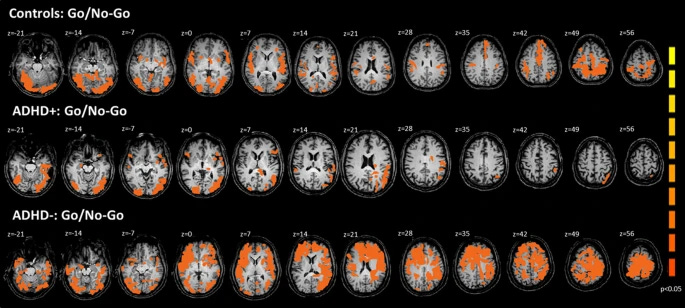
Below is a scan that shows the difference between an ADHD and a non-ADHD brain during a group experiment. The participants went through an attention task called “go/no go.” The ADHD group showed diminished activation, while the non-ADHD group showed “increased activation in the following anatomical regions: bilateral on inferior frontal gyrus, insula, postcentral gyrus, putamen, caudate, thalamus, anterior cingulate cortex, precuneus, globus ballidus and inferior temporal gyrus.” Read the full study here. The activity in brain circuits is clearly visible and trackable.
Neurode uses fNIRS (Functional Near-Infrared Spectroscopy), which is a neuroimaging technique that measures hemodynamics (changes in blood oxygenation) in the brain using near-infrared light. This is an incredibly promising technology on its way to becoming a standard diagnostic tool for not just ADHD, but also for other neurodiversity and mental health disorders. Its accuracy in trials is mind-blowing; it can tell the differences between borderline personality disorder, bipolar, and manic personality disorder. It can tell schizophrenia and psychosis apart. These are similar and complex disorders that even psychologists can have a hard time diagnosing via talk therapy, hence the cases of misdiagnosis.
The stimulating technology is tRNS (transcranial random noise stimulation), which is a low-intensity alternating current with a randomised frequency applied to the scalp of the user. These random currents interfere with the brain’s existing electrical activity, which can help neurons to activate. Very exciting technology!
In case you are wondering for your non ADHD friend, yes, theoretically, this product would work for anyone needing to be nudged to concentrate more effectively. You don’t need to be diagnosed with ADHD to get the benefits.
Can you imagine how much more you could get out of your brain power if you were just a little sharper? Let me give you an example. I was a child who could add and subtract numbers up to 20 at age 2. But I failed year 1 and was told to repeat it, simply because I was too bored to complete the maths exams and lost track of time thinking about my LEGO robot, Elo. My mum used to complain that the concept of gravity took me until age 7 to learn. Almost every day, I would grab a cup of water, and by the time I walked into the living room (say, 2 metres), I would suddenly remember something exciting, throw my hands in the air, spilling all the liquid.
I felt like I discovered myself for the first time after taking ADHD medication. I distinctly remember the moment of sitting through my first exam after the pills; a wave of confidence, sharpness, intention and awareness of the world hit my brain. I remember the time passing beat by beat, instead of a long drag followed by a sudden rush and shock. I handed my test with certainty for the first time, not with embarrassment. I looked inside my teacher’s eyes and said, “I think I got full marks.” The little me felt her potential for the first time.
I think all of us, ADHD or not, need to have a moment in our lives when we feel in our hearts that we are so much more capable than we have ever imagined.
I’ve been following the journey of Neurode since 2023. I signed up for their waiting list ages ago and was a bit bummed to find out that they packed up their business and moved to the US. Unsurprising, and couldn’t blame their choice.
To summarise, the regulatory environment for HealthTech products in Australia is a major financial expense that costs a lot of resources, effort and time. Acknowledging that the TGA (Therapeutic Goods Administration) ensures patient safety; we need regulations to trust the healthcare system. Not denying that. However, the effort is often unjustifiable when the market is too small, in comparison to the US. Jumping through too many hoops can also become a barrier for existing HealthTech companies to expand via innovation and experimentation. Additionally, funding for HealthTech startups in Australia is quite limited. If you’re interested, check out the Australian Medical Device Venture Investment Summary Report. There is a huge gap between how much funding has been out there for HealthTech companies and how much was needed for these companies to grow. The investment is also heavily skewed towards late-stage ventures, leaving start-ups underfunded. While these are the main reasons, there is one more challenge that I have to mention. HealthTech innovation in Australia is culturally not as supported as in the US or UK due to a fear/dislike of disrupting established workflows; the process of gaining trust and adoption from medical professionals faces a lot of resistance. If you are interested, another report you can read, which mentions these issues, is the Medical Research Commercialisation Landscape Report. As a founder, when you weigh the pros and cons, it makes more sense to scale your business idea overseas.
Anyway, I received an email from Neurode a month ago about a product test group in Sydney. I was really excited to have this experience, and I also wanted to sit through an attention test after almost 20 years. Time to time, a part of me had wondered if I really had ADHD, or if my symptoms could simply be justified by C-PTSD. Was it hyperactivity or hyper-vigilance? Was it inattention or disassociation? How come a few months after I began taking the ADHD pills, my behaviour has drastically changed, which led to a diagnosis of Tourette’s Syndrome? It’s totally possible to have both ADHD and C-PTSD, but there is a reason why C-PTSD is described as ‘acquired neurodivergence.’ Mysteries of the past. I already needed to get a Dexa Scan and see a friend, so I justified flying to Sydney for an overnight trip.
Here’s how the product testing went
3 participants booked the 6 pm session; I was one of them. The lights in the room were dimmed (which I found very comfortable for my eyes), so the person on duty could see the lights coming from the headband.
We wore the Neurode headbands and were asked to complete some attention challenges on a computer. We were given 2x 1-hour blocks (10 min break in between) to complete these challenges with a questionnaire at the start and end of each mini task/activity to check how I felt (i.e. how bored, tired, overwhelmed I was). We were informed that the Neurode headband would actively work as we were solving these challenges. So, supposedly, we would become better at completing each mini task towards the end of each session (i.e if the first 2 minutes were very hard, then the last 2 minutes would feel easier)?
What are these challenges?
Imagine a bunch of 2-5 minute games that ask you to switch between different tasks, remember sequences of letters/numbers, spot the difference in images, etc. See below for some examples.
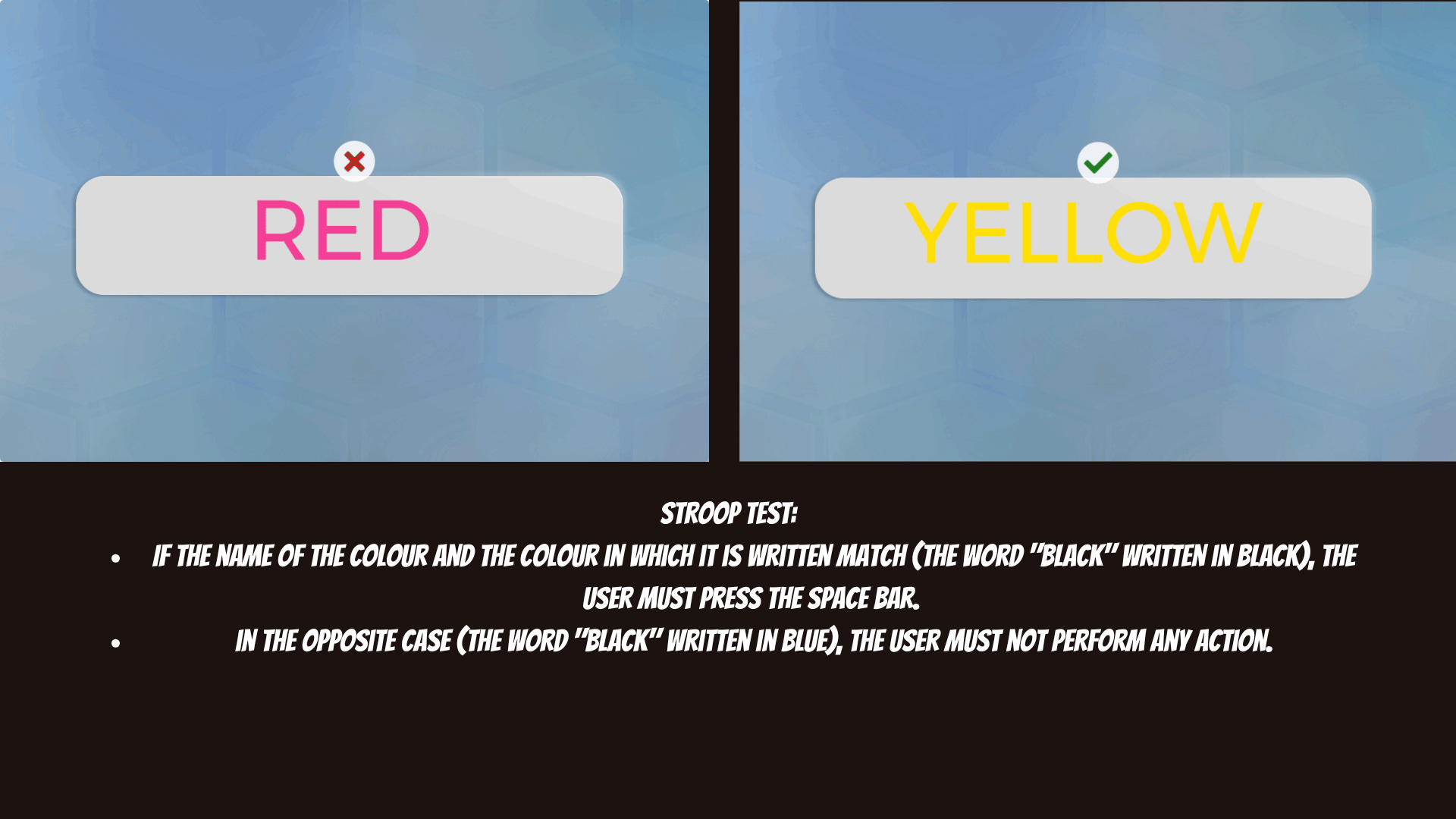
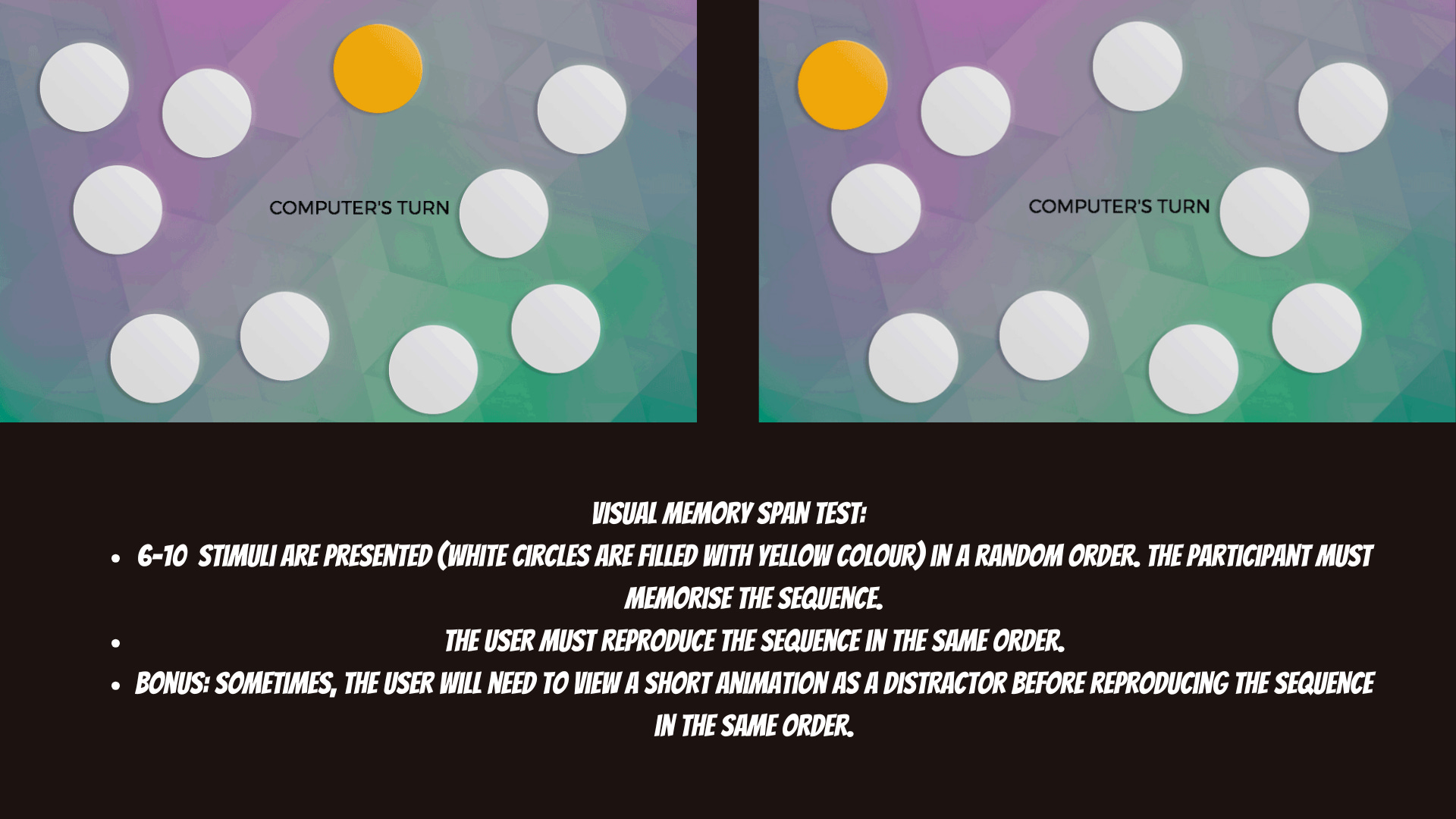
I find these tasks to be interesting and fun at the beginning, and generally feel tired, frustrated and slightly overwhelmed after 30-45 minutes (depending on the type of challenge, so how difficult I perceive it to be). I have always wondered how a neurotypical person would perform during these tasks. Would they also feel frustrated? With what accuracy would they be able to complete such tasks?
This experience took me back to my childhood memories. Especially for 3 or 4 (from about 20 tasks), I felt like I was completely wasting my time — wrong wrong wrong wrong wrong…..for about 3 minutes. But the frustration wasn’t about being wrong; it was about the fact that a millisecond after each wrong answer, I knew that I had made a mistake that I never intended to make. It’s the feeling of, “d*mn, no, no I didn’t mean that, can we go back,” 80 times in a row. For example, I successfully clicked on every ‘3’ when I was supposed to click on every other number but 3. Or, I stared at a screen for 3 minutes to see which direction a pool of fish was moving towards, when I was full-heartedly certain that the fish were actually not moving anywhere. I swore and laughed at myself multiple times. A very humbling experience, especially because I had assumed I would have an easy time because my ADHD symptoms have been mostly long gone. By the end of the night, I felt that I could comfortably re-diagnose myself.
Some interesting observations
Did the Neurode headband improve my resilience?
The product aimed to enable better focus, but I couldn’t help noticing something very interesting, perhaps an alternative use case or benefit. At the start of each 1-hour block, our task was to meditate (breathe in stillness) for 5 minutes. I had very low confidence and felt uncomfortable starting these tasks, due to my prior negative experiences with meditation and box breathing.
A bit of a spoiler to a future article: as part of my ‘improving HRV experiments,’ I tried both meditation and box breathing. These are highly recommended strategies with a massive amount of research backing, to build resilience. However, with my C-PTSD background, I often had the opposite experience of ‘calm,’ resulting in panic and anxious crying within the first 2 minutes. As the experiment resulted poorly, I stopped these exercises and haven’t tried them since for almost 3 months.
For an unexplainable reason, I was alright for 5 minutes of breathing in stillness. It didn’t feel good. But it didn’t feel bad either. And Whoop did not show my heart rate peak on Zone 1 during this exercise either. Very interesting. Perhaps my efforts over the past 3 months to uplift my HRV have resulted in growing more resilient, hence I no longer react terribly to such exercises. Maybe. That’s one hypothesis.
However, another interesting thing happened later that night. Despite getting on an airplane, with 6 hours of sleep (to catch the early plane), eating from a restaurant, having a headache (from the exercises), eating a chocolate bar before bed time, not drinking enough water during a hot day, and sleeping late — all the behaviours which have proven to lower my HRV, even when done independently from each other — the next morning, my HRV remained the same in mid 30s. I actually had great restorative sleep. Yes, I still did my nightly NSDR, but there is no way that having this many negatively-impacting behaviours did not lower my HRV significantly.
Even more interesting, the following day, I also had 6 hours of sleep (unusually low amount for me) to catch the early plane and ate from a cafe, but my HRV remained steady for the 2nd time in a row. I even had a better sleep quality with over 5 hours of restorative sleep. This fascinated and left me with a lot of questions to ponder over.
Could Neurode improve nervous system resiliency (HRV)? Or, did it improve my sleep quality, which resulted in a good HRV? If the evidence holds up, could this become another use case for the product? There are not enough studies to show the link between ADHD and HRV, but we know that poor emotional regulation is a symptom of ADHD. Could there be a link?
The fit matters a lot!
As someone used to wearing accessories quite tightly, due to being uncomfortable with the feeling of something touching my skin (if it’s very tight, then the object becomes ‘one with my skin’ and stops rubbing, so I feel less uncomfortable), I wanted a snug fit around my head. After having a chat with a few people in the team, I realised that I’m the first person who complained about getting a headache from the headband.
I have to be honest: the headache began about 30 minutes into each 1-hour block and increased to an unbearable level, making it very difficult for me to complete the last task of each session. The headband was not necessarily uncomfortable — I didn’t feel anything compressing my head — so I didn’t suspect that the snug fit may have caused the headache. However, during the 2nd session, the person supervising asked me to wear it quite loose, and after doing so, some of my headache went away.
It seems like this is a niche problem, but my conclusion was that the fit of the headband matters a lot, and in this case, wearing it loose makes the experience more comfortable.
The person supervising also checked the angle of our headbands a few times to ensure that they’re positioned correctly. I had similar experiences with the Pulsetto team, where the customer support rep was very particular about the placement of the stimulating device on my neck to receive the best treatment. Seems to be a common theme with stimulating wearables. Not a criticism, but something to be careful of, as a user.
In the moment, it was hard to tell whether the device was actually helping
No surprises here. With any stimulating device, you need consistency — the brain is a muscle, and it needs to be regularly trained for improvements. I found out that most Neurode users report feeling results 3-8 weeks after regular use. The recommended amount is 20 minutes a day for +3 days a week.
So, while I would have loved to say Neurode helped me nail down each task like a neurotypical person, I could not tell whether the device was helping. My performance was based on the type of activity I had to complete — some were harder, while others were easier. There were only 2 tasks that I felt I performed better towards the end of the session (as in, during the first half, I felt lost, and during the second half, I began to respond better), but that could also be attributed to getting used to how the activity worked. So, to set the right expectations, don’t expect magic overnight (and probably not over 1 week either).
Lastly, a compliment I usually give to credible HealthTech companies is the amount of data and research they share with their users — transparency. Not a fan of high-level explanations, as in health, the specifics behind the ‘how’ a product works make the biggest difference; details and science-backed evidence are key to building trust. Love that Neurode already shares some of their scientific studies with their customers (despite being new in the market), and I would like to continue seeing that from them.
There is some very promising and interesting stuff being developed, which is taking us one step closer to understanding our brains. I was grateful to be a part of the product testing group for Neurode and keen to continue following this start-up’s journey as they grow and evolve. Neurode brings to the hands of consumers a technology that carries so much potential, and I believe managing ADHD is only the beginning.
It would be great to see psychologists recommending a product like Neurode to their ADHD patients, along with doing CBT (cognitive behavioural therapy). When I was 6, the only option available was medication (or failing and repeating classes in a highly competitive country, Turkey, where kids are pressured into a race) — I did not even sit through CBT to talk through my challenges. We are living in times with so many more options, and we are privileged to have the opportunity to experiment with many tools to figure out the best way of living.
“Imagine what the world looks like when we understand how our brain works” — Neurode’s vision.
I can, but cannot fully imagine. Is understanding how our brains work a key to human evolution? If we can detect signals from our brains and provide signals back to alter their functioning, non-invasively, what else can we do? Are we coming to times when our brains don’t control us, but instead, interact and provide feedback (in a way that reaches our awareness)? How would that impact the way we store and utilise memories in our brains and the rest of our bodies? What would that mean for not just our cognitive health, but also our vision, hearing, nervous system and hormonal health? Will AI help us to evolve in an alien way that we’ve imagined over science fiction movies (say, telepathy)?
I am not stating or questioning anything novel or ground-breaking, but instead suggesting that we may be closer to a different way of existing than what we imagine now. Understanding our brains isn’t just about developing the next drug or preventing dementia, even though those could be revolutionary by themselves. This process — with the help of AI — can lead to a super-intelligent version of ourselves, starting with hyper self-awareness. And I can’t wait to see ourselves on this journey.
All the images I use have been generated using deepai.org (the pop art generator). 🦸♀️
If this post is helpful to you, it will probably help others too. Share with a colleague, and if you haven’t done so, subscribe.