

If you are into longevity, you would have come across health-influencers promoting “living with nature” in developing nations on social media reels. These people are promoting the healthy “island life” - exotic fruit, waterfalls and organic food.
The green imagery is visually appealing. It also feeds into the assumption that developing nations have whole, “clean” foods, while the Western world is buried deep in fake food like factory-made veggie patties.
These influencers also imply that the island life is what is best for the environment, unlike the big buildings Westerners build. The “ethnic people” know better than “white people.”
Here I am, travelling through South East Asia for almost 2 months now. Not the first time I’ve visited developing nations for an extended period of time. Do you want to know what the “ethnic people” and I think of this narrative?
WHAT A SCAM! It’s a fairy tale these folk are selling.
I never enjoyed staying in the tourist hot spots, or big cities, so the experiences below are from regional towns of Indonesia, Thailand, Vietnam, Philippines, Vanuatu, French Polynesian Islands, Papua New Guinea, Fiji, and Malaysia. But these are not just “travel stories” I’ve gathered from talking with the locals. These are research-backed points that challenge the longevity fantasy shown on TikTok.
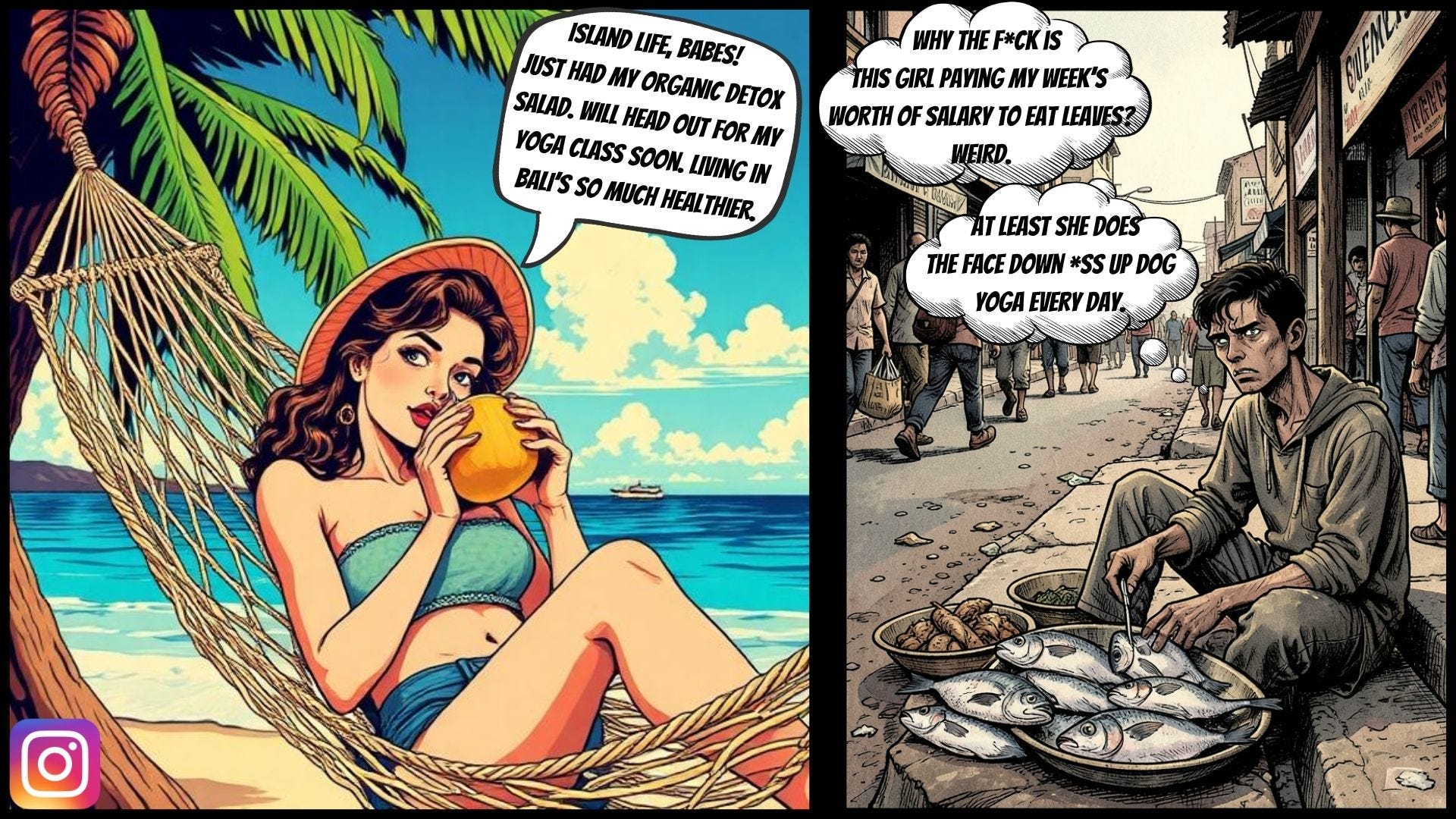
So, why staying healthy has been genuinely difficult?
Let’s explore nutrition in developing countries chronologically - from how food is sourced, all the way to the point it enters your stomach.
Where is the “natural food”?
The myth is “the earth is clean and abundant here”
This leads to another assumption; healthy food is everywhere and cheap. “Nature provides.”
The natural food is in people’s backyards, so they don’t starve. Harsh start to this chapter, but as of mid 2025, almost 3 million households in Central Visayas (Philippines) depend on their backyard gardens to survive. That is 44% of the population. If only they harvest excess food, or collect an excess amount of eggs, they will set up a stand outside their homes for sales. Most of the time, this doesn’t happen because extended families live in the same block or as neighbours, which means, food gets shared with them. Why? Most people can’t afford buying a new property, and in struggling communities, it’s better to support each other as a family, than to try surviving in a nuclear family.
At the same time, a lot people don’t have large acres of land to grow a variety of fruits and vegetables. When food is prioritised, high-calorie foods that are the easiest to grow get planted. So, the “natural foods” are not ones in your “superfood” list, like blueberries, walnuts and leafy greens. They are coconuts, mangoes, bananas, corn, rice, sweet potatoes, and cassava.
Wealthier families have “organic” chickens and cows out on their farms. But they’re skinny, looking sick, grazing among a blanket of rubbish that’s been accumulating for months, maybe years. It really does not look appetising. The concept of putting bins in public places don’t exist in many regions.
Farm land has higher traces of heavy metals found in them. Not sure if I would recommend buying your dark chocolate or rice from South East Asia. Elevated heavy metal contamination (arsenic, cadmium, chromium, lead, zinc) is found in agricultural soils across Thailand, Vietnam, and Indonesia, at levels exceeding local standards.
Average figures for rice for traced contamination:
Thailand (1.25 mg/kg for arsenic)
Vietnam (30 µg/kg for cadmium)
India (178.3 µg/kg for lead)
“Rice absorbs heavy metals that are naturally present in soil, but it tends to accumulate significantly more arsenic, making it a unique and concerning source of exposure” (British Food Journal, Volume 122, 2019). Even Vietnam at arsenic concentration of 0.142 mg/kg is well above the recommended threshold for health.
Why? “Rapid industrialisation, unregulated mining, excessive agrochemical use, and untreated wastewater irrigation have altered soil chemistry across large parts of South, Southeast, and East Asia” (Environmental Geochemistry and Health, 2005). But also think about the relationship between heavy metals with old pipes, pesticide use and synthetic fertilisers.
Some farms genuinely look dirty! Soil-borne diseases kill people every year. There was an incident while we were in Krabi. “South Asia is estimated to have 44% of the global disease burden” for melioidosis, which is caused by burkholderia pseudomallei, and “spread through contact with contaminated water or soil” (Nature Communications, 2019).
Coastal towns with fishermen give the impression that the fish caught will be widely available in the town. Not at all. Availability of fish does not mean distribution of the food supply. Those men are fishing for their families!
Why? Many people we met in Cebu said their daily earnings was 300 Pesos, which is the equivalent cost to a kg of locally grown dragonfruit. The average citizen in regional towns cannot afford to shop.
Quoting our 22 years old tour guide: “My little sister is very spoilt. She sometimes says, I want pineapple, I want pineapple. Because it’s very sweet, she likes it. When I can, I ask the neighbours. They don’t have corn. We trade.”
What happens to those “natural foods”?
The myth is that “the food is unprocessed.”
Where do I start? Perhaps from the problem statement: how to make the small amount of food produced available at cheap prices to a mass population. Take into consideration the annual damage typhoons do to crops, especially in the island nations.
Let me give you some hints.
Almost every yoghurt has added sugars and flavourings. Likewise it’s very rare to just find milk. No simple labels. Some products don’t even have labels. You only realise once you have a spoon of the yoghurt - tastes like honey.
You can find a white, sugary sponge, called “bread” in the supermarkets. It’s quite different from the sourdough you buy in Western countries. You have a higher chance of finding instant noodles than fresh noodles.
Everything has higher ratios of preservatives and lower amounts of protein. Every food item has to be optimised via additives. The “whole food” might only make up 50% of the food you actually buy in the markets. The rest is a bunch of sugars and palm oil, which happen to be the cheapest things found in every country.
But the synthetic items aren’t only for lowering costs and increasing food availability. They are also key for food distribution, which is another major challenge of developing countries. Highly processed foods last longer. More on this in the next chapter.
Food production companies can afford this because they have less stringent regulatory frameworks on their backs. Western countries on the other hand have a stricter approach towards food additive ingredients and chemical substances that have carcinogenic effects on humans.
How does the natural food reach people?
The myth is that “the food is from farm-to-table.”
Refrigeration systems in logistics are more unreliable than Western countries. This has been documented by the Asian Development Bank and the WHO as a significant food safety risk.
“The primary challenge in implementing a cold chain is lack of access to affordable and reliable energy” (Discover Food, 2024). This means food waste is higher in hotter countries - hint hint: the island nations on your TikTok reels. It also means that the frozen strawberries you buy from the supermarket in Thailand have most likely been frozen, defrosting, frozen, and defrosting, during the journey. You can tell by the appearance and taste. Disgusting. And it doesn’t raise confidence to buy frozen meats.
Some mind-blowing stats:
“Developing countries could save 144 million tonnes of food annually if they had the same level of cold-chain infrastructure as developed countries” (UNEP and FAO. 2022).
“The average cold storage capacity in North America, Western Europe and Oceania is around 200 cubic metres per 1,000 inhabitants, whereas in the least developed countries it averages only around 20 cubic metres per 1,000 inhabitants” (UNEP and FAO. 2022).
“More than 40% of food losses in developing countries occur at post-harvest and processing levels” (FAO 2022).
That means, you have to shop every 2nd day. You can either do this via a small corner store, or a street market. In both cases, “fresh” food is warm, very ripe, and coming to the end of its lifetime. If you instantly put most of your groceries in the freezer, you are not saved from this problem. When staying in Bali and Cebu, our electricity was cut off for 1-3 hours once in every few days. In one of those times, the milk that we found in difficulty went off.
To sum it up, the healthy island nation in your fantasies happens to be the nation of food-borne illnesses and deaths.
Speaking of food-borne illnesses and deaths, if you want to buy any type of meat, it’s either sold fresh on food stands (combatting 35 degrees, 90% humidity, dust and flies), or in the open behind glass doors at many supermarkets. You have to stick a metal spoon in and take as many grams as you want - self-serve.
This system has been banned in many European countries for a reason. What happens when someone forgets and leaves the glass door open, exposing all the meats? Consume the day you buy, or risk sharp abdominal cramps. Who decides when the chicken sitting in the heat by the road is starting to go off? Please avoid.
If you’re wondering how others are ok with this, the locals are used to this. And for the ones who aren’t, they contribute to the annual mortality statistics. At the moment, it’s about 420,000 deaths each year (FAO 2022).
Several studies of gut microbiome composition reveal the significant differences between western and non-western populations. Developing nations have a very resilient digestive system. I know some Westerners who feel sickly after eating an overly ripe mango. The difference is not comparable.
Finally, let’s answer, what type of food reaches people? It is the type that the locals can afford. Supply and demand circle means:
Olive oil is not the norm. Seed oils and margarine are commonly found in supermarkets, because they are the cheaper options.
Rather than fresh milk, you may find long-life milk, or milk powder.
Rather than fish, you may find dried fish.
“The increase in volume sales of ultra-processed foods were highest in Southeast Asia at 67.3%, while for ultra-processed drinks, the increases in volume sales were highest in Southeast Asia at 120%” (Lancet Regional Health, 2025).
Packed and highly-processed foods are just cheaper, so some local markets do not even bother to store anything fresh. We’ve seen multiple supermarkets with no options for cheese, yoghurt, milk, or meats. Protein is very expensive!
Reality of food consumption
The myth is “healthy food is cheap, abundant and available everywhere”
Again, the “nature provides” assumption.
Firstly, unless you specify, you’ll most likely be served coffee, juice, and your smoothie bowl with sugar, syrup and long-life milk.
Speaking of “health,” unless you are up for eating pork skin with rice, bananas and whatever vegetable has been harvested that week like the locals do, then get prepared to pay for western prices. That is about 4-5x more than what locals pay. Not very cheap. And that doesn’t guarantee your blueberries, almonds, collard greens and chia seeds. But it may guarantee higher quality foods. Given the scarcity in some areas, sometimes it’s healthier to eat out in a restaurant than to try to find and cook food.
If you are wondering how restaurants find fresh food... do not wonder. Eat. You get what you’re given. Wondering helps no one. Unless you have allergies.
For people with intolerances or allergies, food handling is very challenging. Expect getting sick. You will be lucky to find 1 or 2 people to know what gluten intolerance, coeliac, lactose intolerance, shellfish allergy, or nut allergy means. I’ve been told that cheesecake with crust, cereal, and crackers were gluten free, because “it’s only a little bit of wheat.”
Even if they do, what’s the point? Everything is stored, prepared and cooked together. Most South East Asian sauces will be contaminated with nuts and wheat. Your best bet will be to avoid certain groups of foods altogether, and always ask the sauce to be on the side. Or only eat in expensive cafes and restaurants in city-centres. As mentioned before, some foods don’t even have labels on them.
By the way, burnt food is quite common in regional Malaysia, as not being able to afford a stove is not unusual. It’s quite challenging to control the temperature when you’re trying to cook on open fire in your garden. Organic charcoal - yum!
Beyond food...
Clean, rainforest air
If you have asthma, please don’t follow our trip itinerary. Open fires are not just a Malaysian specialty. They are very common in Philippines, Papua New Guinea, and Vanuatu, for a variety of reasons. Especially past 4pm, smoke covers the streets. Good luck to your lung health.
Also, good luck trying to dodge dust. Developing nations are trying very hard to develop as fast as possible. There is construction everywhere. Day and night, roads are being built, people are renovating their family homes in cheaper ways, and better infrastructure is being put in place. But life goes on. Construction is open, exposed and completed in practices that could be called hazardous. Dust and many pollutant particles are flying up in the air. When travelling on a scooter, you feel the dirt stick on your skin and fly in through your nostrils. Make sure to not yawn.
Almost everywhere regional is green. But I am not sure about using the adjective, clean.
The daily exercise shown on social media reels
If you enjoy jogging outside for cardio, run on sand. Hopefully, the beach doesn’t have rocks. Actually, if you are staying near the beach, go for a swim. That may be your best chance for cardio.
Unless there is an established route in a national park that everyone knows about, I do not recommend following a random flat-looking trail. If you are lucky, there will be a gym driving distance that has treadmills.
I know you are thinking, “just run outside! Why isn’t that possible?” It is. I have transformed into a vehicle, travelling outside early morning along other vehicles on the road, trying to avoid inhaling dust, falling into a pothole, and getting run over. We take pedestrian footpath for granted guys. That doesn’t exist in some countries.
If you are wondering what mothers with young children do, the only places we’ve seen a pram were the rich parts of Krabi and New Caledonia. Toddlers walk. Babies get strapped around their mother’s chest.
Footpath is not a priority here. Given the fact that nobody likes walking in extreme heat, humidity and showers of rain, I don’t think it will become a priority anytime soon.
Gyms are like small houses, or large bedrooms, with random, old equipment dumped together. No place to warm up, as everything is very crammed. Some dumbbells show kgs, some show lbs, and some are rusty. There is also a poor fan running on high speed, trying very hard to cool a handful of people sweating through their asses. Admitting that gyms in touristic towns in Thailand are better in quality, and Bali has the most amount of options.
”Living with nature” is peaceful
Stray dogs are everywhere! Have you ever been woken up several times throughout the night by 6 stray dogs barking with intense emotions?
Buildings are cluttered and squished. There is traffic on the road almost all the time, and a scooter/car honk could mean several things (hello, behind you, watch out, on your side, give me way, thank you, look at me). I would describe the life here as energising, hustle-bustle, and constant chaos. I mean, try crossing the road as a pedestrian in Ho Chi Minh City.
You could find peace near a luscious green waterfall… only if a wave of tourists don’t arrive. “Gonna do a back flip! Gonna backflip and dive!” “No, that’s not the right angle, my butt looks flat.” “Mum, mum look, mum look, look!” Splash splash splash.
”Living with nature” in developing countries is better for the environment
To put it simply, nothing in South East Asia is good for the environment. People do live in nature. But there is no infrastructure or widely used system to cleanly live in nature.
Rubbish on the ground. Rubbish everywhere. People get creative and build random stuff on their land to expand their property because they are having their 5th child. Everyone is trying to find creative solutions to survive and that often comes at a cost to the environment. Plus, no one has the time for what Westerners call, “volunteer work,” or “a hobby.” No one has the time to clean up the neighbourhood for fun.
Developing countries recognise the trade offs between prioritising the environment vs economic growth (poverty, cost of living). And they have clearly chosen to sacrifice certain things.
Living in nature causes the local monkey to steal your eggs from the kitchen in Indonesia - cheeky bastards! It’s tourists who demand the aesthetics of rainforests for the Instagram shots. It’s also tourists that make up over 21% of Bali’s economy (BukitVista, 2024). Of course, the government is not going to feel sensitive about ruining the marine life by building a resort at the foot of a beach, when this is expected to bring them back millions of dollars in revenue, and open up many employment opportunities for the Balinese.
No one is intentionally trying to hurt the animals or the environment. In fact, I’ve seen some incredible development from locals who build rooms around trees to blend into nature. However, some people are not educated about how to treat animals and the environment, and when push comes to the shove, everyone seems to prioritise economic growth and survival.
We seem to forget what Western countries can afford to discuss sustainability. We can afford to have vets. We can afford to prioritise animal rights and environmental policies. Be grateful for that.
Some Afterthoughts
“Doa, what the f*ck are you doing in these countries then?!” Dunno, trying to die, I guess.


I must say, we booked our trip before doing all of this research. Despite never buying into the influencer narratives, in certain towns, my experiences were very surprising. It led me to conduct this research, and I felt shocked by some of my findings.
This article did not even touch on the high rates of traffic accidents, rabies, and other developing world problems that impact longevity.
I think a better indicator of whether a place is suitable for a healthy lifestyle is the average lifespan of the locals living in that region. That’s something you can search. In short, despite travelling to 33 countries, I haven’t come across a “longevity island” so far. But I do like the sound of it.
While staying healthy is a big challenge, most of the time, it is somewhat doable, especially if you don’t mind a slight caloric deficit. In certain towns, we’ve been lucky to find various types of mushrooms, herbs, spices, organ meats, and exotic fruits filled with antioxidants; my gut felt incredible, my HRV hit its best numbers twice. Vitamin D is plenty in supply.
I also admit that forcing my healthy lifestyle in towns with poor infrastructure and accessibility issues has been somewhat stressful. Occasionally, being healthy became completely impossible, and we had to eat out 2x a day. Currently, we are staying in Alcantara, and it feels like we are exploring the “how to die” protocol.
“Natural” is one part of the puzzle for a healthy life. Infrastructure, distribution of food, accessibility, and availability are the other parts. Longevity is directly related to options. And first-world countries provide options.
So, unless you put in the effort to build your self-sufficient longevity system in a developing country, the dream of eating wild-caught fish from the ocean under a coconut tree after doing pull-ups in an outdoor gym is a marketing myth.
I explored a very large volume of data, therefore could not include every piece of information. If you are wondering why I only mentioned a few countries and not others in my research article, that is because I did not want to overwhelm my readers. Scroll to the bottom to find my citations.
We only have a week left in the Philippines. Looking forward to Taiwan, Japan, South Korea and Mongolia. Very curious about my blood test results when we arrive London. I’ll hold my breath, see what the damage is, and move on with my life.
All the images I use have been generated using deepai.org (the pop art generator). 🦸♀️
If this post is helpful to you, it will probably help others too. Share with a colleague, and if you haven’t done so, subscribe.
For more information, see below:
1. British Food Journal, Volume 122 (2019) — Rice arsenic contamination: ingentaconnect.com/content/mcb/070/2019/00000122/00000001/art00009
2. Environmental Geochemistry and Health, Springer Nature (2005) — Heavy metal contamination in Asian agricultural soils: link.springer.com/article/10.1007/s10653-005-4670-7
3. Nature Communications (2019) — Agricultural land use and infectious disease risk in Southeast Asia (includes melioidosis burden data): nature.com/articles/s41467-019-12333-z
4. “Asian Development Bank and WHO cold chain reports”
5. Discover Food, Springer Nature (2024) — Cold chain energy access challenges: link.springer.com/article/10.1007/s44187-024-00129-0
6. FAO / UNEP (2022) — Refrigeration infrastructure gap; cold storage capacity comparison: openknowledge.fao.org/server/api/core/bitstreams/cf42e3c6-157e-4ea9-8873-8b3cc9242b96/content
7. FAO (2022) — Post-harvest food losses in developing countries: fao.org/4/mb060e/mb060e02.pdf
8. The Lancet Regional Health – Southeast Asia (2025) — Ultra-processed food volume growth in SEA: thelancet.com/journals/lansea/article/PIIS2772-3682(25)00104-0/fulltext
9. Nature npj Biofilms and Microbiomes (2021) — Western vs non-Western gut microbiome composition: nature.com/articles/s41522-021-00248-x
10. BukitVista / RoadGenius (2024) — Tourism as a share of Bali’s economy: roadgenius.com/statistics/tourism/indonesia/bali/