

Product management isn’t a dream job for most uni students and it’s not surprising. One can’t study product management as a degree, and it’s not talked about in high school. Most of the time, one either stumbles into a product role, gets shoved into a product role, or their teammates at work suggest that they would be a great product manager. The last one described my experience. In all cases, one can’t help but wonder, is product management right for me?
I knew that I loved solving problems by building and creating things, felt sparks in my heart when seeing customer impact, and my mind saw everything as something to improve. Seriously, the All Trails App I used on my weekend hikes needed improvement, my personal routine needed improvement, team collaboration at work needed improvement — I always want to optimise everything. But was that enough (to pursue a career in product)?
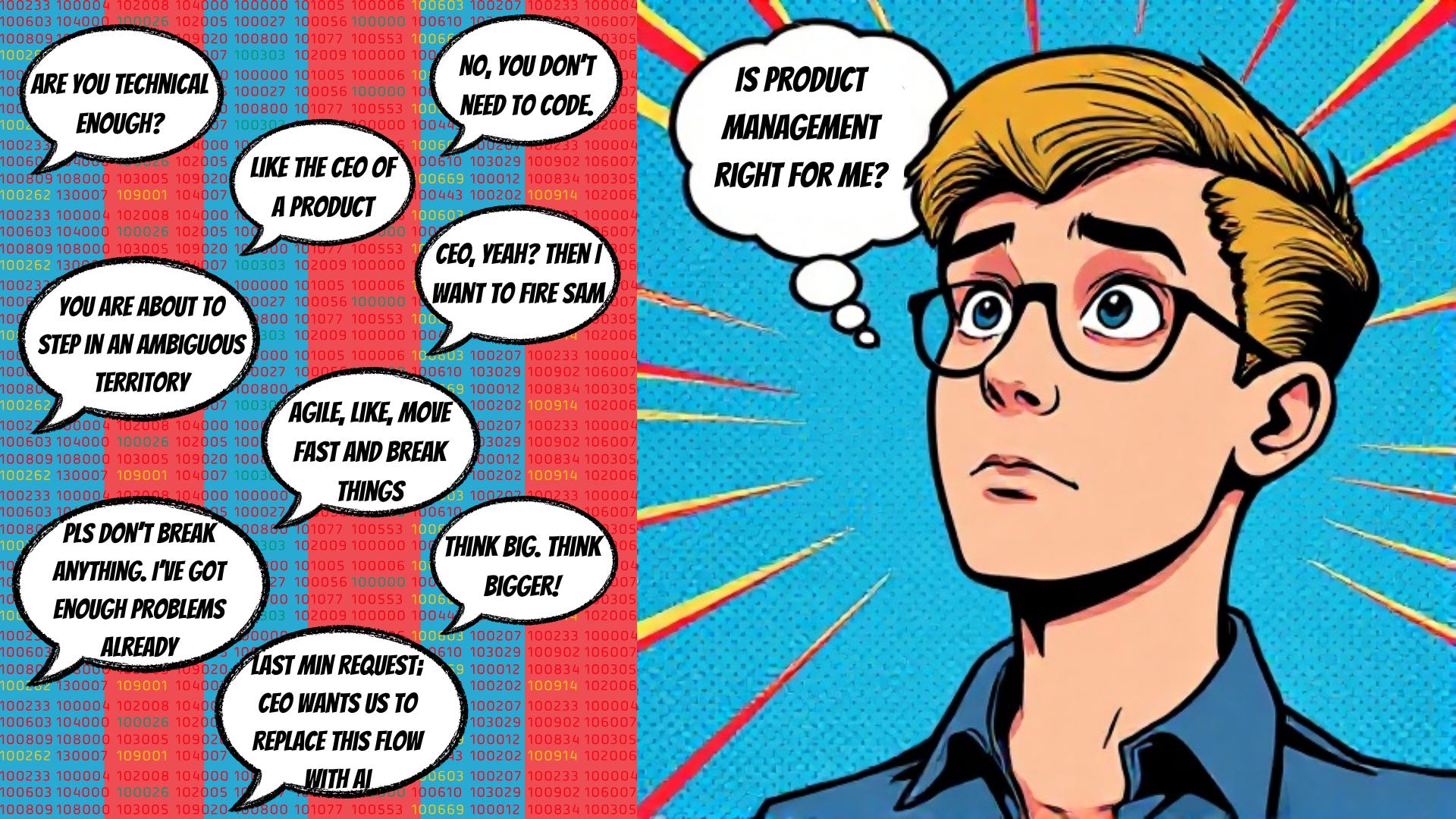
Let’s break this thought into 2 major and a few minor questions so you can answer with confidence.
What is Product Management?
If you know anything about product management or have worked alongside a product team, start by asking yourself what product management means to you. Let’s get any opinions, observations, expectations, prior beliefs and biases written down. Be honest with yourself. How do you imagine your life to be as a product person? Then, you can compare whether your expectations match the reality.
If you are clueless, that’s ok. Let’s get to the next stage — heavy research. This is a very important step which you should spend a lot of time on. No shortcuts are allowed.
Your research should uncover what product management is in theory and how it plays out in real life. It should lead you to understand the must-have and the nice-to-have skills of a product manager. What is the life of a PM? What are the common work routines, values, and complaints of PMs?
At the end of this research phase, you should be able to describe product management as a person with its distinct personality traits and lifestyle. I know that the role of a product manager differs according to the company. However, you should still be able to recognise the trends and patterns. You can also create 2-3 different PM personalities/archetypes to capture this variance.
How do you go about researching all of this? I highly recommend varying your resources to gain a holistic and objective view. Read books, online articles, LinkedIn posts written by product people, the job descriptions posted on LinkedIn ads, listen to podcasts, watch YouTube videos, and talk to other product people from different types of businesses (i.e. start-ups, scale-ups, big corporations, B2B, B2C, SAAS, e-commerce, and even different industries).
Marty Cagan’s book, ‘Inspired,’ is an all-time classic which would give you a great understanding of the theory behind product management. Lenny’s Podcast (and Lenny’s Newsletter), Ant Murphy’s Newsletter and Product Thinking Podcast (by Melissa Perri) are great to tune into.
Interviewing other product people is so much fun! It will definitely improve your interviewing skills and confidence. Product community is usually open to helpful communications (despite how busy they are) if you approach with curiosity and passion. They can even become your future advocates when you start to apply for product roles.
Find a group of people who have a similar background to you on LinkedIn (in my case, it was professionals who began their careers in marketing).
Send them a clear and concise message, stating your intentions of transitioning into product and asking for a 30-minute call to grab their advice.
Some PMs will respond. Some won’t. Schedule many calls. You are not only trying to find out what the role of a PM is (with its pros and cons), but also how this role differs in different businesses.
Prep a list of questions. While good preparation is necessary to unlock necessary insights, when you allow the conversation to flow naturally, there is a lot of surprising information you can uncover. So remember to be flexible during your call.
Take many notes during your conversations, or ask to record the session.
Sometimes, I see young people reading online articles about how product management is a booming, cool techy role where you get to build unicorn products with fancy taglines like blockchain, DeFi, GenAI, on fancy platforms, without knowing how to code. Woohoo! Don’t miss out! If a role is marketed to you as ‘too good to be true,’ then you know what that means.
The reality is that smaller companies don’t have the budgets to work on mind-blowing technology (most of the time), and larger organisations drown you in their political games and slooooowwwww speed (most of the time).
Sometimes, I see ‘wanna be entrepreneurs but can’t take a risk with their financial situations’ (fair, economy is tough), who hope that in a product role (and in the industry they are interested in), they’ll have the freedom to build their dreams and control the business flow. They just end up causing chaos and drama in the teams they join (until they get forced out of their role).
Sometimes, people who didn’t find success as a software developer but still wanted to feel like a developer think that moving into product is the answer. They assume that being technical is enough, that they can make plans independently, and that the skill of effective communication is for the project managers and marketers in the team. Not sure what to say — they’re in for a shock.
Sometimes, people just want to be a project coordinator with an impressive and ‘intelligent’ title, so they think that product management is the solution. Unfortunately (and sadly), people like that can find roles in large organisations with bad product culture and disappear within the crowd.
Talking with other PMs really grounds you in the ‘ugly’ reality.
Heads up: half of the PMs I met in my career would not recommend anyone to become a PM (high burnout rates, etc), unless they have strong personal reasons (a passionate fire in their hearts) to pursue this career.
Most PMs I met would also say that they absolutely love their roles. So do I. Transitioning to product management has been the best career decision of my life so far. If you can still find the beauty in this role and empathise with the passion of being a product person, then this role is right for you.
Is it right for me?
Once your ‘product discovery’ (deep research) is over, identify some key themes to question and challenge yourself. This exercise requires self-awareness and self-reflection skills.
Here are some questions that I asked myself during the early stages of my product journey. Think deeply and critically.
Personality Questions
I don’t want to label anything as a ‘must-have’, but this section is quite important. If you find most of these points relatable, it's a good sign.
Do you like chasing after challenges? Do you enjoy solving complex problems? Are you persistent with your goals and won’t give up until you try every possible way?
Do you get excited about the unknowns? Can you approach ambiguity with optimism and motivation? When there are factors out of your control, how uncomfortable do you feel, and how much does it impact your focus at work?
While working for larger organisations will provide more certainty and predictability to your day-to-day, the product role revolves around testing assumptions (not defending and forcing your ideas and opinions out).
Expect a high number of dependencies, unknowns, floating ideas, uncovering new insights every day/week (depending on how fast your company moves), and changing direction to a new solution when your heart was sold on delivering something else.
Do you have the courage to strongly express your ideas/vision and lead? Do you have inner confidence without an external reason or backing? Even when you know that there is a high chance of being proven wrong and blamed for it? Even when you know that you are not the expert in this area for making that decision? Even when you know that everyone else in the room is actually more technical, more experienced, maybe even more intelligent than you? Even when you know that all of these people may challenge your view on the spot?
A Head of Tech I once worked with mentioned that one of the worst qualities a PM can have is uncertainty and insecurity — when they can’t commit to something (make a decision) and keep apologising after each person who asks a question or challenges their views. He described it as “a scared leader spreading confusion.”
It’s ok to make mistakes. There is no mistake that’s worse than disabling your ability to make a mistake. When there is a flow of movement, you can iterate and reverse directions. When you are static, you fade away, and the product will die with you.
Do you have the curiosity and humility to be proven wrong again and again? Do you have the courage to admit when you are wrong?
PMs like to say, “focus on the problem, not the solutions” because even the “best solutions” could easily be proven wrong when put out to the market for testing.
I made a scientist analogy a few times in my LinkedIn posts because the best PMs really know how to think like a scientist. When they have a solution or an assumption to test, instead of looking for reasons to prove themselves right (like a lawyer defending a court case), they search for reasons to prove themselves wrong. If there is nothing to be found, then they are more right than they are wrong.
Are you a lifelong learner? Do you enjoy the process of learning?
I love how almost everyone answers, ‘yes,’ to this question. It must feel good to know oneself as a ‘lifelong learner.’ But most people seem not to go out of their way to pick up new skills, hobbies, or information, and limit their ‘learning’ to what their roles (or performance plans) offer them (to get a pay rise). I believe being a ‘lifelong learner’ requires a bit more effort than that.
Enjoying the process of learning is an idea that the book, ‘The Inner Game of Tennis,’ by W. Timothy Gallwey explains really well. It has been a transformative book for me at the beginning of my product journey.
Do you have a drive to make an impact in this world? Do customers/users motivate you?
Maybe seeing positive feedback from a customer makes your day. Maybe knowing that you helped a friend overcome a challenge or start a new hobby lit a fire in your heart. Maybe you enjoy community work. My point is, maintaining a strong customer connection and empathy will help you succeed as a product person.
Do you enjoy driving progress and improvement?
Maybe you have personal goals to work on. Maybe when you subscribe to a new product, your mind immediately thinks of a way to uplift the experience. Maybe your house gets a renovation every X years. You want to see progress, iteration and innovation all around you.
Can you express opposing traits/skills or wear multiple hats?
Examples…switching between being analytical and creative. Or, being futuristic and focused on the big picture during a strategy session, then grounded and examining the details of a current project you need to deliver. Or, showing sensitivity to customer problems, but resolving issues with a rational business sense, considering financial impacts on teams. Or being extremely focused on a task, but then ready to switch directions quickly when necessary.
Skills Questions
You don’t have to be perfectly aligned in this section, but you need to want to make an alignment. Hence, these questions are phrased differently.
Are you interested in communicating clearly, with more impact and influence?
You may be the ‘ideas person’ of the team, but that doesn’t mean that the team will follow everything you say. The art of convincing (and negotiating) will come in handy to move through situations smoothly.
Are you interested in developing my conflict management skills (including providing negative feedback, setting boundaries and saying ‘no’)? Can you do that while feeling and showing empathy to others?
This is a BIG point and one that a lot of us find uncomfortable to practise.
If you work for a passionate team where people tend to wear multiple hats, you will hear a lot of good-intended feedback on the product vision. You’ll hear some ‘awesome’ product feature ideas that are rooted in personal biases, historical experiences, or from a conversation someone had with one customer. You might even hear out-of-touch ideas from the CEO (with immense passion) — shocking, I know! Some of these ideas/suggestions will make you laugh (don’t laugh, as it will be offensive), some of them will make you frustrated, and some of them will put you in a difficult spot.
If you work for a team with strictly defined and separate roles (also with a strong hierarchy), there may be an assumption for you to follow the direction of your leaders (even if they don’t talk to the customer or have the relevant product skills to make a judgment).
Either way, this role works under pressure with a lot of (opinionated) stakeholders, mostly demanding more revenue in a magically short amount of time. You will need to respond to them appropriately to gain credibility, trust, and support.
Remember that dropping the ego, feeling curious about alternative solutions, being flexible with plans, and talking with customers will be your skills as a product person (even though it will be nice for others to share similar qualities). Others may not be skilled in these and may be reactive to defend their ideas. We all want to be right as humans; being proven wrong makes us feel stupid. Successfully managing conflict will make you shine as a PM.
Are you interested in building your resilience, stress management and emotional regulation skills?
It’s an intense role with a lot of mistakes to be made along the way (and some frustrated and frustrating stakeholders), so buckle up and set up some box-breathing habits.
Are you interested in becoming more adaptable and agile with your plans?
When there is a bug, your perfectly structured plan of delivering something else may go into the trash (or at least, be put on hold). There is a reason why the topic of creating ‘roadmaps’ is highly debatable (it’s a fiery debate) in the world of product. To summarise, while a lot of roles view following a plan step-by-step as a measure of success, product people are often suspicious of highly detailed and perfected plans. Have you ever heard of the saying, “plans are useless, but planning is essential?” Hint hint.
Also consider if you are strictly a 9 am - 5 pm person, or a ‘jobs to be done’ (task by task) person. I am not advocating for ignoring work-life balance or glorifying burnout. There are some jobs where one will succeed with a strict day-to-day structure (and an hourly plan of what need to be achieved), and some jobs that needs to be taken week by week (or day by day).
I also have to admit, as an over-planner, this is an area that I found more challenging in my product role. There are certainly ways to overcome this challenge; it’s about where you put your focus and how you list your priorities.
Are you interested in becoming better at prioritising problems, goals and tasks?
I mentioned in one of my LinkedIn posts that product managers swim in an ocean of problems, and most of the time, they can only hold onto one problem at a time. It doesn’t end there. A problem could have a hundred different solutions. Lots of probabilities, possibilities and pathways that you can take every week. The magic word to navigate your day-to-day challenges will be ‘prioritisation.’
Are you interested in developing your creativity? Can you try to solve problems in unconventional and creative ways?
A common misconception about product managers is that they need to be very technical and analytical. Products need innovation to stand out — sometimes, radical change and disruption by solving problems in unconventional ways. Looking at life’s challenges from a creative lens will really help you to be successful as a PM.
Are you interested in working with data and becoming more analytical?
It may be easy to feel a lot of empathy for a customer and get caught up in solving their specific problem in a B2C product. But that customer may be an outlier of the wider trends and mass data. Strategically and purposefully using data to uncover insights will advantage you. On the other hand, manipulating data to prove your point will lead to losses.
Are you interested in understanding how technology works?
You don’t need to excel in coding, but you will need to have excellent communication with the people who code every day. Communication is a two-way street, but in this case, the unspoken rule is that it’s the PM’s job to enable good communication.
General Career Questions
What were your proudest moments at work? What were the moments that made you feel fulfilled, motivated and excited?
What skills were you utilising at those times? What made those moments special for you? Do these moments have similarities to product management? Will you be able to capture those special moments in a product role?
What does ‘play’ mean to you?
If it helps, think of your childhood. What sparks the innocent childish excitement in your heart? Can you find that in a product role?
You don’t have to answer, ‘yes 100%’ to everything. But by the end of this exercise, you should feel more confident in answering, “is product management right for me?”
If this post is helpful to you, it will probably help others too. Share with a colleague, and if you haven’t done so, subscribe.