

Interviewing for product manager roles is a unique experience with a lot of “role-playing” challenging scenarios.
You can’t prepare much for it, because the ultimate goal is to understand the way you think through challenges. This is unlike some interviews in tech, where the hiring manager expects you to tell a story (about how you were challenged in the past) with a happy ending involving impressive metrics.
Product interviews are mostly not about the past; they are about the present moment, where crafted and memorised scripts won’t get you through the door.
As product interviews aim to reveal your product mindset and how you communicate your thoughts/ideas, there usually isn’t a right solution (or response to questions). This is also contrary to other interviews in tech, where the hiring manager may expect specific answers to some of their questions, and getting them right proves your skills and experience in the field.
Let’s assume that you passed through the initial door; let’s skip ahead to your interview with the hiring manager. Expect 3 different types of questions.
1) Standard “who are you” questions
These are the opening questions to any interview. The goal is to understand your background, experience, interests and skills at a high level.
Tell me about yourself
What draws you to XXX company (and why are you leaving your current company)
Short and sweet, easy with no tricks or surprises.
As someone transitioning into a product role, the only additional question that you will get is “why product management?” Every interview I joined to land my first role had this question. You can prep for it and see my “why do you want to be a product manager” article as a guide.
Additionally, you may also want to prepare for “why this industry?” Why do you want to work in the EdTech/HealthTech/crypto space?
2) “Tell me about a time…” questions (or, “how would you…?”)
A few of these questions will be thrown out to flesh out your experience and skills. I have observed that in product interviews, these questions address the riskiest assumptions (like in the product discovery process). In your case, the riskiest assumptions all relate to your lack of product management experience.
You can safely answer these questions with the famous STAR method (situation, task, action and result). The key is to shape your answers to be related to product management and use product terminology. Some examples…
“How would you ensure you are not a blocker to the tech team?”
“Tell me about a time you dealt with a conflict of ideas involving customers/users.”
“Tell me about a time you had to make a decision in ambiguity, without a lot of data backing.”
“How would you prioritise resources when you have two important things to do but can’t do them both?”
In case nobody told you yet (or dared to put it in writing), you don’t need to tell about a time that has actually happened to you with every detail being accurate. The more junior you are in your career, the fewer options you have in the job market (meaning, a higher chance that you’ll not end up in a flash company with a unicorn team), the fewer managers you’ll work under, and the less variety of experiences you have. You may have put up with a toxic manager who moved the goal post 5 times within a quarter, and nobody in your team delivered. You may have put up with an incompetent stakeholder, driven by their ego (instead of data) and expected you to nod along (instead of challenging back).
In real life, some things don’t have happy endings to fit into a STAR method for your future interviews. Make one up. Imagine the same ‘situation,’ ‘task’, and ‘action,’ but end your story with a more positive result.
“How would you…” questions are a bit more challenging when you don’t have a lot of product experience. My tip is to not complicate things; think in basic terms.
For example, “how would you ensure you are not a blocker to the tech team” can also be rephrased as, “how would you ensure you are not a blocker to any team.” When I was in marketing, having strong alignment on priorities and regular cadences to communicate progress on projects ensured I didn’t have dependencies built up on my plate. Guess what? Alignment on priorities and communication also helps the tech team. You don’t need to ponder over the words “tech team” too much.
3) Product role-play questions (or “technical” questions)
This is honestly the best part of the interview. In my opinion, these questions make product interviews fun, interesting and challenging. However, this is also the part where most new PMs feel shocked (unprepared).
In this section, you are expected to role-play as a product manager; so, the best responses will come from…
Clarity of thought (connect with Shreyas Doshi on LinkedIn, as he has thought-provoking posts on this)
Clear, concise and engaging communication (which mostly comes from clarity of thought)
Product mindset
Some role-play questions are quite obvious, while others appear to be “fun and casual chat,” but the follow-up question will turn into a role-play. Some examples you may want to practise…
“How would you design a solution for someone trying to communicate with the new human settlement on Mars?”
“What would happen if Google were no longer able to see your location?”
“How many cars are there in Sydney?”
“What is your favourite product?” OR “What’s a product you use every day?” (Pause) “Why?” (Pause) “How would you make it 10x more profitable/engaging?”
“How would you explain what LLMs are to a 5/90 years old?”
“What’s a new skill/fact/information you recently learned? Can you teach me?” OR “What’s a recipe you love making? Can you teach me?”
“Our active user numbers are down. Senior stakeholders are concerned. We want you, as the new PM, to fix this. How would you go about it?”
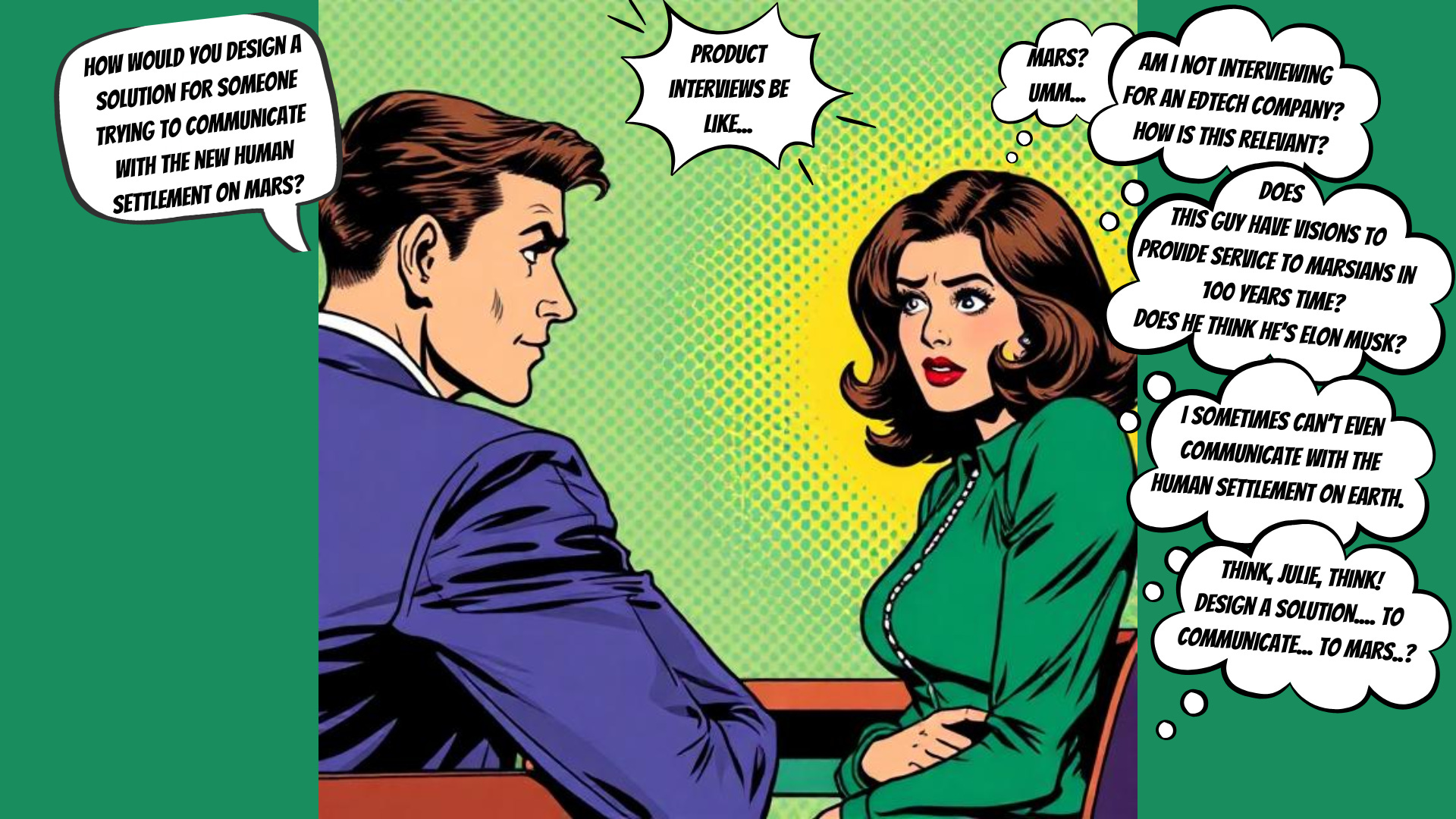
Common mistakes people make when responding to these questions:
Processing the question in very literal terms and overthinking the response
These questions don’t have any “correct” answers. No one is going to fact-check the number of cars or windows in New York, or the population of China. It doesn’t matter if “the new human settlement” is on the Moon, on Mars, or on Saturn’s rings. If you miss a step when describing how you bake a strawberry crumble, no one will care. Stop stressing over factual details.
You could be completely off the exact number and still respond impressively, by focusing on the product mindset. What truly matters is the way you think through these problems.
Only saying “I haven’t done this before” (and freezing) 😬
This links back to my first point — thinking through questions too literally. The chances are, you haven’t done most things in product (because you don’t have the experience), but you will receive questions as if you have these experiences. You can’t just shut the question down.
Someone once told me that hearing questions like “how do you ensure you are not a blocker to the tech team” is frustrating, because “it’s obvious that they haven’t spent much time working with the tech team, and the hiring manager already knows that they haven’t been a PM before. So why ask?” The hiring manager isn’t trying to rub your lack of experience in your face. They are trying to understand if you can be adaptable by using your current knowledge and skills. You may not have done that specific thing before, but maybe you have done a similar thing in your existing role, or watched someone else in your team do something similar. Rephrase the question in your mind as “how could you ensure…”
Tip: being a product manager involves knowing so much and so little at the same time. No matter how experienced you are, things always change around you. There will always be a new technology, team restructure, funding issue, goal, social change (which may impact your target customer), economic change (which may impact your sales), Covid (which took a hit to the tourism products), and another black swan event. As a PM, you will never know everything (actually, you will operate in ambiguous environments way more than you’d like to), so adaptability is a key quality.
Impulsivity — the urge to jump to a conclusion
Panic and pressure to impress can often result in impulsivity, a response without thought. Blurting out, “1,657,920” for the number of cars in Sydney shows nothing other than impulsivity. Don’t fall into the trap of thinking that if you can guess the right answer, you’ll be hired.
In product role-play questions, your answer will often lead to follow-up questions to further unpack and challenge your thinking. Your initial response should strategically set you up to be at an advantage in the following questions.
Tip 1: take your time when thinking and responding. Let go of the anxiety and self-imposed pressure to move through the interview questions fast. You are allowed to (and encouraged to) take a deep breath, reflect, feel curiosity (ask questions for clarification), then respond with confidence.
Tip 2: smile. 😁 It’s funny to see how people’s faces suddenly tense up when they receive a question they haven’t memorised the answer for.
Rambling on and on and on and and and actually, on and also, on and on……
See the point above. I think the root cause of rambling is a lack of calm and thought. People pleasing, panic, and insecurities give you the illusion that more is better. So, you start using the words “also,” “actually,” “and,” “by the way,” “this too,” to add more and more to your response.
Confusion is contagious. If you are trying to communicate while feeling confused and overwhelmed, your listeners will hear the meaning behind your words less and feel your energy more.
Tip 1: ground yourself. Before the interview, take 5-10 minutes to lower your heart beat and respiration rate, and feel in tune with your body. Create calm for your mind (and nervous system), whether by box breathing, a short meditation, hugging and rocking your body, counting sheep, humming, or another technique. We often start interviews on edge without even realising; it’s self-sabotaging. The worst is that the more we desire to work for a specific company, the more tense we feel.
Tip 2: view life as a game of tennis. Ok, you may want to read the book, “The Inner Game of Tennis” by W Timothy Gallwey first. While it’s got nothing to do with product management, it will shape your product mindset. This was a life-changing book which helped me grow up. Viewing life (or in this case, your interview) “as a game of tennis” will help you enjoy the interview, feel creative, courageous and curious. Enter the scene for the experience (to learn something, receive feedback, feel curious, connect with new people and assess if they are right for you). We often enter into the interview scene with the goal of proving ourselves (that we are good enough for the role) to the hiring manager. This leads to an overemphasis on avoiding mistakes, rather than enjoying the time and being mindful. The attitude and mindset you bring to the scene matter a lot, much more than the accuracy of your answers.
Update: I recently came across Lenny’s “definitive guide to mastering product sense questions” article, which highlights the importance of structuring your answers in an interview. Bookmarked for my future interview practice. Very valuable resource.
Trying to prove that they are intelligent enough to take on the role
This is why I don’t like describing these “role play” questions as “technical” or as “intelligence tests” — sounds intimidating. It leads people to show off their intelligence by over-engineering ideas (by complicating concepts), instead of focusing on clear and concise communication. Simple and engaging is better than word knots.
Also, let me make something crystal clear; you will not be role-playing a developer. Unless you are applying for an AI PM role (only in an AI advanced company, which is very rare to find and will most likely not accept applications from an aspiring PM) or a Technical PM role (which I don’t recommend you to apply as your first PM role, unless your background is in software development), you will not be expected to answer these questions in deeply technical ways. You are a product person expected to communicate with marketing, sales, customer support, design, and other non-technical people in the business. Be practical, not cool.
Pretending you know something technical (when you have no clue)
This links to the above point — trying to prove that you are intelligent enough to take on the role. You may feel that this advice conflicts with my second point (only saying “I haven’t done this before,” and freezing). Let me clarify; if something is not your area of expertise, don’t pretend like it is, while still answering the question gracefully with the best of your capabilities.
There is nothing wrong with saying, “while I haven’t used that tool before, I have achieved a similar outcome using…” There is nothing wrong with saying, “I haven’t heard of that acronym before, could you please clarify? (Pause) Oh, I see. In that case, I would be following an approach I’ve learned from my leader. I’d be…”
There are some things which you can play along — i.e. when you have a good understanding of the wider context. There are other things which you cannot pull off, and trying to play along without acknowledging your lack of expertise will not look good. Ego is a toxin in the product world. Not admitting you are wrong, not admitting you need to conduct further research before coming to a conclusion, or not admitting you need assistance can lead to large failures. You can be confident and humble at the same time.
You can’t possibly prepare for every odd question. So let’s go back to the basics and unpack how you can demonstrate a ‘product mindset.’
On The Product Manager podcast (8 Sept 23 episode), Natalia Baryshnikova was asked, “from a hiring perspective...what are some of the markers you see when you are evaluating someone’s background?”
Natalia answered, “when interviewing product managers, I usually think about the HACK methodology…
‘H’ stands for Humility*...
‘A’ stands for Analytical...
‘C’ stands for Creativity...
‘K’ stands for Knife* (“cut off the pieces that don’t belong” — prioritisation).”
*I would include ‘curiosity’ within ‘humility’ and ‘clear and concise communication’ within ‘knife.’
Side note: I highly recommend listening to the full podcast episode, “How One Street Artist Became Head of Product at Atlassian.” Natalia sounds like a very interesting and passionate product person.
One last tip: bring a pen and paper to your interview. You may want to drop down quick notes or numbers, draw a chart, etc. You may even want to show your notepad to the interviewer to provide further context when answering questions.
With that in mind, let’s workshop some responses to potential interview questions.
“How would you design a solution for someone trying to communicate with the new human settlement on Mars?”
Key qualities: creativity & analytical
Think about customer value, needs, behaviour — environmental factors — estimated technical challenges — estimated risks/safety — Mars speed of light 4-13 mins for message to reach
“What would happen if Google were no longer able to see your location?”
Key qualities: analytical & knife
Think about the top 3 impacts to businesses (+200 million) — top 3 impacts to customers (+1 billion/month) — estimated impacts to Google’s revenue, users and reputation — estimated impacts to Google (Maps) competitors
“How many cars are there in Sydney?”
Key qualities: analytical
Think about population — estimated no of license holders — estimated no of cars per license holder — estimated demand for cars based on age — estimated no of rental cars based on tourism
“What is your favourite product?” OR “What’s a product you use every day?” (Pause) “Why?” (Pause) “How would you make it 10x more profitable/engaging?”
Key qualities: creativity & knife (clear and engaging communication)
This question holds the opportunity to reveal your personality, passion, interests, values and observation skills (mindfulness) depending on your response.
Did you know that “Apple” is one of the top-performing answers by aspiring and new PMs? I found this out after interviewing for a prior role. The hiring manager took a deep sigh before asking me that question; he was clearly bored to death. I received immediate feedback after my answer; “thank you for not saying Apple — that’s brilliant.” Please, please, please don’t say Apple, Google, Instagram, Youtube, Facebook, ChatGPT, or another HUGE company that everyone else uses. It’s boring(!), ruins the opportunities I mentioned above (as you can’t differentiate yourself from everyone else), limits your creativity, and sets you up for a difficult follow-up question. How can you make a HUGE company 10x better? I also think it shows you lack observation (mindfulness) and appreciation for the technology behind products that aren’t flash multi-billion dollar in revenue. I get it; maybe we move through life really fast and hardly ever pause to see what is around us, observe how the products around us function and add value to our lives. But we can do better than that.
Try to pick a product with a few areas for improvement (i.e. common in small/young companies) that you feel excited about and know well enough (i.e. maybe you know a fun fact about it). Someone once asked me, “but what if the hiring manager doesn’t know about this product?” Then passionately sell that product to them first, so they are on board with what you are talking about, then explain how you would make it 10x better. I think most product leaders would appreciate learning something new (it could even inspire their thinking).
In my case, I responded with an EdTech company that had a very clever and customer-centric go-to-market strategy (involving product pricing and packaging). I was genuinely impressed by the way their product team thought through the launch and expressed my thoughts with the same passion.
Update: again, for this type of question, refer to Lenny’s “definitive guide to mastering product sense questions” article.

**Comment about the image: it’s always a struggle to create images with AI when the prompt is about a specific body part, especially hands/fingers (i.e. making hush sign, or whispering to another person’s ear). This image took me way too long to create, as every other option looked slightly disturbing.
“How would you explain what LLMs are to a 5/90 years old?”
Key qualities: knife (clear and engaging communication) & creativity
Think about using metaphors, imagery and humour — tailor your response to the audience (i.e. what can a 90-year-old relate to?). Simplify your answer.
“What’s a new skill/fact/information you recently learned? Can you teach me?” OR “What’s a recipe you love making? Can you teach me?”
Key qualities: knife (clear and engaging communication)
Please don’t actually try to explain something you learned recently (i.e. on the morning of the interview). Chances are, your brain is still trying to process the information, so you won’t be able to clearly articulate your response. Instead, talk about something you learned this year, feel passionate about and confident enough to go into detail. You may again like to use humour, imagery and metaphors — again, think of your audience.
“Our active user numbers are down. Senior stakeholders are concerned. We want you, as the new PM, to fix this. How would you go about it?”
Key qualities: humility (curiosity) & knife (detective)
Act as a detective to unpack the problem first — ask how the business currently defines active users, why active users matter, when and how the user numbers go down, etc. Once you have clarity on the problem, you can start to make assumptions and explain how you would test these assumptions. Remember, investigating the root cause of problems and going through the discovery stage are part of a PM’s job.

Lastly, “do you have any questions for us?”
Yes, you do! You also need to test your risky assumptions about the company — i.e. do they have a good product culture? There are so many questions you can ask! Some thought starters…
How do they define success? How is the product’s success measured (what are the key metrics)?
How do they prioritise ideas and make product decisions (i.e. how autonomous are teams)?
Are you going to be able to learn from them?
What is the attitude towards learning and growth (i.e. is the pathway very structured, or do they like to throw you into the deep end and you learn as you go)?
Why are they hiring you (i.e. is it just to give you Jira board management tasks)?
What type of PM (i.e. qualities, skills, traits) grows successful in this company?
How does the product team collaborate with other departments like engineering, marketing, and design (or do they work in silos)?
What is the biggest challenge the product team faces right now?
What is the process for gathering and incorporating customer feedback into the product roadmap?
What does a successful launch look like? How is it evaluated?
You may also want to ask specific questions about their product, vision, or future plans. Research about the company (very important)!
You may want to ask about funding and product-market fit if you are applying for a start-up. By the way, in most cases, I don’t recommend aspiring PMs to apply for startups under 15 people.
Try to see if the team has an ego problem (or insecurities). For example, does the hiring manager keep referring back to how one needs to be very intelligent to be a PM? Or is there a strong underlying belief that only developers can become PMs? Or are you hearing that the team “cannot afford to make any mistakes this year” because they are “working on really important stuff” (unlike other companies)? 🚩 🚩 🚩
Other examples to watch out for…
How the founder has very diligently built everything from scratch and is VERY particular about the roadmap and everything has already been determined by him for the next 5 years —> 🚩 Meaning the decisions come from 1 person at the top and may be detached from customer research.
How the product is so useful that anyone from 18 - 80 is the customer —> 🚩 So, is the team building for EVERYONE in this country? I have different needs from my grandfather, my neighbours, my colleague, so what’s going to happen when your customers want/need different things?
I once asked, “how does your team prioritise and make decisions about the product,” and received, “like everyone else, I mean, it’s pretty standard, like the other companies.” 🚩 I am very sure that not every company executes in the exact same way.
In another interview, I once asked, “how would you describe the product culture here,” and received, “umm…good? Like, we talk to each other when needed, we are nice people, if someone needs help, we try to help. I mean, we all have our own things to do, but I guess we can help.” 🚩 Didn’t sound like a reassuring answer coming from the hiring manager.
I have also been in an interview where I didn’t get a chance to ask questions. This was unusual because I generally like to keep interviews conversational and free-flowing (i.e. if I feel curious about something, I will ask for elaboration on the spot). I was told to wait until the end of the interview, then told that we only have time for one very quick question. 🚩
While I made a few judgements and brought the 🚩, at the end of the day, you are the real judge of whether the company is the right fit. Some questions you ask may also not have one right response. For example, you may prefer companies with very structured growth pathways (i.e. every junior PM does this task and to step up into a Sr PM role, every PM has to do this other task). I don’t mind structure, but prefer to work in flexible environments with strong experimental culture and be thrown in the deep end to learn along the way. I find that too much structure limits spontaneous learning opportunities, unique growth and creativity. You probably have some personal preferences that match your personality too.
The reality is that you will most likely end up in a team with a few orange flags because aspiring PMs don’t have many options. The hot scale-ups famous for their product culture generally hire the hot PMs famous for their prior product success. You decide what you can tolerate.
These questions are also there to prepare you for the situation you may be entering into (set realistic expectations in your mind). It’s totally ok to take on a role for 12 months, learn some new skills as a PM, then move on to your next adventure once you have a bit more experience.
Additional Tips & Info
Let the conversation flow naturally. You are both there to understand if this is the right fit. So many times, people feel nervous because they hyped up a company in their heads; that’s like falling in love with your own imagination. Test them back; maybe the reality is different.
Landing your first product role may take between 6-12 months, depending on the market conditions. You are in for a marathon, not a sprint. Don’t beat yourself up and feel like a failure if you haven’t found your role in 3 months.
Practice makes perfect! Practise with your product friend/mentor and collect their feedback. Practise in front of a mirror. Practise with AI. Seriously, NotebookLM is a very cool product (can be very effective for learning new skills and preparing for interviews). Tina Huang made a great tutorial on how to use NotebookLM a while ago, so check it out if you’re curious.
Don’t forget to ask about the next steps in the hiring process!
All the images I use have been generated using deepai.org (the pop art generator). 🦸♀️
If this post is helpful to you, it will probably help others too. Share with a colleague, and if you haven’t done so, subscribe.