

If one were to analyse ‘pathway to X career,’ they would quickly realise that product management is quite a unique profession.
Every product group I’ve ever entered has a large variety of backgrounds — ex-marketer, software engineer, UX designer, science professor, entrepreneur, architect, finance analyst, YouTube influencer, etc. At this stage, you can’t surprise me.
I reject the general commentary of “become a BA, then a senior BA, then a PM.” Some hiring managers would classify you as a “safer” hire if you have this background, as BAs work closely with PMs. I have a few counterarguments to this way of thinking (but that’s for another post).
Side note: the BA to PM pathway may make internal transitions a little bit easier, in comparison to someone with a different background. But, based on my experiences helping people land their first product role, in the external market, BAs don’t get an easy pass into the product game.
My point: transitioning to a product role from a different background is not a unique experience.
The ones who have successfully made the transition were able to leverage their ‘superpowers’ to create their ‘product’ resumes and smash their product interviews. Later on, those who saw their background as their unique advantage were able to learn product skills and grow rapidly throughout their careers.
Yet, one of the top conversation topics I have with aspiring PMs is about how “there are no commonalities, nothing to leverage.” Let’s unpack this, shall we?
Firstly, let’s get something out of the way. You’ll find it easier to write about your skill gaps than about your transferable skills. That’s because the chances are that there is a lot you don’t know about when it comes to product management. That’s expected! But that doesn’t mean you should focus on what you lack. You will be able to close the gaps once you land your first role.
What should you do with your skill gaps?
Be aware of what you need to upskill on. Awareness and acceptance are the key words, not worry and reduced self-confidence.
Use a source that will give you a crash course on any area you don’t know of — AI, Google, Youtube, etc — shouldn’t take longer than 15 minutes on each topic. That will help you to gain a high-level understanding of the product lifecycle and some technical terminologies, so you can maintain a conversation with other PMs.
Note down the areas you need to gain a deeper understanding of, so you can use them to build a career development plan once you land your first role.
Let’s drill down on your existing strengths
Transferrable Skills
Have you ever seen this triangle before?
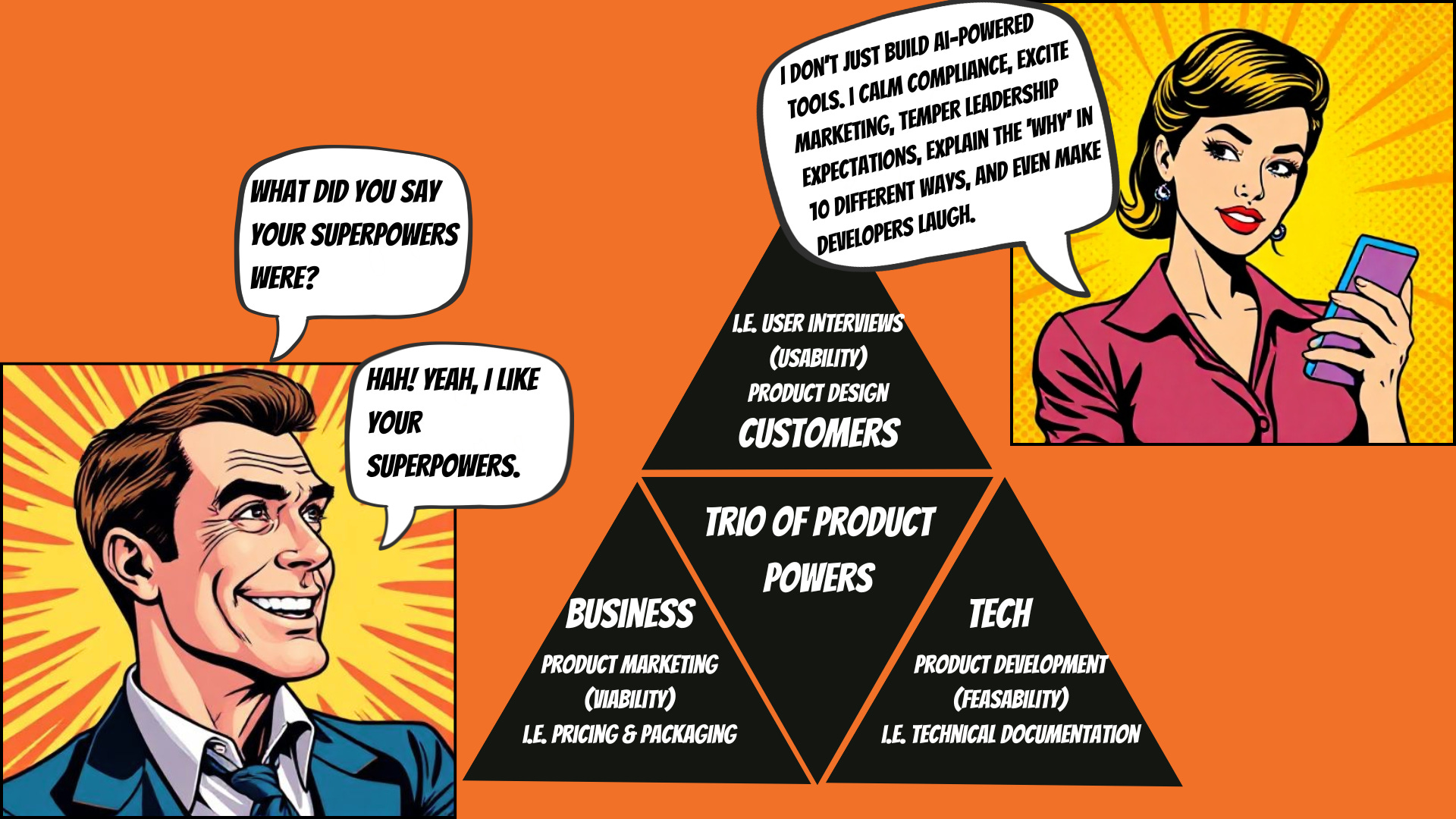
It’s a visual demonstration of a product management skills theory, where there is a connection between tech (goal: feasibility), business (goal: viability), and customers (goal: usability). Your background will generally help you to feel strong at one of these corners, moderately capable at another corner, and lack confidence in the last corner.
A classic example is a software engineer being a “natural” at product development, or a UX designer nailing down the product design part of the ‘trio of product skills.’
When you break down each corner of this triangle to specific skills, you may realise that there are plenty of valuable transferable skills you already have. Go, you!
As a product marketer who has moved into product, I also deconstructed this triangle and noted down the skills I brought from my background.
Project management
Market research & competitive analysis
Product engagement strategy
Data-driven decision making
Product pricing & packaging
In-product copywriting
Experimentation & A/B testing
Someone from a technical background might have QA testing and technical documentation experience, analytical and systems thinking, and architecture knowledge.
Side note: if you have a startup background like me (or were a founder before), you may have worn multiple hats and had a go at mocking up bad Figma designs, conducting user interviews, QA testing, accounting, fixing HTML for email marketing and some other random things. These may not have seemed like useful skills at the time, but are now great experiences to have as a PM!
I have also had the chance to work with individuals who came from unconventional backgrounds (not from tech companies). Note: examples below are specific to the individuals and may not relate to everyone who comes from the same field.
Scientist from a lab: curiosity, experimentation, analytical, humility, and the mindset that one must look for evidence to prove their assumptions wrong (instead of cherry-picking the evidence or manipulating data to suit their narrative)
YouTuber: creativity, clear & concise communication skills, storytelling, influencing, and customer empathy & tailoring a service to the needs of customers
Fashion: precise & detail-oriented, stakeholder management, project management, and strongly aligning with the product vision & brand
Personality Traits & ‘Product Ways of Thinking’
Transitioning into a product role taught me that demonstrating product ways of thinking was more important than specific skills.
Firstly, a lot of hard skills can be taught on the job. Soft skills are much harder to teach. In product, bringing on the wrong culture can be quite destructive, as there are only a few product people with a relatively large influence on other teams (and sometimes we wish this influence were even larger), and what’s shipped to the market directly goes into the customer’s hands. Hiring for the right attitude and personality will lower a lot of risk for your manager.
Secondly, a lot of ‘product skills’ stem from the ‘product ways of thinking.’ Having the right mindset in product is like having very strong foundations. It’s not about ‘what’ you do (i.e. can you run an experiment, or a user interview), but about ‘why’ you choose to do that thing, and ‘how’ you choose to do that thing. Because unfortunately (and fortunately), unlike the theory in textbooks, the product lifecycle is not a linear checklist to follow.
Somebody once told me that all product managers were product leaders. They lead by influence, by being an example, by their innovative ideas, or passionate energies; they lead by having the right mindset, not by a hierarchical power over others.
Personality traits are also valuable because the soft skills that relate to them are more unique (to you), so you can leverage them as superpowers. Let’s explore some examples.
Maybe, you are…
The mad hatter who solves problems in creative and unconventional ways, with successful results, of course.
A tornado of ideas, lighting passionate fires in every corner of the organisation, sparking collaboration for innovation. (Not to brag, but a data engineer I worked with once described me that way, and afterwards, I bounced around as a bubbly bunny).
A sculptor with a knife — very precise and particular with their decision-making, detail-oriented, with excellent prioritisation skills.
The connector of the dots. You can always answer the ‘why’. You can link every decision to a wider rationale that supports the future strategy (product vision) and impacts on customers and business.
The storyteller. The one that influences and inspires others (to become the product’s fans) with the stories they share about the products they build.
The ‘mission impossible’ man/woman. The one who will show an immense amount of stamina, determination and resilience to get the job done. They will challenge and push others to reach further. They will remove or jump over obstacles in their way to achieve outcomes.
There are various ways to think about ‘superpowers.’
Hilary Gridley (Head of Product at Whoop) describes a superpower as “your native way of engaging with the world to create some change… Maybe you turn ambiguity into clarity, or stagnation into energy, or conflict into trust, or isolation into connection.”
This can be summarised with an X —> Y frame: “what’s the ‘before’ state you thrive in, and what’s the ‘after’ state you consistently produce?”
She even built a GPT to help you figure out and connect with your superpowers. 🔥🔥Check it out; Hilary’s Superpower Finder asks some clever questions that’s worth reflecting over.
Natalia Baryshnikova (Head of Product at Atlassian) said on the Product Manager Podcast, “when interviewing product managers, I usually think about the HACK methodology.”
‘H' stands for Humility... (involves curiosity)
'A' stands for Analytical...
‘C' stands for Creativity...
'K' stands for Knife (“cut off the pieces that don’t belong” — a.k.a. prioritisation).
Some other qualities hiring managers are generally after: agility, adaptability, storytelling (or clear & concise communication), futuristic thinking, resilience, customer empathy, courage (to face challenges, try something new, or to say ‘no’), etc.
Side note: the presence of AI in tech companies is challenging all of us, even experienced PMs, to land a role. The traditional ‘hard skills’ or even ‘areas of expertise’ are no longer seen as special traits, because AI can technically learn anything that is constructed by a set of rules.
However, AI does not have a human way of perceiving situations and solving problems (i.e. considering contextual information, feeling the implied meanings during communication, personalities of teammates, trying to find the path of least conflict in an organisation, etc). Being 'human' with our distinct personality traits, backgrounds, ways of 'connecting the dots', and soft skills will continue to separate us from AI (at least in the near future).
As Gridley points out, “people will increasingly be sought out for the unique way they turn problems into results” (a.k.a. their superpowers).
When I realised how much I could draw on my experience and ‘natural’ talents in my product journey, a few things changed.
I felt much more confident in my capabilities
I was able to communicate a stronger pitch when talking with hiring managers
I was able to use curiosity to develop my weaker areas (rather than fear, or acting defensively to cover up the gaps)
If this post is helpful to you, it will probably help others too. Share with a colleague, and if you haven’t done so, subscribe.