

How come every product role requires you to have “a minimum of 2-3 years of product manager experience,” even for “junior” PM roles? Let’s be real; some actually want 4-5 years of experience, and the “intern” roles are only after 1 year of experience.
Real people starting their careers or wanting to transition into a product role who face these unrealistic expectations feel real confusion. They may have a cheeky inner thought to respond to such a demand in the job market with, “in my past life, I launched 0-to-1 products, scaled, delivered, iterated and sparkled over a decade.”
Ok, I’ll stop joking around. I’m confident that you can reflect your “product experience” even without a “product manager title” by the end of this article. And the trick isn’t about having a past life.
If you’ve been following my “land your first product role” series, this article will stitch up some of the ideas previously mentioned.
Step 1: Put on your Product Manager hat (or mask) 🎩 🎭
Referencing the “art of blending into the product culture” article, you need a strong understanding of the product language (terminology) AND the product mindset (values and ways of executing).
Using the right terminology in the appropriate context will help build trust.
Keeping product values in mind will help select the most suitable experiences when drafting your resume.
Knowing the product ways of executing will help describe those experiences with relevance.
Three of them combined on a resume is like talking with someone who sounds like they know what they are talking about — credibility.
Note: someone once asked me if there was a “product dictionary” hey could use to draft their resume (i.e. desirability, POC, backlog, agile, prototyping…). I’m sure there is one somewhere on the web. But if you only use the right terminologies without engaging the product mindset, then warning, the result looks a bit funny. Kind of like an inauthentic collage, or puzzle pieces that clearly don’t belong with the rest of the picture.
Step 2: Highlight specific experiences across different roles/companies where you applied the product mindset
Go through your existing resume. Editing what you already have can be an easier start.
Find where your role has intersected with the role of a product manager.
Maybe you assisted with user interviews (as a designer), took a part in the sprint planning sessions (as a BA), brainstormed solutions to user problems (as a customer support rep), conducted market analysis to help with product discovery, or were one of the decision makers in launching the product pricing tiers (as a marketer).
Find which situations did you had to think like a product manager.
Maybe you had to put an experimental mindset and run tests to validate an idea (i.e. as a marketer, A/B testing concepts on social media or emails). Maybe you made customer-centric decisions in your area of expertise. Maybe you were data-driven and adopted a long-term product value focus while planning for the next quarter in your role.
Other questions to get you thinking…
When learning about the role of a product manager, what resonated with you? Did you ever think, “Oh, product people do this too? This is the best part of my role!”?
What were the aspects of product management which really aligned with your personality and natural talents/strengths?
Note: refer back to my “how to leverage your superpowers when transitioning into a product role” article for additional inspiration.
Whichever points on your existing resume that you highlighted as relevant to a product role, edit the wording. The chances are, you wrote that resume using your current role’s lexicon and emphasised what your current role valued.
Think about how a product manager would describe this experience. What part of this experience would they want to focus on? Which words would they choose to use? Which KPIs would they mention to showcase your impact? Remember…
It’s not about making a release but showing that the solution solves a problem or provides value to the customer, business, stakeholders.
It’s not about running a test but what you learned from it and how you used those findings to iterate on a solution.
It’s not about attending backlog grooming sessions but understanding how product managers and tech leads ruthlessly prioritise tasks and find a balance between short-term and long-term gains.
As for the remaining points of experience in your resume (the non-product relevant ones)…carefully analyse their purpose. Depending on how many relevant product experiences you were able to identify, remove most of the irrelevant points that belong to your current role. You can keep a few points that reflect your proudest moments, but you want to ensure that majority of your product resume showcases your product self.
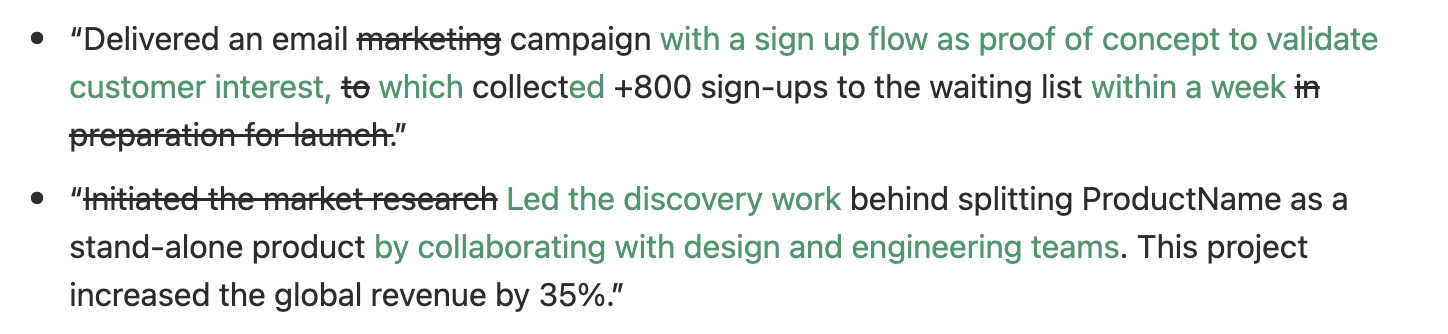
Examples from my prior resume drafts:
Note that I have a background in product marketing.
Step 3: Reflect back and note other experiences in which you used the product mindset
‘Exposure’ and ‘experience’ — once again, I’d like to draw your attention to my “how to gain experience in product without having experience in product” article.
“Other experiences” can include personal projects, entrepreneurship (even if the idea did not receive funding), or volunteering your time to assist the product team in your company (or in another company). If you don’t have any exposure to product management, then you are one step ahead of yourself by drafting a resume.
Add those pieces of experiences in your resume, where you think is the most appropriate. Most of the time, you will write additional points under your current and prior roles. But some people have a ‘personal projects’ section of their resume, which is also a very good idea.
Examples:
These are from my prior resume drafts, all volunteer work to other product teams.
“Coordinated a CMS migration from WordPress to Prismic to uplift website capabilities.”
“Conducted customer interviews and usability testing to uplift the in-app copy and designs for the ProductName flow. This reduced the weekly support enquiries about the onboarding flow by 25%.”
Step 4: Attach relevant links and additional supporting information
Is there anything else about product management that can go in your resume?
Did you attend a product management course or workshop?
Do you have any attachments or links that you can provide? This can be an opportunity to showcase your experience visually via a demo, code, mock-up, customer journey designs, or POC in another format. If you have a structured product portfolio (I didn’t), attach it to your resume — even better.
Step 5: Let your product personality shine through the details on your resume
Resumes are one way of revealing who you are as a product person. The person reading it will give their initial judgement/assessment on whether you could be the right fit for their team.
I’ve seen hiring managers pay attention to…
The types of companies one has worked for (i.e. startup vs big corp),
How long one has remained in each company they worked for,
How the applicant described themselves in their blurb,
Whether they appeared to be too young (which could be interpreted as, too junior) or too senior (which could be interpreted as too old),
If they got the ‘dynamic, go getter’ vibes, or the ‘experimental, risk-taker’ vibes, or the ‘detail-oriented, precise’ vibes, etc,
And other things not listed above.
We are human; our intuitions play an important role in our decision-making. It’s the little details that make us stand out and reveal glimpses of who we are (the ‘vibes’).
So, show them who you are.
I won’t get into the details of how your resume should be designed — if it should have a blurb, cover letter, profile picture, or any of the other components. I have strong opinions on this topic which works very well for me, but also contradicts what is generally recommended.
One suggestion: use this as an opportunity to share who you are, rather than send a paper identical to the 327 other papers the hiring manager receives. You don’t need to be Picasso and reinvent the wheel. Just don’t bore the person picking up your resume because they may never even bother reading it.
You may like to use Novorésumé; this is my go-to platform to browse for resume templates and inspiration.
Some questions you may like to ask yourself to be more intentional (there are no right answers)…
What are your top 3 qualities which should stand out in your resume? What vibes do you want to reflect? How would you like the person reading your resume to describe you?
How will you achieve that? (i.e. visually, via the design of the resume, written form in the blurb, by bolding some of the words)
Based on that, you can decide…
If you want to display your personal projects (relevant to the role) on your resume.
If so, how visible would you want that component to be (or, how important is this to you)?
If you want to highlight your technical skills and education in separate components.
How visible would you want that component to be (or, how important is this to you)?
If you want to showcase a short summary/blurb about yourself at the top of your resume.
What advantage would that give you?
If you want to share that you speak other languages?
What advantage would that give you?
Additional Notes:
If you are lacking experience overall (i.e. fresh out of uni or with less than 3 years of work experience overall), your resume may look a bit empty. I’ve been there. The general recommendation is to list your achievements in uni — volunteering time, tutoring, if you were the uni captain (some leadership role), if you got high distinction marks, etc. There is nothing wrong with this approach, but I was never a fan of it. Something that worked for me was having a small section at the bottom of my resume where I either added my interests or two fun facts about me. This section became a conversation topic in a lot of the interviews I attended, sparked curiosity and acted as an ice breaker.
While there isn’t one right way of writing a resume, please don’t write a biography. Nobody has the time to read a 5-page long resume. It won’t make you more credible. I promise.
Use your resume draft as a template; be flexible with it. It needs to be adaptable and customisable to the specific role you are applying for.
Don’t forget about your LinkedIn presence. Having an up-to-date profile really matters.
Ask for feedback on your resume from a variety of people, ideally from product backgrounds. Take what resonates and leave the rest behind.
After you re-craft your resume with a product spin/touch, will you finally pass the first hurdle and be selected for a recruiter screening call?
Not necessarily. The recruiter’s job is to reduce hiring risk by selecting the most qualified candidate for the provided salary range. It’s not to give you a shot, empathise with your ambitions, or see your inner potential. So, I want to be honest with you; don’t be disappointed if you see rejection emails.
That being said, applying with a product resume without a product manager title is very impressive. It shows how much thought you have put into adapting your resume, your proactive learning ability, creativity, and, honestly, makes you much more hireable. This is the best shot you’ve got. While you don’t catch every fish in the ocean with a short fishing rod, you will eventually catch one and grow your rod. Best of luck! 🐟🐟🐟
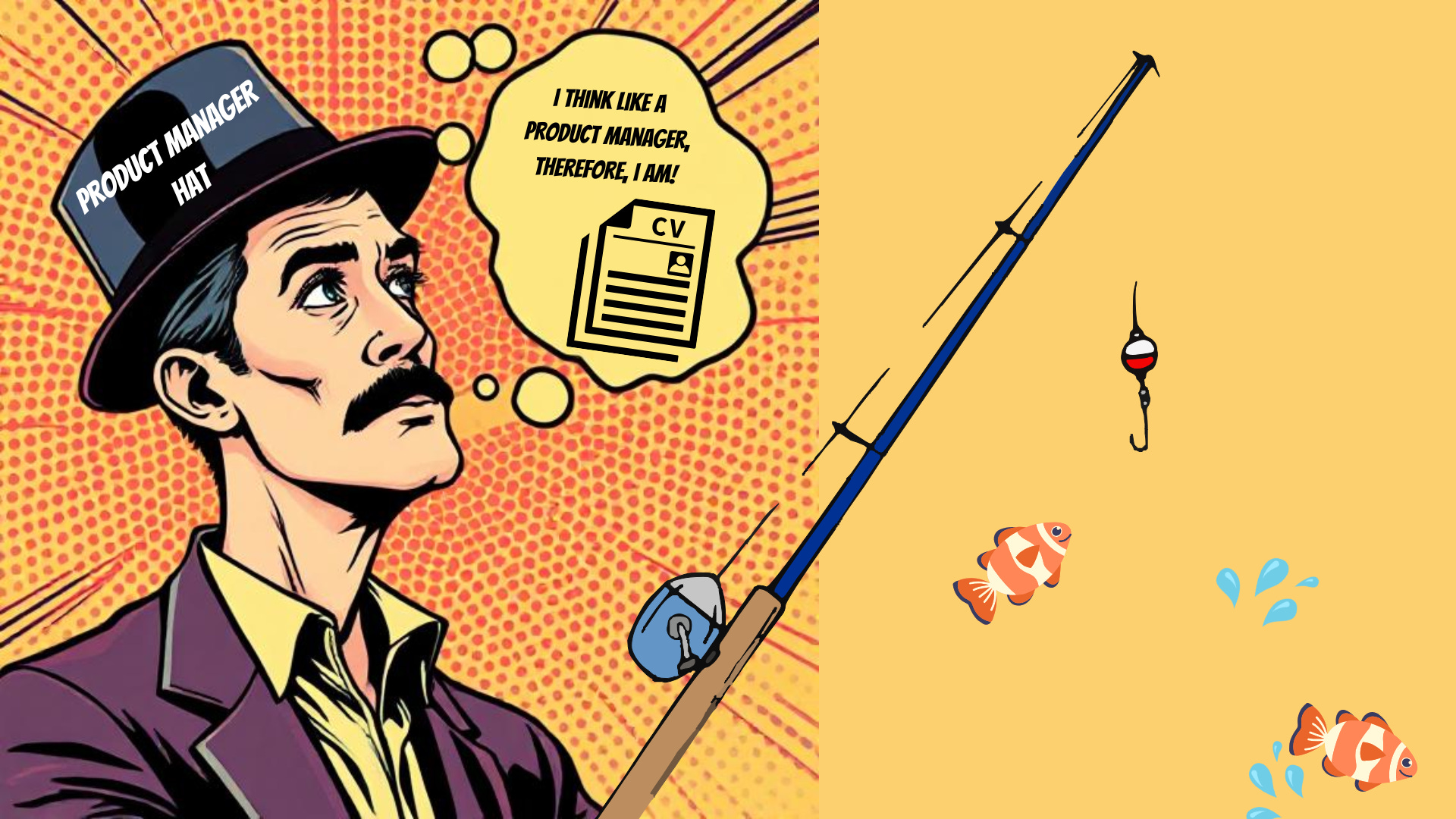
All the images I use have been generated using deepai.org (the pop art generator). 🦸♀️
If this post is helpful to you, it will probably help others too. Share with a colleague, and if you haven’t done so, subscribe.