
How to Build Your HRV Protocol
Genetics out of the picture, this guide focuses on diagnosis & personalised protocols

How come some people can turn on a “magic switch” and double their average HRVs within a few months, while others take decades to move the needle?
This was the mystery I’ve been chasing for the last 10 months. On the 1st of August 2025, I set an incredibly ambitious North Star: I was to explore every way possible to quadruple my HRV, as a proxy for improving the health of my nervous system. No timeframe was set. This was a lifetime journey.
At the end of last year, I provided an “Update on my Mission Impossible“; I was able to move my average HRV from 24 to 44, and my highest ever recorded was 54. Since then, despite a surgery and constant travelling, my highest ever recorded HRV increased to 56.
Yet, I still hear from many (including some scientists!) that HRV is all about genetics and we don’t have much control over it. These claims always rise after one has given a few months of trying someone else’s protocol.
This article is about why improving one’s HRV is a complex and difficult goal for many, and how you can build a personalised protocol that works for you. I promise, it will work for you.
One pre-requisite for this exercise: you must put on your mystery hunting, Detective Sherlock hat.
I highly recommend reading What is HRV and Why Having a High HRV is Important, if you don’t know much about this topic.
What is a “Low HRV”? What is a “Healthy High HRV”?
We don’t know.
We do know. But health measures (like blood tests) are based on two things:
Are you in a critical health condition?
Are you in the average of the population (assuming majority of the population is healthy)?
If the 1st is a ‘no’ and the 2nd is a ‘yes’, doctors and most HealthTech companies will send you off as ‘healthy’. Hence, nobody has studied the “optimal” HRV ranges for individuals. That’s why, we don’t know what is a sign of poor health vs optimal health in this topic (and frankly, in many other topics).
There are still ways for us to figure out what a healthy level of HRV looks like.
HRV fluctuates up and down, so it is best to observe it daily over a 2-week period.
Generally, the higher your HRV is, the better. So far, theoretically and practically, we have not discovered a point where one’s HRV is too high that it’s causing them problems. Feel free to aim high.
It is common for healthy and fit men with regular cardio trainings (i.e. soccer players, runners) in their early 20s to consistently hit between 130 - 170 HRV. Some hit even higher than that. 200 HRV is certainly not unheard of.
Men generally have higher HRV than women do. We could safely subtract 10 points and assume that young female athletes in good health can expect 120 - 160 HRV. These ranges cater for bad night sleeps, stressful days, pre-menstruation tiredness, etc.
Chronic HRV below 20 for both men and women can signal serious health problems in most people. This could range from bad flus that drag, infections, post-surgery recovery, sports accidents (i.e. bad sprains, broken bones), serious psychological trauma, cardiovascular health issues (i.e. stroke risk), heavy alcohol consumption issues, overtraining syndrome, insomnia, and high blood pressure.
Younger people generally always have higher HRVs, and HRV drops with age.
See the approx. HRV chart by age group below. Again, averages or the “norm” don’t mean the optimal for health.
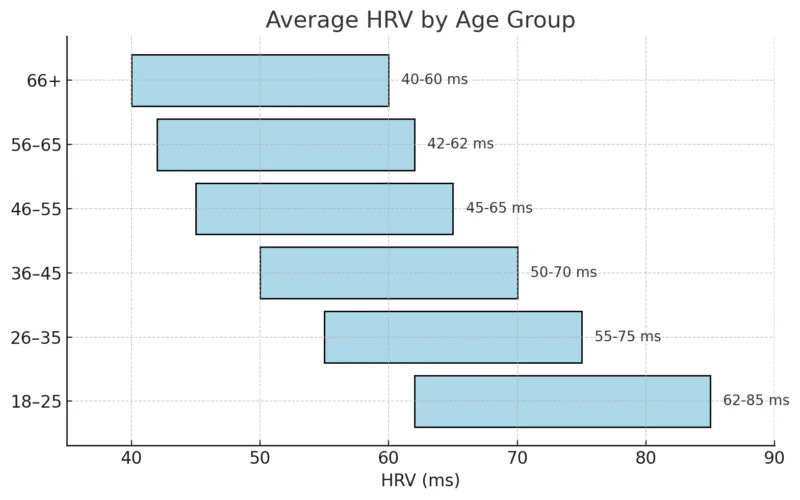
Based on this information, it is your call whether or not to improve your HRV. Everyone’s “good enough” is different when it comes to health.
The Diagnosis
It’s wild that most of us are stuck at the first step of improving our HRVs: the diagnosis. Actually, most of us never even think about diagnosing what is going wrong with our bodies, to cause an unusually low HRV.
Last year, in one of the longevity events I’ve attended, a neuroscientist tried to convince me to not bother much about improving my HRV, as this number seems to be related to nothing but genetics, from his personal experience. Yet, when I asked some follow-up questions, he failed at the most simple tests. Inconsistent bedtime, ~5 hours of sleep every night, eating ~2 hours before bed, and no daily habit of calming the nervous system (i.e. meditations, NSDR, visualisations, boxed breathing). To his defence, he has tried cold showers and 3x a week cardio.
Where did he go wrong? The diagnosis.
Upon chatting with him, I realised that he has never thought about the root cause for his average 30 HRV. From my perspective, it was his shitty sleep, which was something that he hasn’t thought of before.
First set of questions: Did you have an unhealthy upbringing as a child? Examples: abuse, neglect, domestic violence, grief, etc. Are you diagnosed with C-PTSD? Are you, or you might be, diagnosed with a psychological disorder? This includes chronic anxiety, depression, etc. Do you have drug addictions, including alcohol?
If the answer is ‘yes’ for any of these questions, you now know why your HRV is chronically low. There is 0 point in focusing on anything else but fixing these issues, as they cause the most amount of damage to the nervous system than anything else.
Your recovery protocol is going to look significantly different (and more challenging, complex) than others. I want to emphasise that following a psychologically healthy person’s HRV protocol could cause you more damage than good (high risk).
If the answer is ‘no’ for all of these questions, then the next questions cover basic health: Do you have insomnia? Do you have a cardiovascular health problem? Could you be diagnosed with the overtraining syndrome? Do you have high blood pressure? Do you have an autoimmune disorder, or cancer?
If the answer is ‘yes’ for any of these questions, you now know why your HRV is chronically low. There is 0 point in focusing on anything else but fixing or managing these issues. Your recovery protocol should look very different than others.
If the answer is ‘no’ for all of these questions, then let’s examine lifestyle factors. This includes chronic stress (i.e. going through a messy divorce, in severe financial difficulty, toxic work environment), bedtime routine & sleep schedule, diet, exercise (especially cardio), hydration, climate, habitual alcohol consumption, and daily busy-ness (i.e. never having time to wind down and take a break).
If you are exploring your lifestyle factors, then lucky you. This is the profile of people who can double their HRV within 3 months. Only if you are consistent and disciplined.
How to Test Each Exercise to Include in Your HRV Protocol
For a fair measure of progress, make sure you have a 1-month baseline of your HRV levels - what is your lowest and highest ever recorded, and what is your average HRV?
To accurately test the effectiveness of each exercise, try them one by one, between 2-4 weeks. What works for one person may not work for another, so testing is very important, rather than copying someone else’s protocol.
HRV recovery protocols range from beginner to advanced. Just like exercise progression, do not jump into advanced activities before completing beginner ones.
Treat your nervous system as a muscle. It needs slight stressors to challenge it to grow, but then enough time to recover and adapt. Progressive overload. Adaptation can take more than a month for the nervous system. The slow road is the safest and most effective road.
Remember that most women see a natural dip in their HRVs 1 week leading to their periods, then a natural increase straight after their periods.
Track: HRV levels, your mood, RHR, and sleep quality every day.
It is possible for some exercises to not have a measurable impact on your HRV, but lift your mood during the day. These may still be worthwhile to include in your protocol. That would be your call to make.
Severe Childhood Adversities, C-PTSD, Psychological Disorders, Addictions
Your HRV is chronically low, because your instincts and nervous system don’t feel safe. They are not convinced that the danger is over, yet.
This group of people have serious nervous system damage and it may take them decades to heal, depending on how much they are willing to invest in this journey. I’m so sorry for whatever has happened to you. But I have to be real about healing; it is not easy or a quick-fix.
Firstly, if you are in danger, or if you are a danger to yourself, seek help to remove yourself from danger ASAP. Your HRV is extremely low because it is reacting to a real threat.
If you are not in danger, it’s time to heal your psychological health. Seek professional help. There is no going around this. 99% of people do not heal themselves via daily affirmations. Some would like to think that they have healed themselves, when in fact they have only tuned down the screaming anxiety, and replaced it with anger or unhealthy coping mechanisms. This process is so much easier, if you have a group of support.
Consider rehabilitation (addiction recovery centres), eating disorder treatment centres, etc, if this is applicable to your condition.
Consider seeing a trauma-informed psychologist or a clinical psychologist for advanced therapies, like EMDR, DBR (Deep Brain Reorienting), hypnosis, or CBT. It’s now widely accepted that EMDR can improve HRV by ~10 points (Chen et al., Psychology, Health & Medicine, 2025).
Remove triggers and stressors from life, as much as possible. This includes going no-contact with perpetrators, even if it means parents.
Actively work on re-wiring traumatic memories and beliefs with healthy ones to build confidence and healthy behaviours.
Resolve recurring nightmares via trying different versions of IRT (Imagery Rehearsal Therapy). The one that has instantly worked for me was imagining and re-writing the nightmare with a very ridiculous and absurb ending (i.e. you realise that the scary witch who’s chasing you with a knife was actually enthusiastically running to cut a giant chocolate birthday cake). This is one of the most effective ways to instantly stop a specific recurring nightmare.
Once all of this is done, try NSDR (non-sleep deep-rest) or yoga nidra. It typically takes 10 - 30 minutes and requires you to lay down. It uses guided body scans and minimal breathwork to lower heart rate, reduce stress and restore focus. Feels like a nap without being a nap.
It is a proven exercise to improve HRV by ~10 points and improve sleep quality (Cureus, 2024; Journal of Alternative and Complementary Medicine, 2012). I found out about NSDR on a Huberman Podcast (listen to “30 Minutes of This Feels Like 8 Hours of Sleep” for more info).
Here is an example NSDR practice you can try at home. There are many audio tracks on YouTube, some with sound healing music playing softly at the background, some guided by a male or a female voice.
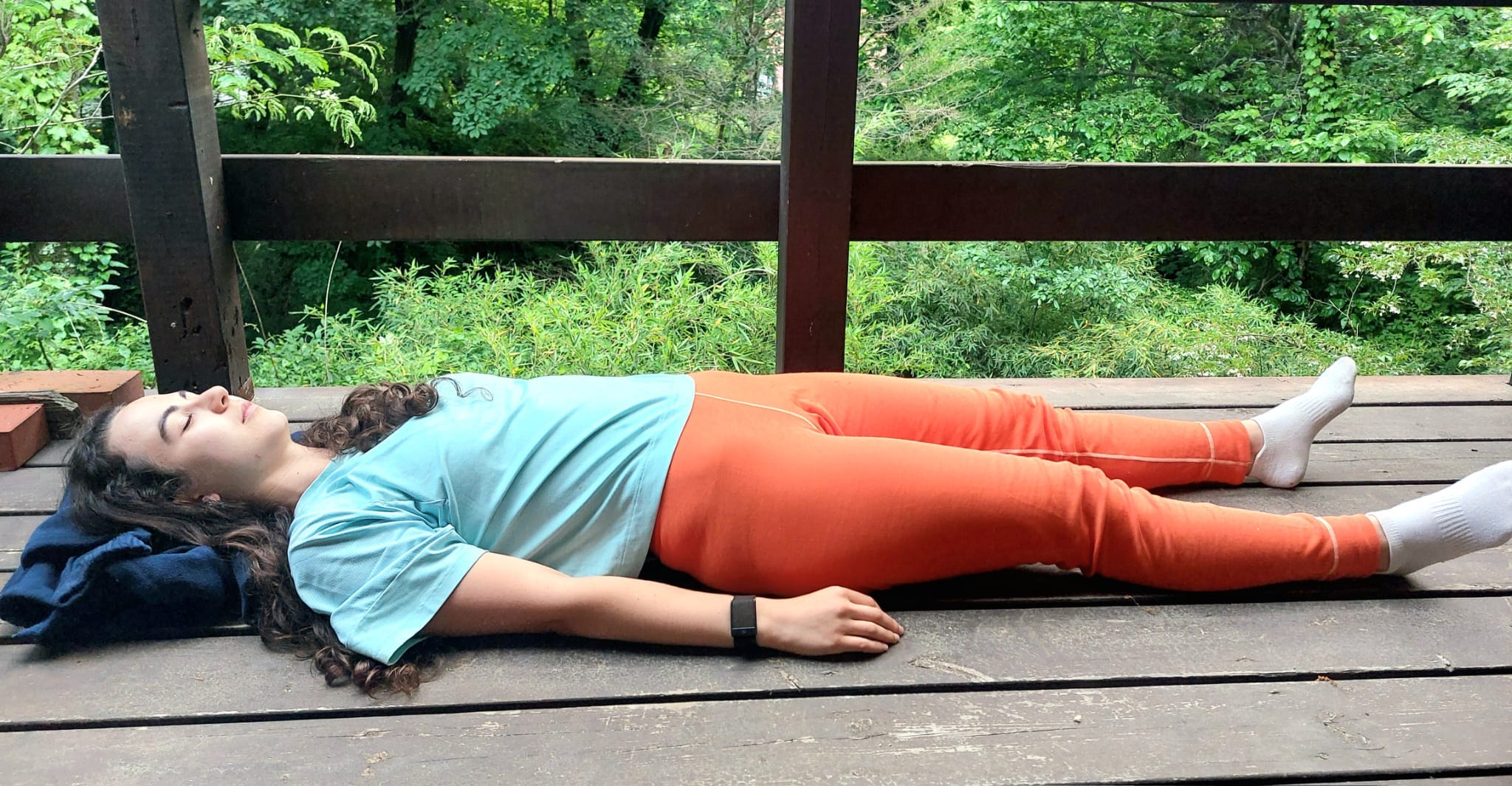
Note: through therapy, some people may discover they feel safest in rigid routines. Therefore, NSDR in general may not help, but rather one specific audio track of NSDR that is predictably played every night at the same time, in the same room, helps. My recommendation is to do what it takes to heal.
Once your therapy work is on track and you can comfortably do NSDR without an anxiety attack for a few months, you could consider ashwagandha as a supplement. But be careful and start on very low dose. Some people can have a bad reaction to adaptogenics.
Ashwagandha has improved my and a lot of people’s HRV (Smith, Lopresti & Fairchild, Sage Open Nursing, 2023), but most people also report their nightmares coming back. This is a temporary “side effect”. May be the best kind of side effect, because having old nightmares resurface after ashwagandha generally means your nervous system feels strong enough to try to process unresolved issues.
The reason why I cannot recommend other strategies for people in this category is due to the safety risk. After therapy, you would have gained enough self-awareness and realisation of the past to conclude what triggers you. Unfortunately, most advanced HRV training exercises cause extreme distress in trauma-patients. Some examples:
Ice baths are great, unless you have memories of medical neglect where you’re shivering in fever as a child and your mum is screaming at you for it.
Taking a walk in the park to connect with the nature is great, unless you’ve been attacked by a dog as a toddler.
Boxed-breathing is great, unless silence and peace caused intense anger and irritability in your BPD father.
Repeating affirmations is great, unless your parents always criticised you and called you derogatory words.
Sometimes, even falling asleep or remaining asleep is very difficult for trauma patients, who’ve experienced fear of danger during the night. For example, I had a habit of waking up with an intense feeling of being late every morning at 5am. The normal strategy of “lay back down and cuddle, enjoy the peaceful morning” for normal people was more likely to cause an anxiety attack.
So, before you get into exploring alternative exercises, make sure that you have this part of your HRV protocol nailed down. Then, start with the activities that won’t trigger your nervous system.
Basic Health Problems
Seek professional help to resolve basic health problems. When the body is under heavy stress from lack of sleep, toxins, training too much, or an illness, then it cannot declare ‘safety’. This naturally results in a chronic low HRV.
Most common health problems that lead to low HRV are insomnia, cardiovascular health problem (i.e. increased chance of stroke), overtraining syndrome, high blood pressure, autoimmune disorder, and cancer.
While some issues could be fully resolved, like overtraining syndrome, others will need to be managed, like autoimmune disorders. But all of these are beyond my level of expertise. Before taking basic health issues under control, following an advanced HRV protocol won’t help much.
That being said, some activities could help you recover from your underlying health problems AND improve your HRV.
Examples: Zone 2 cardio (very important), strength training, doing NSDR (or yoga nidra, as a meditative practice), removal of alcohol from your life (or limiting to one serving a few times a year), adoption of a healthier diet^, and establishing a healthy bedtime routine & sleep schedule^^.
Side note: if you have diabetes, blood sugar spikes and crashes throughout the night causes additional stress to the body. You cannot improve your HRV when your body is under stress during the night.
^”Adopting a healthier diet” advice can open a can of worms. In general, removing ultra-processed foods, not eating out, lowering sugar consumption, avoiding deep fried foods, ensuring you are consuming an optimal amount of protein, fibre, healthy fats, antioxidants, and greens, is a good start.
^^”Healthy bedtime routine & sleep schedule” includes avoiding food 4 hours before bed (unless instructed otherwise by a health professional), having a consistent bedtime, sleeping 7-9 hours every night, removing stressors 1 hour before bed (i.e. endless scrolling on social media, reading the news, engaging in arguments), including relaxation 1 hour before bed (i.e. reading a book, listening to soft music, prayer), adjusting the room temperature so it is not too warm, avoiding sharp bright light 1 hour before bed (warm lights are more soothing for the eyes), avoiding driving or being a passenger in a vehicle 2 hours before bed, sleeping in complete silence (might want to investigate in earplugs), sleeping in complete darkness (eye masks are great), and removing disruptions from the bed (i.e. if your dog wakes you up every night, you might want to say, sorry buddy, out you go).
This is a long list! Some people only need to make 1 change to see big improvements in their sleep quality, so start from somewhere. Routines only work if you can consistently execute every night.
Side note: there is increasing anecdotal evidence that tools designed to cope with ADHD (i.e. Neurode) help increase HRV via calming the mind.
Lifestyle Factors
Be honest with yourself: what are your unhealthy habits that could be preventing you from improving your HRV?
Alcohol has proven impacts on lowering HRV and sleep quality. If you are looking to improve HRV, it’s best to avoid even a single glass of wine. If you must drink, make sure to consume a lot of water to dilute it.
If you are going through chronic stress, you may want to seek help and support. Try to remove the major stressors from your life. You could consider ashwagandha or other adaptogenics, but be careful, as some people can have a bad reaction to them. Additionally, incorporate rest and wind-down time every day, ideally 1-2 hours before bed.
Activities that could be relaxing: colouring, meditation, NSDR (or yoga nidra), boxed breathing, gentle yoga, sound bath (or sound healing), prayer, affirmations, knitting, reading, expressing gratitude, watching the sunset, going on nature walks, and weighted blankets. There are probably many more!
Avoiding food 4 hours before bed will be highly effective. Avoiding heavy dinners with oily, deep fried foods, heavy carbs and sugars will also help. Blood sugar spikes before bed will cause low HRV and poor sleep quality. Digestion is a stressor to the body. It’s very challenging for your body to digest heavy meals and try to relax for the night at the same time.
Make sure you are consuming enough water. It will help your body to cool down before falling asleep.
Speaking of cooling down, try to control the temperature of your bedroom to ensure you are not too warm while sleeping. It makes ~5 HRV point difference for me. There are mattresses (i.e. 8 Sleep) that automatically cool down for an optimal temperature to sleep. It’s too expensive for me, so I do my best with the aircon.
Sleep quality is highly important and one that gets ignored the most. Have a consistent bedtime and sleep 7-9 hours every night. Remove stressors 1 hour before bed (i.e. endless scrolling on social media, reading the news, engaging in arguments). Avoid driving or being a passenger in a vehicle 2 hours before bed. Avoid sharp bright lights 1 hour before bed; warm lights are more soothing for the eyes, or you could try blue-light blocking glasses.
Sleep in complete silence and darkness. If you live in a noisy and bright neighbourhood, I highly recommend earplugs and eye masks. They feel awkward at first, but you get used to it. Remove disruptions from the bed. So, if your dog wakes you up every night, you might want to say, “sorry buddy, out you go.”
But not everyone’s nervous systems need to be relaxed. Some people need the opposite. Going back to the idea of “training the nervous system” via progressive overload, there needs to be a challenge for healthy adaptation (and an improved HRV). Resistance training in the gym is not enough.
There is so much evidence behind doing regular Zone 2 cardio early in the morning and improved HRV. In fact, a vast majority of people who double their HRV within months simply sleep well AND exercise. Exercise ensures you are getting regular healthy stress. Our bodies like to tackle challenges in the morning to receive adrenaline and motivation hormones pumping in, and calm down before bed for a peaceful sleep.
Once your sleep and exercise routine is on track, check out the advanced HRV training techniques below.
Advanced HRV Training Techniques
Let’s get into the micro things that move the needle. These are generally called vagus nerve training exercises and tools.
It’s important to have a high-level understanding of the vagus nerve, so I recommend having a quick read about the Vagus Nerve & the Polyvagal Theory. Some ideas to experiment with:
chanting and humming (gentlest entry point)
acupuncture
massaging the neck
using controlled breathing devices like Oxyfit
using vagal-nerve stimulating devices like Pulsetto
ice baths (you could start with cold showers and progress)
sauna (you could start with warm baths)
Additionally, you may want to experiment with ashwagandha, or other adaptogenics.
Your HRV cannot increase if your body is under stress while sleeping. This is why controlling the room temperature is important; heavy sweating stresses the body.
Likewise, most people have no idea how stable their blood sugar is during the night. Blood sugar spikes and crashes throughout the night causes additional stress to the body. It is worth investing in a blood sugar tracker for a month, especially for women, because hormonal shifts throughout the menstrual cycle impacts blood sugar levels.
Example: if you are noticing regular blood sugar crashes every morning around 4am, addressing this issue will help your metabolic health and your HRV.
Having a strong nervous system is highly linked to having a high resilience to stressors in life. So, think about how you can take on challenges and adversities without traumatising yourself. Maybe sign up for public speaking, or another activity that puts you out of your comfort zone.
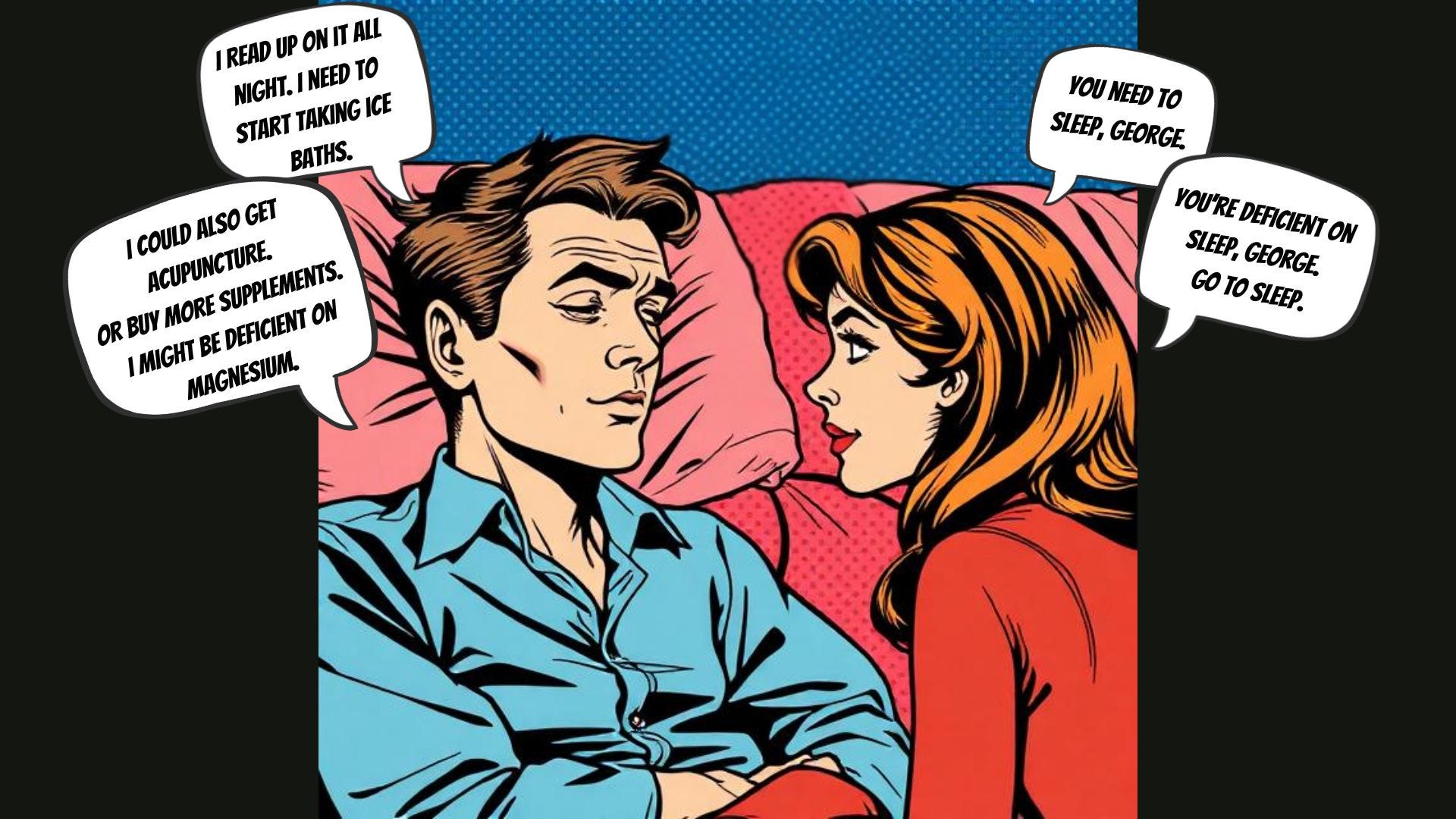
I want to emphasise that there is no need to experiment with advanced techniques if you are struggling to get the 3 pillars of your health on track (sleep, exercise, diet). Also want to emphasise that it could be highly risky to experiment with advanced techniques if you are struggling with C-PTSD/PTSD, self-harming behaviours, mental health disorders, addictions and insomnia. So, this section is truly for the advanced.
So, how come some people can turn on a “magic switch” and double their average HRVs within a few months, while others take decades to move the needle?
On one hand, people with basic health problems are comparing their HRV to healthy and fit 22-year-olds hitting 150+. They’re trying meaningless advanced vagus nerve training exercises and tools.
On the other hand, people with C-PTSD are seeing influencer videos talking about Zone 2 cardio doubling their HRVs in 2 months. After 6 months of running, they’re wondering what’s wrong with them.
And of course, the famous, “I don’t need to sleep, I feel fine on 5 hours” crowd, waiting for a magical pill to lift their HRVs.
These groups have arrived to the same conclusion: “it must be the genetics.”
The reality is, improving your HRV is a highly personal process and cannot be hacked via copying someone else’s protocol.
The “magic switch” works for some people and not others because they accidentally started from the right place. Lucky them.
This article aims to provide guidance, so you can self-diagnose your place on this journey. Everything after that is just patience.
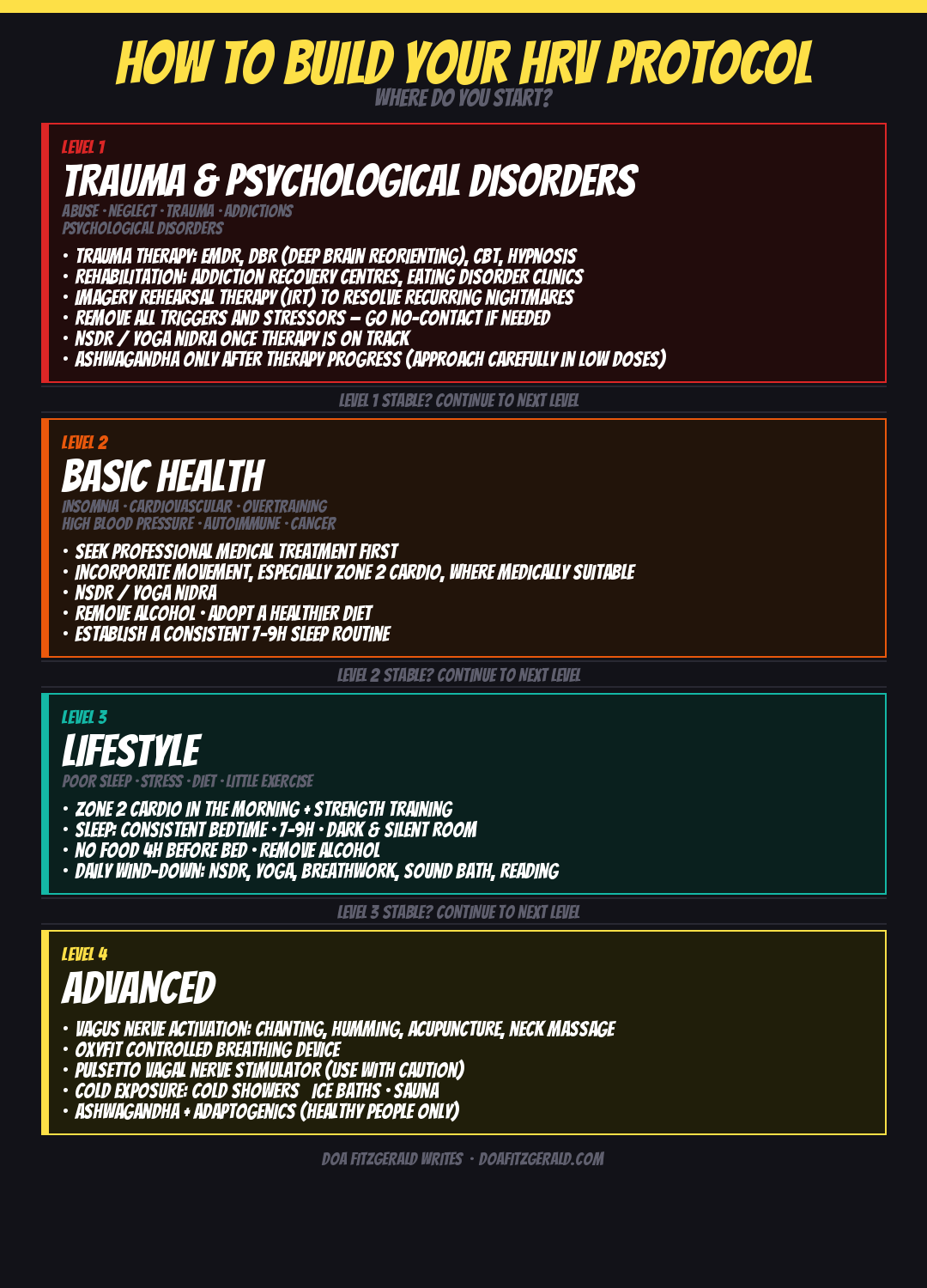
Cheat sheet for convenience
All the images I use have been generated using deepai.org (the pop art generator). 🦸♀️
If this post is helpful to you, it will probably help others too. Share with a colleague, and if you haven’t done so, subscribe.
For more information, see below:
Chen et al., Psychology, Health & Medicine (2025) — EMDR improves HRV in hypertension patients: randomised controlled trial: pubmed.ncbi.nlm.nih.gov/40301706/
Cureus (2024) — Impact of yoga nidra on HRV in cardiac patients: ncbi.nlm.nih.gov/pmc/articles/PMC12535617/
Journal of Alternative and Complementary Medicine (2012) — Yoga nidra increases HRV: pubmed.ncbi.nlm.nih.gov/22866996/
Smith, Lopresti & Fairchild, Sage Open Nursing (2023) — Ashwagandha improves HRV: randomised controlled trial: ncbi.nlm.nih.gov/pmc/articles/PMC10647917/
Systematic meta-analysis (2025) — Long-term exercise intervention and HRV indices: pmc.ncbi.nlm.nih.gov/articles/PMC12198180/
Systematic review with meta-analysis (2021) — Exercise training and cardiac-parasympathetic activity in sedentary people: pmc.ncbi.nlm.nih.gov/articles/PMC9656115/