
Boltz: AI for Scientists
Research lab building generative models for biology and chemistry

Recently discovered a UK-based start-up known as a “frontier research lab building generative models for biology and chemistry.”
Finally! — I thought. Drug discovery takes 10–15 years on average and well over $1 billion US per approved drug. Could a specialised AI product for scientists reduce this time and cost? How?
Dived into another rabbit hole, learned a ton, and decided Boltz was too cool to be unknown to many. So, here’s an aspect of the drug discovery process for dummies.
Disclaimer: ClaudeCode assisted with the research that went into creating this article. All charts, tables and the citations have been created by ClaudeCode.
Drug discovery lifecycle
Let’s start with the big picture and unpack the birth of a new drug; what happens over the course of 10-15 years?
I have summaries of this complex process as a table and an infographic, both created by Claude Code. Keep in mind that Claude tends to be optimistic on how fast work can be achieved.
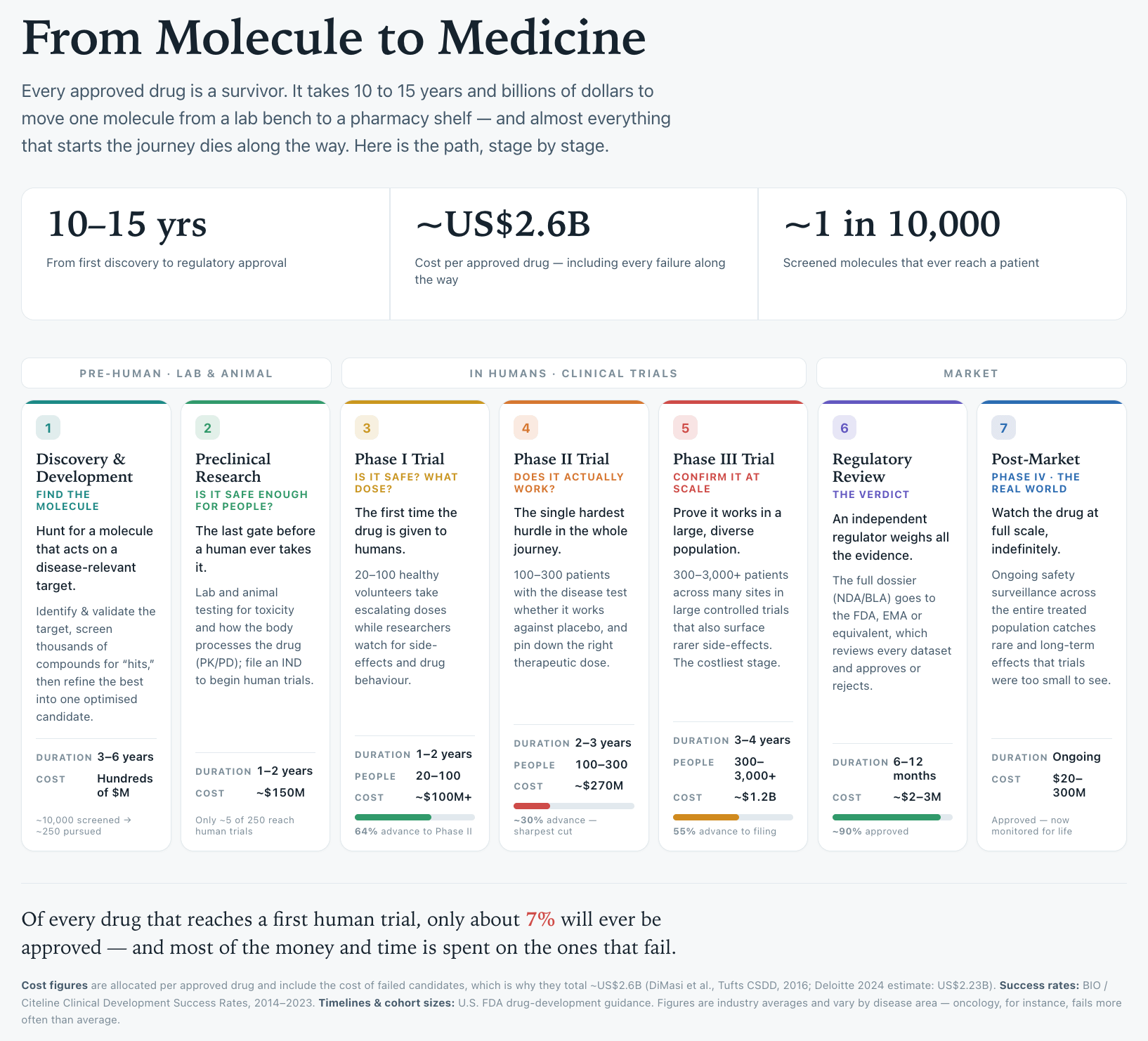
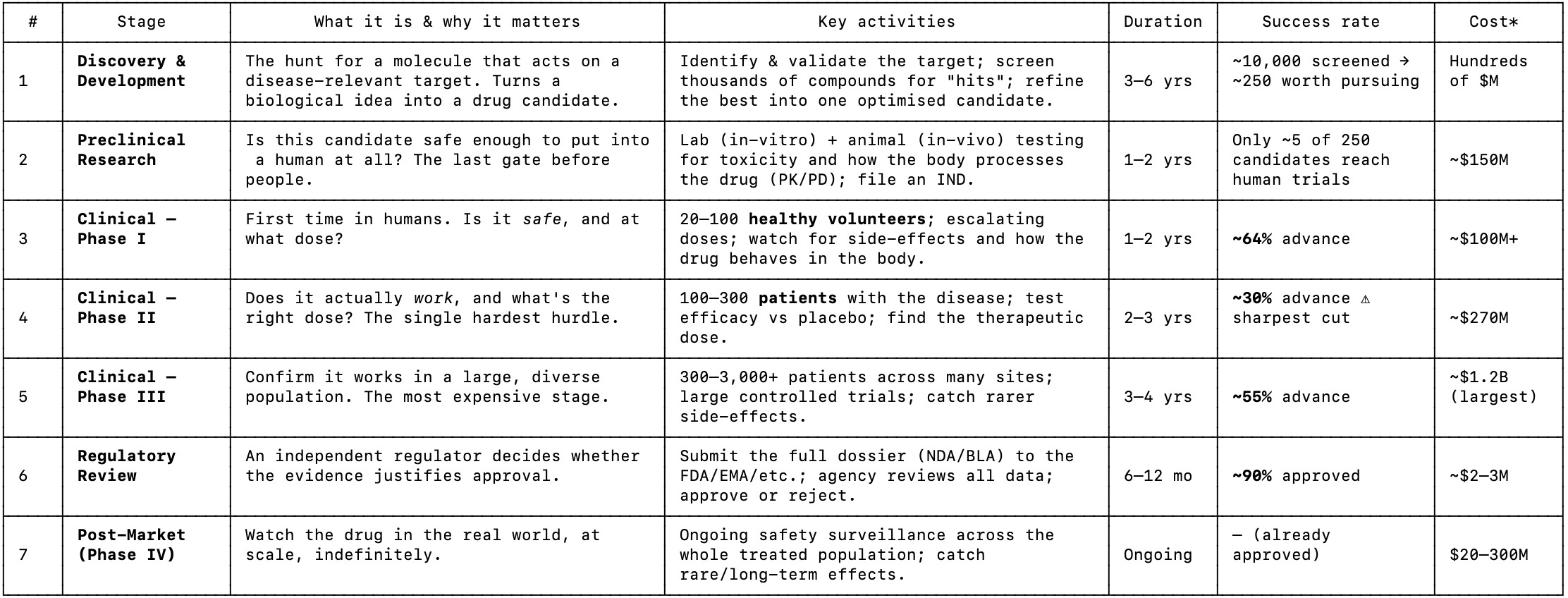
By the way, most of us are old and grew up reading about animal trials. This practice is changing. In April 2025, the US FDA published a formal roadmap to phase out animal‑testing requirements, starting with monoclonal antibodies (where animal models are poor predictors of humans). This roadmap expands over a 3–5 year period to make animal testing “the exception rather than the rule.” As a replacement, FDA wants labs to lean on “the New Approach Methodologies” (NAMs): lab‑grown human organoids, organ‑on‑a‑chip systems, in‑silico toxicity models, and “digital twin”/virtual‑patient simulations.
Where Boltz fits into the drug discovery lifecycle
Simply put, Boltz does 3 things with the help of AI:
Predicts how molecules bind to each other
Invents new binder molecules
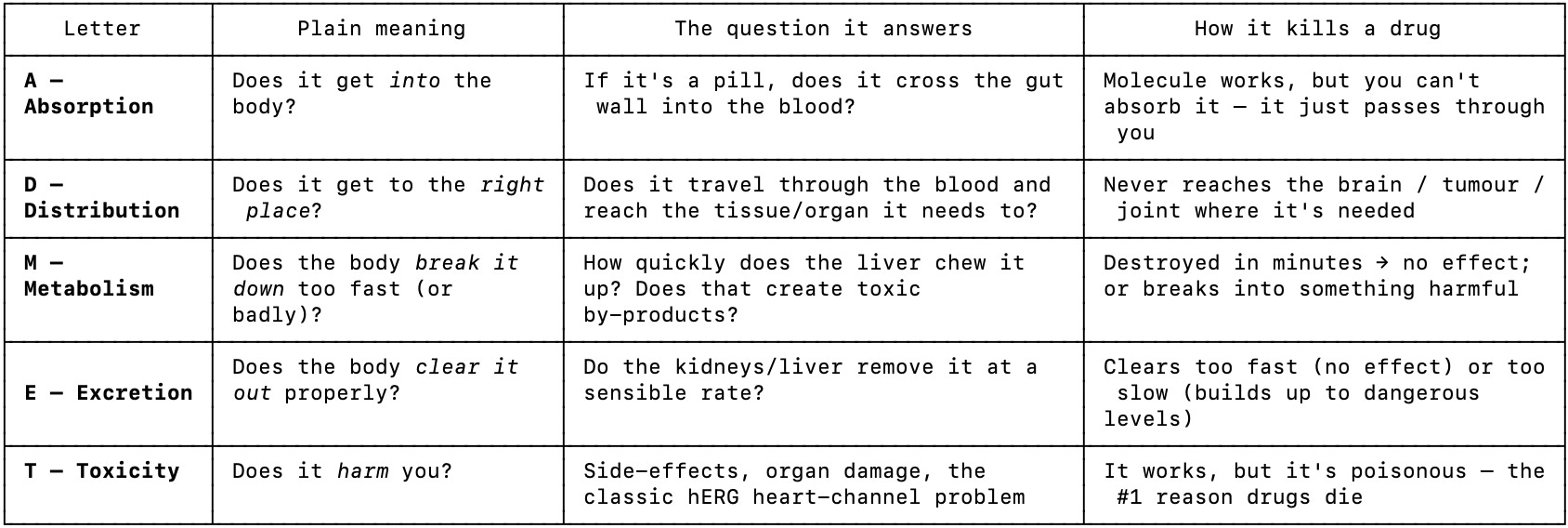
Filters out molecules based on ADMET model (absorption, distribution, metabolism, excretion, toxicity) before they reach physical testing
In a bit more detail, Boltz builds AI models that examine a protein’s amino-acid sequence, then predict the 3D shape it folds into (its interaction with another protein, DNA, RNA, or a small‑molecule drug). Shape determines function. Function determines whether a drug works… in theory.
Think of it like puzzle pieces. If two pieces fit, that is a good sign. “How tightly” the pieces fit is a proxy for whether something will work as a drug. Remember that there are billions of candidates to filter through. Boltz’s accuracy seems to approach that of gold‑standard physics simulations (free-energy perturbation), reportedly at ~1000× the speed.
The ADMET model is used for further filtering. Its criteria - absorption, distribution, metabolism, excretion, toxicity - aim to answer “what the body does to the drug” and “what the drug does to the body.” Without it, the only way to know if a molecule is absorbable, or toxic, is to physically synthesise it and run slow, expensive lab assays.
The “generative design” part involves AI inventing new molecules from scratch according to its prediction models (how tightly molecules bind, ADMET, etc). And of course, with every round of feedback, AI learns and iterates much faster than humans.
All of this can be bought as an API. Super cool stuff.
Building for the future
Earlier this year, I mentioned the possibility of a new business model in tech: AI2AI. Designers will be “designing,” developers will be “building,” and marketing will be “marketing” for AI adoption. A swarm of agents with HITL creating products for a swarm of agents - this idea is not unique. It is increasingly becoming the reality. And Boltz seems to be preparing for that future.
Their products are built for AI coding agents - native integrations with Claude Code, Codex, and Gemini CLI - holding the vision that an AI agent orchestrates the grunt work of discovery (fires off thousands of predictions, designs a screening campaign and iterates on the results), while a human sets the goal and judges the output.
Does this sh*t actually work?
Claude found some of Boltz’s published papers on the internet. The answer seems to be a little blurry, but very promising.
Paper 1 Summary:
What it tested: Can the model rank a library of small molecules so that a target’s real binders sit at the top?
Result: Confirmed actives on 6 of 10 targets (458 compounds total, vs the ~100,000s in traditional screening).
The 4 misses: mGlu4 PAM, AMY3, MALT1, Nav1.8 — all targets where the useful molecule binds an allosteric / non-standard pocket^ or requires stabilising a specific conformational state^^.
I appreciate their honesty about failure. I am very supportive of transparent science.
^This means the shape, the grooves and cavities on its surface were unusual, therefore hard to predict.
^^Imagine the molecule on action, moving shapes. In order to bind (or fit the puzzle pieces together), you need to first catch the protein and freeze it in one particular shape/position.
Paper 2 Summary:
What it tested: Can the model design new nanobodies (small antibody-like proteins) that bind a target — and are they actually manufacturable as drugs?
Evaluated on two axes: binding and developability.
The core claim (2.4× improvement): On 10 “low-homology” targets (no close relatives in the training data), swapping in the new BoltzPPI scorer to rank the same candidate pool raised the confirmed-binder rate from 3.3% → 8.0% (150 designs each).
Target coverage: it found at least one confirmed^^^ binder for 4 of those 10 targets, vs 2 for Boltz’s old model.
Of its confirmed binders, 58% passed every criterion in a full therapeutic-grade panel (stability, aggregation, purity, stickiness, etc.).
Boltz designed nanobodies that scored better on manufacturability than antibodies already in human clinical trials (58% vs 21–25%).
^^^This is pointing at the increasing accuracy of Boltz. The word “confirmed” does the heavy-lifting. Binding ≠ function.
So, why isn’t the drug discovery process 1000x faster?
Fast forward into the future, if Boltz can significantly improve their accuracy, the drug discovery process still won’t be 1000x in speed.
To not lose your mind during this part of the article, refer back to the drug discovery lifecycle image.
The remaining problems of drug discovery
A confirmed hit is still years away from a drug. Only about 1 in 5,000–10,000 compounds that enter discovery ever reaches market, and roughly 90% of drugs that make it into human trials still fail. The issues are physiological, not necessarily structural.
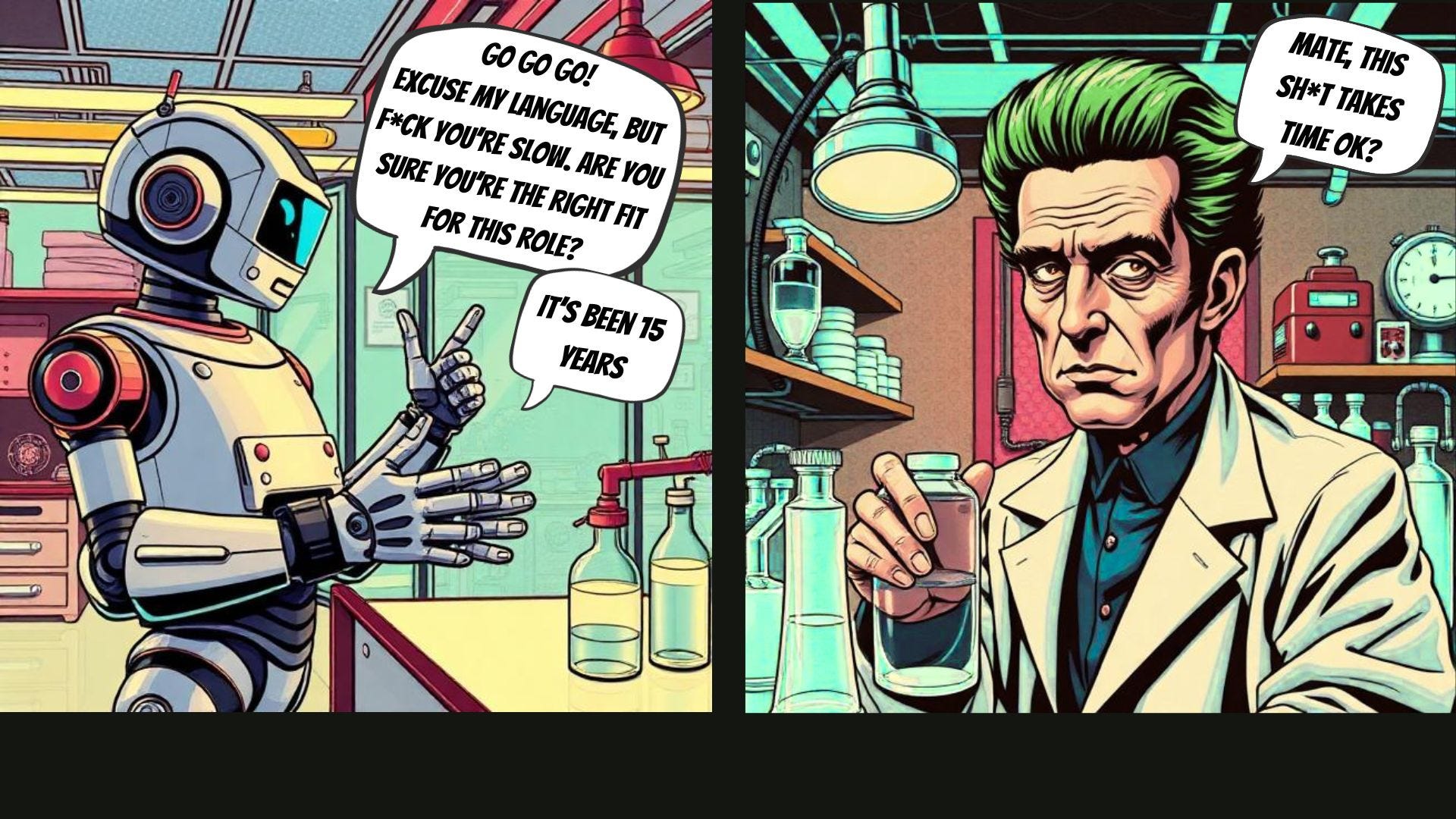
Humans in the labs are still the limiting factors. One still has to make and test the molecules. The assays for a novel target can take months to develop and validate.
Sometimes, the molecule binds to its target nicely, but the target turns out not to drive the disease. Sometimes, the biological hypothesis is wrong. Boltz makes one faster at answering the question they were given. But which question to ask, that judgment (reading the biology, choosing the target) is still on the scientist.
The gaps in AI and Boltz
Binding ≠ function. Just because a key can enter into a lock, doesn’t mean it can open the door. While the ADMET model answers questions about toxicity and absorbability, it does not respond to what immediately happens after the key fits into the lock. It does not answer: “does the molecule switch the target ON, OFF, or do nothing?”
Novel biology is a big challenge. AI models are strongest on targets resembling their training data and weakest on the novel ones. This is the chicken-and-egg problem that AI in its nature has. Without unique training data, there is no unique AI output, but there needs to be a unique output for there to be unique training data. This is what blocks us from making great discoveries.
The tool amplifies a good scientist and misleads a not-so-good one. And this is the other problem that AI in its nature has; it is only magical for magicians. Knowing what campaign to run, how to interpret an ambiguous result, when the model is fooling you, what to do when 4 of your 10 targets fail... yeah, we still need a human brain for that.
What’s on the horizon?
Only the founders of Boltz can provide that answer. However, here are some things going through my mind about where I see this company evolving…
1. Prediction beyond binding
Binding ≠ function. Just because a key fits inside a lock, doesn’t mean it will open it. I’ve already pointed that out.
Given Boltz’s core competency is predicting how molecules bind to each other, a natural next step would be to predict if it will complete the desired action. In other words, answering whether the molecule switches the target ON, OFF, or does nothing will significantly reduce the time and cost associated with lab trials.
How could Boltz achieve that? If I have a go at predicting that, I may embarrass myself (assuming that I haven’t done so already). In abstract terms, getting a single 3D shape of a molecule is like making guesses from looking at a statue of a man. He moves, just like how proteins also move. So, I imagine finding many statues of the same man will solve this problem.
2. If you can’t block them, destroy them
Did you know that roughly 80% of human proteins don’t fit into my “puzzle pieces” analogy? They’re smooth, flat scaffolding proteins or transcription factors. In other words, there is no “lock hole” for a key to be inserted in. These targets are “undruggable.”
So, you can’t block them. But you could destroy them. Sounds evil. The scientific word for it is “a glue” or “PROTAC”. This drags the target protein and one of the cell’s “destroyer” proteins together. Rather than trying to fit target + drug, the equation becomes target + drug + destroyer.
Sounds complex, and I’m sure it is. This is one of the hottest areas in drug discovery, because it doesn’t just resolve the problem of proteins without pockets. Here are the other reasons to use a glue technique:
Some proteins cause damage simply by their existence. Examples: they are holding a complex together, scaffolding, or sticking to other proteins. The traditional “block them” approach doesn’t work. They need to be removed or destroyed.
Some proteins are manipulative; they play the ‘on and off’ games. The blocker only works while it’s physically sitting on the target; the moment it’s left alone, all the progress is gone. So you need a lot of drug, kept at high concentration constantly. Not sustainable.
Cancers act like the military resistance. They mutate, strengthen, adapt and escape the blockers. Absolute menaces! Best to destroy.
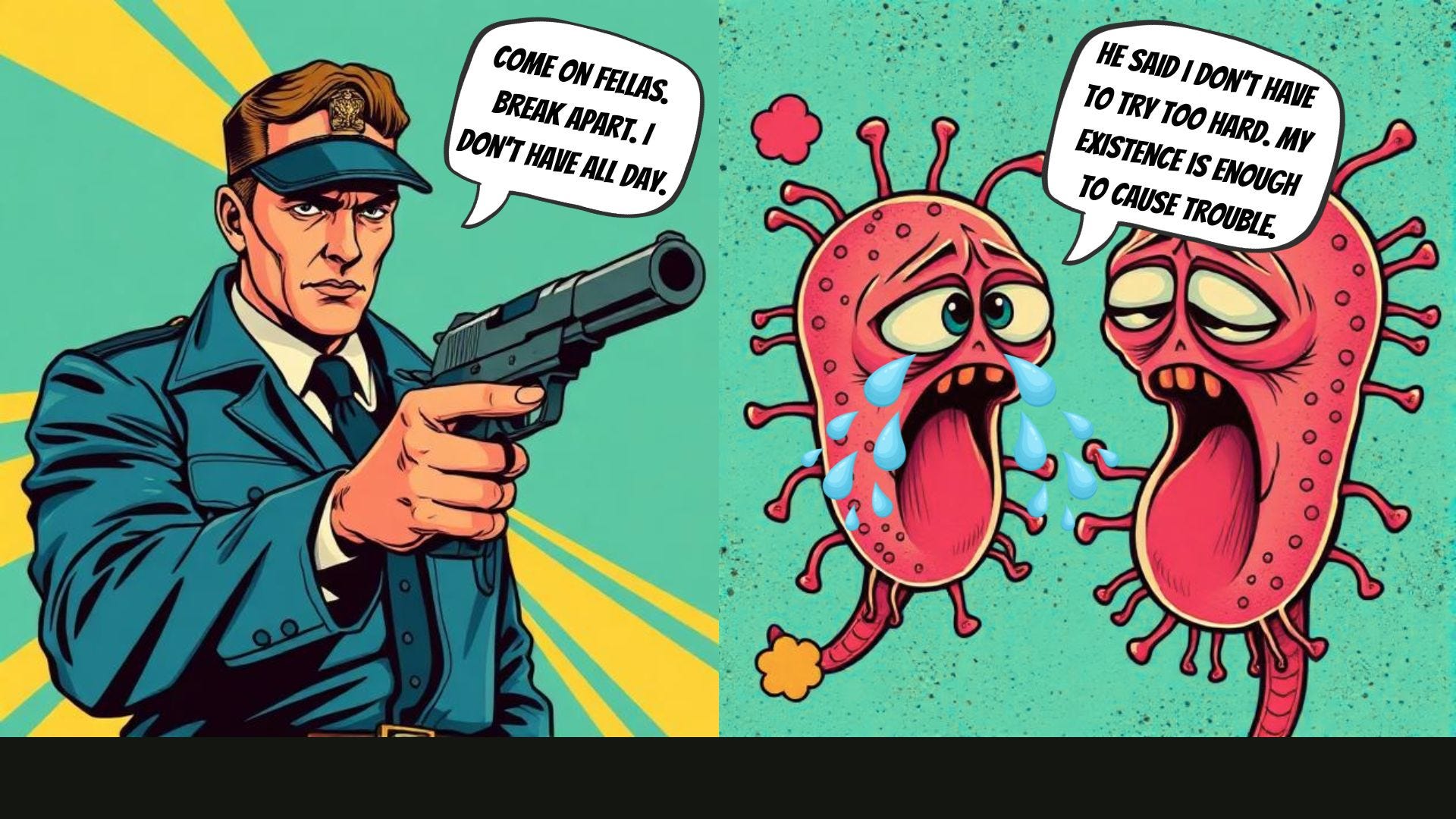
Not just cancers, but bacteria also tend to mutate. This is why antibiotics fail after overuse. If Boltz could predict likely mutations before they appear, then scientists could get ahead of the game. But between predicting mutations and the “glue” technique, I’d pick the destroy option.
3. Test the usual suspects
Here’s the thing: the 3D imaging tests whether or not two molecules fit together. But what about every other molecule in the human body? What if a drug accidentally sticks to other proteins?
Unfortunately, this happens relatively commonly. Or side-effects that were not predicted spring up due to how a drug interacts with everything else in the body. This is a major problem, as by the time human trials kick off, millions of dollars are already spent. So much time wasted.
What if Boltz could test every candidate against a panel of ~50 proteins pharmacologists already flag as the usual troublemakers (hERG, key enzymes, ion channels), and surface the risks up front? Another filter before drugs hit human trials.
4. The data mine
Given how much data Boltz already has access to, I think we can call them a data mine. But they are not making use of it for obvious reasons. Each company pays Boltz, trusting that its secrets won’t be shared with others. Currently, data is locked away with each pharma company. This limits Boltz’s capabilities.
ADMET outputs are static, point-in-time properties. What’s missing is full pharmacokinetics (PK — what the body does to the drug over time) and translational prediction: whether a result in a simple environment (a dish, a test tube) will carry over to a human.
As mentioned before, AI can’t accurately predict without training data (specifically experimental outcomes from labs). Back to the chicken-and-egg problem.
Some companies outside the HealthTech industry simply make their customers pay more to keep their data private. Everyone else’s data is collected anonymously for model training purposes. Regulations in the HealthTech industry complicate everything, so perhaps this idea is not possible to execute.
I don’t believe there is a company with this capability, yet. So, I believe the company that is able to access and stitch the data from pharmas and their mine will hit the jackpot.
Final thoughts
I am so impressed with Boltz. Also, very excited about the future of drug discovery, because they are not the only companies investing. Several serious players are competing in this space.
Historically, every generation had to suffer from a disease before the next generation could work towards drug discovery, for the following generation to benefit from it. History is full of people who did not have to suffer or die from simple diseases that we now have answers to. What gives me hope is the possibility of a much more compressed timeframe.
Cutting the cost, time and resources drug discovery demands also frees up more for the “luxury” items. Some rare diseases receive no budget. Preventative strategies for genetic diseases and ageing (which is not recognised as a disease) have very minimal budgets allocated for research.
Lastly, have you ever wondered why some drugs show side effects in some people and not others? Due to high costs in drug discovery, producing a generally safe drug for 99% of the population is prioritised, rather than taking the “personalised medicine” road.
While there’s been a lot of progress made in this field, one can argue that this is only the beginning of something much greater.
If this post is helpful to you, it will probably help others too. Share with a colleague, and if you haven’t done so, subscribe.
Sources
DiMasi, J.A., Grabowski, H.G. & Hansen, R.W. (2016). “Innovation in the pharmaceutical industry: New estimates of R&D costs.” Journal of Health Economics, 47, 20–33. https://www.sciencedirect.com/science/article/abs/pii/S0167629616000291 (capitalised cost ≈ US$2.6bn; the Tufts/DiMasi figure is widely cited but contested)
Hay, M., Thomas, D.W., Craighead, J.L., Economides, C. & Rosenthal, J. (2014). “Clinical development success rates for investigational drugs.” Nature Biotechnology, 32(1), 40–51. https://www.nature.com/articles/nbt.2786 (likelihood of approval from Phase I ≈ 10%, i.e. ~90% fail; the “1 in 5,000–10,000 compounds” ratio is a widely-cited industry composite figure, not a single study)
Hopkins, A.L. & Groom, C.R. (2002). “The druggable genome.” Nature Reviews Drug Discovery, 1, 727–730. https://www.nature.com/articles/nrd892 (foundational reference; the ~80–85% “undruggable” figure is the modern estimate built on it)
U.S. Food & Drug Administration (April 2025). “Roadmap to Reducing Animal Testing in Preclinical Safety Studies.” https://www.fda.gov/files/newsroom/published/roadmaptoreducinganimaltestinginpreclinicalsafetystudies.pdf
“Boltz-2: Towards Accurate and Efficient Binding Affinity Prediction.” bioRxiv (2025). https://www.biorxiv.org/content/10.1101/2025.06.14.659707v1 (preprint, not yet peer-reviewed; reports Pearson 0.62 on the FEP+ benchmark, described as comparable to open-source FEP, at >1000× lower compute)
BoltzMol-1, “Towards Reliable Virtual Screening for Fast and Cost-Effective Hit Discovery”; BoltzProt-1, “Towards Efficient De Novo Binder Design with Good Developability” (Boltz PBC / MIT CSAIL).
Boltz company, product and API — boltz.bio.