

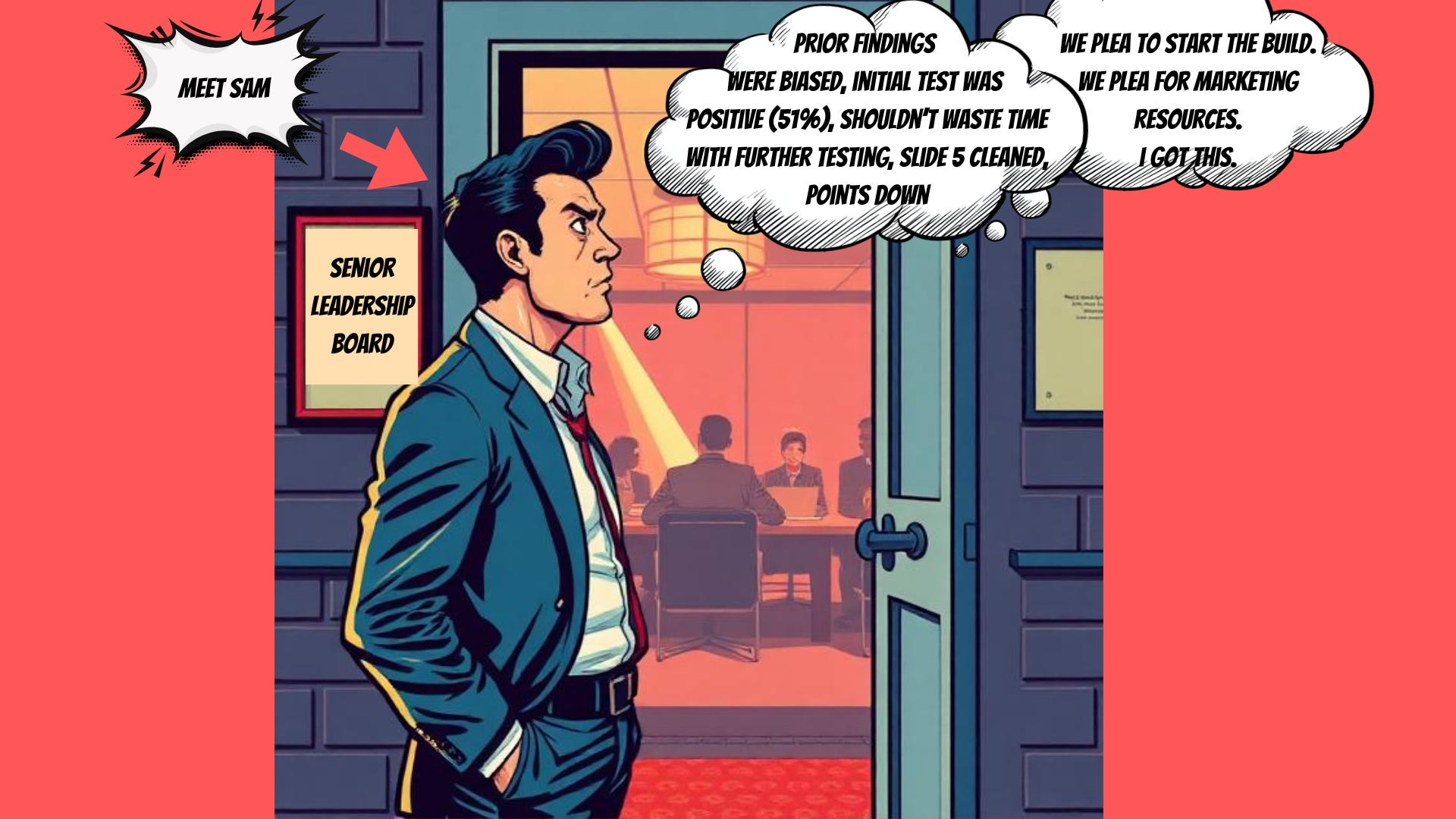
9.29am. Meet Sam. He’s holding a laptop that stores a 15 slide presentation with charts, tables, and other supporting evidence. He’s tapping his foot in a rhythm of stress. His mind is racing from Plan A, to B, to C, playing scripts, running through all possible cases of resistance from the opposition. He checks the time - 9.30am - gulps.
Sam is about to spend the next hour defending a complex case with an audience of 8 other people. Sam is not a lawyer. Sam is a Product Manager. And he just wants to get support and resources from the relevant stakeholders on an idea. He is ready to enter the room, sweat, negotiate, and engage in several conflict management techniques.
You either know a Sam, or you are “Sam.” If you’re laughing, it’s probably the prior. If your face looks like you’ve just eaten a lime, it’s probably the latter. This article is about “Sam” and how you can avoid becoming like him.
Lawyer vs Scientist
2 years ago, I had a call with a scientist who wanted to move from a lab to an office, and become a Product Manager. He was doubtful of this career transition, as he was convinced to not have a single transferrable skill. This was the time when I was writing posts about how PMs stopped thinking like a scientist. The irony!
When we consider the discovery phase of an idea, or the research phase of a problem, the main difference between a “scientist” and a “lawyer” is the intent.
Lawyers have the intention of defending a case to prove themselves right.
Scientists have the intention of stress-testing a range of ideas to prove themselves wrong.
The intention becomes the “mindset,” influences how one approaches the process. This is important because there are two different ways of looking at evidence and working with data.
If the intention of a lawyer is to defend a case to prove themselves right, we can expect to see the following behaviours:
Cherry-picking user research quotes that support the hypothesis
Shaping data visualisations to tell a particular story
Dismissing data that does not validate the idea/solution as “edge cases” or “niche segments”
Framing discovery findings as validation (when they were actually inconclusive)
Building marketing narratives before testing core assumptions
Using cognitive bias techniques, like confirmation bias, anchoring effect, sunk cost fallacy, endowment effect, and blind-spot bias
Including personal opinions and feedback from people who are not core/target users of the product
Playing the prophet by predicting huge outcomes if the idea was to be implemented
I’m sure we’ve all seen some of these, if not all, in action. If you imagine a timeline, lawyers work backwards. They rush into the most rational conclusion (according to their opinions/feelings) or the first conclusion that comes to the mind (if under time pressure), then work backwards to find suitable evidence. Lawyers don’t go through a “discovery phase” to decide whether or not their client is guilty and if they should defend them or not. They are given a client, given an outcome (”plead not guilty”), then explore all evidence to draft a narrative.
You may be thinking, but why would anyone try to prove themselves wrong? It feels counterintuitive to go against your solution, then try to sell/pitch it to stakeholders as an idea to invest in. But there is a difference between (a) the discovery or the research phase, (b) asking for more resources, and (c) the build. Each requires a different framework.
There is a time and a place to act like a lawyer. I’d argue that this requirement is overestimated by a lot of PMs who struggle to turn off the defence mode. Sadly, junior PMs and “wanna be entrepreneurs” are the most prone to having the lawyer identities stuck on them.
Why Do PMs Become Lawyers?
Company Culture
Too many companies only like the idea of hiring PMs, because “project manager” is an old-fashioned role. It’s just like how they’d like to be seen as “tech companies” rather than legacy Titanics. These companies have limited idea of the product mindset, no resources to establish a product culture, and even if they did, it would be incompatible with their established processes. Senior PMs recognise these companies from a kilometre away and stay clear. Most Junior PMs don’t have the experience to make that judgement. The smarter ones who can sense there’s something wrong, don’t have other options to choose from.
These companies are like infectious bugs that eat a PM’s heart and soul, break them in to surrender into Project Management. They have no space to think like a scientist. The company hates scientists! So, the PM is left with 2 choices: they either submit and do as they’re told (turn their squad into a feature factory), or they try to reclaim power via entering into defence battles as a lawyer. They could, theoretically enter into a longer, bloody culture battle to upgrade the company processes and force their “product mindset.” Most sane people don’t do that. I am not very sane. So, I tried that. You need a very resilient nervous system - do not recommend - expect most people’s hatred.
Stakeholder Pressure
This situation is fairly common in medium-sized companies or scale-ups. When operating in a business, money runs the show, folks. Everything is money. Time, resources, buying a subscription to a SaaS analytics tool, building that tool yourself - everything is money. And that is scarcity.
Best case scenario, each department or stakeholder wants to help but cannot unless the project enters into the top 3 important things to do (because they are on limited supply). Worst case scenario, every department or stakeholder’s running on short-term thinking, “saving themselves.” How much the highly infectious practice of “politics” entered into the decision-making systems of the organisation’s body also determines the “stakeholder pressure.”
Even the act of speaking with stakeholders adds emotional pressure to a PM. We have egos to protect and want to appear like we are putting forward an idea that is going to be successful, even if we cannot guarantee an outcome. So, psychology plays a role in this interaction too.
Stakeholders generally want certainty before committing. Fair enough. Plus, most don’t understand what PMs mean by “the product culture” or the “mindset.” From their perspective, this is not their area to learn. PMs feel pressure to sell an idea. Time adds to this existing pressure. It’s very easy to turn your discovery phase into (1) rushing for the most plausible conclusion, then (2) searching for evidence, narratives, and the strongest version of your sales-pitch to support that conclusion.
”The Other PMs”
Have I mentioned that politics is like the bubonic plague in a company (eats away the heart, the soul, and the rational thought of its employers)? One infected soul can sometimes be enough to shift the product culture. Politics is an illusion for success, luring the desperate into its lazy world.
Back in my big corp days, a colleague asked for “influencing techniques” from me, stating his ideas are hardly ever prioritised, when compared to another colleague. He was worried about not being seen as a successful/good PM in the company. He clearly didn’t realise that asking assistance from me on this topic was a joke.
This woman had a marketing background and used her influencing skills to get ideas approved. She was more diligent with her presentation packs than anything else at work. Infamously known for saying that the quality of a powerpoint presentation shows your professionalism. You can imagine how much time she spent each week moving a chart from one side of the slide to the other, wondering if anyone from the senior leadership team would catch the slight asymmetry. But selling ideas is one part of the puzzle. Her relationship with developers was non-existent and almost all technically complex ideas failed even before execution. She was creative, but didn’t pay much attention to detail (that part sounds a bit like me, too). She certainly knew how to market herself internally.
If I were to put some fake numbers behind to illustrate the pipeline of two PMs, it would look like:
A: 100 ideas proposed -> 8 approved -> 2 executed -> 1 with success
B: 80 ideas proposed -> 2 approved -> 2 executed -> 2 with success
Person B (my colleague in the story) has better outcomes in comparison, but it doesn’t feel that way throughout the year.
One might argue that most ideas approved, more potential of successful landings. Not necessarily. It would mostly depend on *why* the idea fell flat. Plus, consider how much money the business is losing, including the opportunity losses, pursuing ideas that customers never wanted, or did not solve the initial business problem but was a ‘fun to have’ instead. It just creates an illusion of ‘successful work,’ until someone rounds up the numbers.^
I told Person B to zoom out and see the big picture, showed him the maths, because he felt the pressure to engage in being a lawyer.
The “Wanna Be Entrepreneurs”
Everyone knows a PM who has never taken the entrepreneurship pathway seriously - maybe tried for a few months here and there but quit too early - but still wanted to feel like they were the “mini entrepreneurs” of the company. This is the group who is now claiming that AI is removing the only barrier to entrepreneurship via vibe coding, and soon, they’ll take off. Unfortunately, this group’s ego is larger than their critical thinking capabilities.
I often find them hugging their lawyer identities, passionately defending their ideas to the end of the world, complaining about how the team members who disagree don’t understand them, and compare themselves to Henry Ford. Someone, please let them know that Ford never said anything about “faster horses.” That’s been debunked ages ago. Ford didn’t ignore the problem space. He just found a solution users didn’t instinctively expect.
Ego is dangerous, folks! I’ve once had the pleasure of meeting with a Head of Product who tried to force her product idea in a company, when the users showed no desire. She called it her “product intuition” and that “users will understand” how useful the feature was once launched. I later found out that this product was her life-long entrepreneurship dream. No amount of campaigns could solve the engagement problem, which was almost non-existent. She got her dream come true via internal politics (the infectious disease that feeds off other people’s egos). Hands down - one of the best lawyers I’ve ever met (with minimal product management success). The irony is that the best entrepreneurs also wear the scientist hat and only pull out the lawyer hat during pitching nights for investor funding. Pity, no one told her that.
Big corporates kill scientists. Internal politics kill scientists. Companies driven by external races (i.e. the “let’s make everything AI in the AI race ASAP” line) kill scientists. So, what nourishes scientists?
The answer is older than product management itself. The line between science and pseudoscience was drawn by Karl Popper’s Falsificationism:
“a theory is only scientific if it can be tested and potentially proven false.”
Unlike lawyers, scientists start with a hypotheses and work forward to try to destroy it. For a PM, this looks like pulling out the riskiest assumptions from each idea and testing them simultaneously. While one assumption gets A/B tested, another gets validated through user interviews, and a third gets a feasibility check from the tech team. A good PM might start with a handful of ideas. After rigorous testing, most fall apart and 1 stands — not because it was defended the hardest, but because it survived the most scrutiny.
Curiosity and humility enable a scientist mindset. Emotional detachment from individual ideas helps too. In other words, focusing on the problem, not the specific solutions allows for adaptability.
Three other factors influence whether or not a PM wears the scientist hat:
Having excitement for exploring alternative and adjacent ideas
Having a positive attitude towards experimentation
Working in an environment where testing continuously via different methods is encouraged.
This isn’t just for prioritisation purposes, or to find the strongest idea from a list. Letting go of defences allows the mind to reach clarity. It’s also a way to be real about edge cases, risks and ambiguities out of a PM’s control. It’s to eliminate as many surprises as possible. Maybe some of us like surprises. Developers don’t.
Why Am I Bringing This To Your Attention In 2026?
AI allowed for anyone to “vibe code” simple mock-ups in less than an hour. Newer models are becoming better and better at brainstorming. Claude Code can easily turn a tech team into a feature factory. Product people are aware of it, hence the rising discussions of “product taste” on LinkedIn.
It’s important to have “good taste” more than ever before. But who defines this subjective goodness of taste? The outcome? What if it’s a Black Swan? Taste without a rigorous approach is just opinion, and worse, feelings. The scientist mindset is what separates taste from ego. Becoming aware of this will save you a lot of time and money as a PM.
Pause for a second. Think about what you are working on right now.
Are you building a case for that thing? Are you trying to test hypothesis and assumptions for that thing? Are you secretly hoping the evidence proves your point? Are you excited to find counter-evidence? Have you tied your intelligence to this piece of work?
Are you Sam?
^Note that one can never guarantee the outcome of an idea in specifics, and there are various factors in and out of a PM’s control to make a feature “boom.” The purpose of this article is not to discuss these in detail. My focus is on the lawyers wearing product hats.
All the images I use have been generated using deepai.org (the pop art generator). 🦸♀️
If this post is helpful to you, it will probably help others too. Share with a colleague, and if you haven’t done so, subscribe.